Showing posts with label UP Diliman. Show all posts

Thursday, December 13, 2018

"What?! Belly Dancing is Not Indian?!": A Bharatanatyam Solo Spectacle by the Philippines' Premiere Indian Classical Dance School!!

- Dec. 1, 2018, Saturday.


- What's the first thing that comes to mind when you think of Indian dancing? Unless you've seen one, or are exposed to Indian culture and society, you probably have wrong impressions of what Indian dances are. Most people I talk to usually bring up "belly dancing," which isn't actually Indian at all!! (Its roots are in West Asia and North Africa.) "Indian dance" is actually an umbrella for a variety of folk and classical/court dances that originate from the different regions of India, one of which, is the ancient-but-still-popular South-Indian dance called "Bharatanatyam." These dances, for me, are important vehicles of culture, as they not only teach performing arts, but they also carry other aspects of culture like language, music, clothing, literature, history, and much more. Here in the Philippines, there is only one Indian dance school that strives to share the art of this dance, especially to Indians who are far away from the motherland - Natya Mandala. This school is headed by the award-winning Bharatanatyam and Kuchipudi dancer, Mrs. Shanti Sreedhar.

- I have personally seen performances by Natya Mandala throughout the years, the first one being in 2013, during the 150th birthday of Indian thinker and revolutionalist, Swami Vivekananda (click here to see). This time, Natya Mandala is staging an "Arangetram" of one of its young but talented students, 13-year old Roshni Sandhu. It was held at the University of the Philippines Diliman's Aldaba Hall. An "Arangetram," which means "ascending the stage," is a kind of rite of passage ceremony in the world of Indian classical dance. It is a debut solo performance by a disciple; think of it as the solo performances students of music conservatories do, or solo exhibits that art students organize before they graduate. How long does it take before a student can do an "Arangetram" performance? Well, for Roshni, it took 7 years under the tutelage of Mrs. Sreedhar; she started when she was 6 years old, and never stopped learning and persevering. Once the student or disciple has successfully done this performance, the student "graduates" a level and can actually perform by themselves. However, in order for them to professionally teach or choreograph, they have to continue learning and understanding other principles and nuances of the dance form. They must learn other forms of "margams," or the traditional path of the Bharatanatyam repertoire; it is a course or a set in which several Bharatanatyam numbers are arranged in a particular way.

A well-decorated venue.
Like I said, well-decorated.
Had to dress for the event, in a pink South-Indian kurta with an orange dupatta. Upon entering, the welcoming committee had to put tilak marks on the visitors' foreheads (the red dot.) Thank you also Mrs. Sreedhar for inviting me!
- This Arangetram was not only a milestone for Natya Mandala and Mrs. Sreedhar, but also for the Indian community as a whole. It was attended by many big names, such as His Excellency Jaideep Mazumdar (ambassador of the Republic of India to the Philippines,) Dr. Ramon Acoymo (Program Director of the Cultural Center of the Philippines National Music Competition for Young Artists (NAMCYA); and Member and Chair of the Philippine Commission on Higher Education (CHED) Technical Panel for Music,) and Dr. Ramesh Subramaniam (director general of the Asian Development Bank). This was a big deal with the community since preserving and passing on culture and traditions to the younger generation is not only a general challenge for many societies,  but there is an added layer of complexity when it comes to overseas/diasporic communities. It is because overseas or diasporic communities always need to negotiate and recognize their in-betweenness; they negotiate identities, ideologies, space, opportunities, and so on. (This is significant especially for overseas Indians, many of whom become twice- or thrice-migrants in their lifetime.) By having this Arangetram performance, it shows that there are still people like Roshni who are lights of hope when it comes to not forgetting their roots despite living in a foreign place. ("Roshni," by the way, means "light" in some Perso-Indian languages.) Natya Mandala's students, however, are not only limited to Indian students, but also Filipinos and non-Indian foreigners who are also enthusiasts of Bharatanatyam.

Our beloved emcee, and in front of the podium are statues of Shiva (in his Lord of the Dance or "Nataraja" form), and Ganesh, the Lord of Knowledge and Remover of Obstacles. These two Hindu gods are very important for those excelling in performing arts.
The event's VIPs, including the parents of Roshni.
- Bharatanatyam is a difficult dance to master. This dance, which is more than 2000 years old, was originally danced by temple dancers or "devadasis" in what now is the southern Indian state of Tamil Nadu. Like many classical dances in India, the techniques, rules, and principles are drawn from the Natyashastra, which is an ancient book/manual on dance and performing arts. The manual does not only teach postures or poses, but specific guides on rhythm, footwork, expression, costume and jewelry, and my favorite, the hand gestures. The hand gestures all symbolize certain things, which is why those who have some knowledge of these gestures can make out a story from the dance even though the dances does not say anything. (The song that accompanies the dance can help too, at least, for those who can understand the language used in the songs.)    

I may not be a professional dancer, but I can say that the emotions that she showed during her dances very sincere and convincing.
This is the standard Bharatanatyam costume by the way.


Was trying so hard to take a shot of this, since this is one of the most popular postures of Indian dance. This posture shows the Shiva Nataraja dance. There is a photo of him above, compare Roshni's posture with the statue's posture.
- Though most Bharatanatyam numbers tell stories, there are also some numbers which are quite abstract since the focus would be on the postures and rhythm. However, the ones that tell stories interest me the most. Stories in Bharatanatyam numbers usually come from Hindu tales, such as the "Churning of the Ocean" or scenes from the Ramayana and Mahabharata.

Her second costume fort he night. Pay attention to the hair details.
To those like me who did not know Roshni personally, one would think that she was not a 13-year old girl simply because she was able to show emotional maturity in he performances.
She was supposed to portray the god Krishna in this number.
Bharatanatyam costumes are also known for their "fans" between the dancers' thighs.
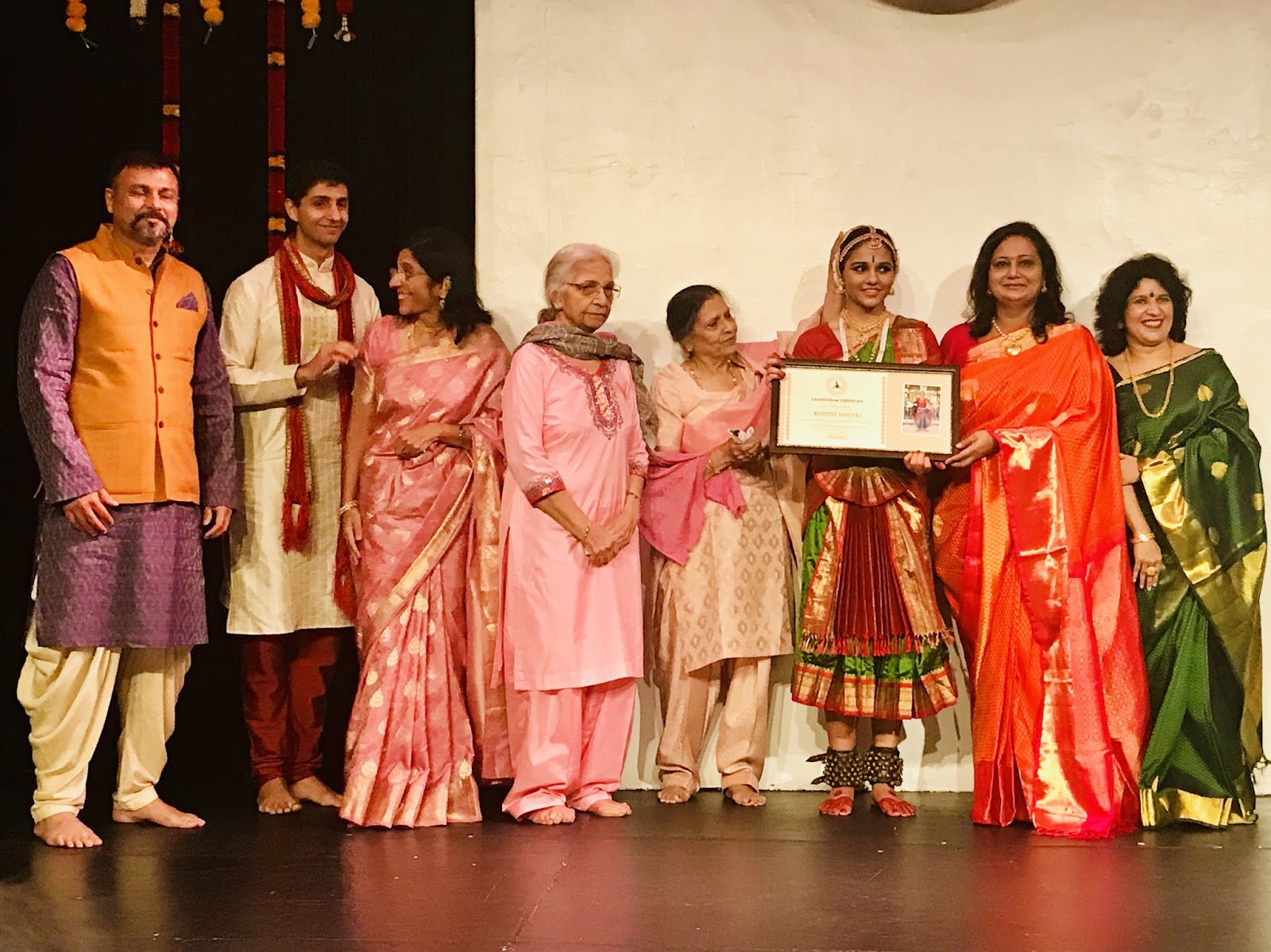
- After all the impressive dance numbers, Roshni was finally awarded with her certificate. However, this does not mean that she should stop dancing and learning from Mrs. Sreedhar. This Arangetram was only Roshni's stepping stone in becoming a better dancer, setting an example of perseverance and maturity not only to young Indians, but to the youth in general.

It is common for Indian students to bow like this as a way to pay respect to their guru. (This is also done to people that one would perceive as highly respectable, like an elderly family member or a monk, etc.)

Student and Teacher.
Roshni and her proud family members.
The proud grannies in pink.
- The night ended with a sumptuous Indian vegetarian buffet dinner. It had been a while since that last time I had Indian food, and so you could just imagine how happy I was to see naan, daal, pani puri, and other dishes that I longed to eat for many months now. I was also glad that I had time to catch up with the ambassador himself, H.E. Jaideep Mazumdar, my Hindi-language teacher Mrs. Goswami whom I have not seen in a couple of years now, and my student Sparsha.

With H.E. Jaideep Mazumdar and his wife, Mrs. Parvati Mazumdar.
Didn't know that Mrs. Sreedhar and I wore matching attires. Pink and orange were the colors of the night!!
- There is always an unexplainable happiness whenever I attend cultural events like Roshni's Arangetram by Natya Mandala. Perhaps, this is because I too come from another diasporic community, and so I can relate to the significance of staging these kinds of performances. With people like Roshni and Mrs. Sreedhar, and with institutions like Natya Mandala, some aspects of Indian culture are now more accessible to the Indian community here in the Philippines, and more people in the Philippines will have the opportunity to explore and experience other cultures as well!!

Saturday, November 14, 2015

"Utsav": UP Asian Center's Festival of India 2015

- Nov. 10, 2015, Tuesday.

- Two years after the UP Diliman Asian Center's first ever "Festival of India" (click here to see,) a second "Festival of India" showers the Asian Center center with mesmerizing colors and age-old cultures. While the first "Festival of India" is in line with India's Ratha Yatra festival (divine chariot pulling,) the "Festival of India" this 2015 is entitled "Utsav" (one of the Hindi words for "celebration") and is in line with this year's Diwali festival. Diwali is the festival of lights, and some Hindus consider it as the new year. (Click here to see this year's Diwali Mela held in SM Mall of Asia, to have a better idea on Diwali.)

Event poster.
- This year, I was not able to attend the whole-day event since I had classes to teach in the afternoon. I was also wondering why they held the event on a Tuesday, instead of a weekend, when more people are surely more available. Despite this, a good number of students and other visitors attended the event.

- Right before the event, I was seated behind incumbent UP chancellor, Dr. Michael Tan, and the ambassador of India to the Philippines, H.E. Lalduhthlana Ralte. While both of them were talking, the ambassador suddenly faced me and introduced me to Dr. Michael Tan. I found that funny and ironic, since I am a UP graduate, and with that thought it would be more sensible for the chancellor to introduce me to the ambassador - however, the reverse took place. I was not too sure what they were talking about, but I was pleasantly surprised when it happened. It was an honor to know that the ambassador recognizes me, and that he knew and understood my passion and enthusiasm towards his country.

- The festival started with a ceremonial lighting of the oil lamps, and the remarks by Dr. Michael Tan,  H.E. L.D. Ralte, and Dr. Joefe Santartia, current dean of the UP Asian Center, and my MA adviser. Afterwards, a short opening bhajan (devotional song) and a Carnatic song (South-Indian style,) both facilitated by Ms. Mythili Balasubramanium.

Ceremonial lighting.

H.E. L.D. Ralte.
Dr. Joefe Santarita.
Carnatic music.
- The highlight of the morning session was the Bharatanatyam by Ms. Priya from Natya Mandala. Natya Mandala is the Philippines' first Bharatanatyam dance group, headed and usually choreographed by Ms. Shanti Sreedhar; I was fortunate to have attended one of their previous performances, during Swami Vivekananda's birthday (click here to see,) As for Bharatanatyam, it is an Indian dance originally from the southern state of Tamil Nadu, but is widely practiced even by non-Tamils in India and abroad.

Ms. Priya from Natya Mandala.
Bharatanatyam has a lot of stomping.
A quick "Nataraja" pose. I was a split-second late.
End of dance.
- Before the cultural workshops started the ambassador became an "instant celebrity," with people lining up to talk to him and take photos with him. In my case, I just did a quick small talk with him, and handed him my new professional calling card before leaving the event to go to work.

With H.E. Lalduhthlana Ralte. It's an honor to have spoken to you, and a bigger honor to know that you remember me.
With Ms. Priya and Ms. Mythili. My Indian costume fits in!!
- I know I missed a lot after I left, like the yoga session, music performances, the Bollywood dance workshop, and the screening of one of the most well-loved internationally-targeted Bollywood films - "Three Idiots." I also missed the free vegetarian lunch (boo.)

- India truly is incredible, and despite its flaws (and any country has its own,) I cannot describe the whole of India with any other word. It is one of the countries to have successfully preserved its cultures and traditions locally and through its overseas communities, while continuing to develop, modernize, and compete well in different fields and sectors. I do hope that more people will learn about and understand India, and UP Asian Center's "Festival of India" is one of the ways that India's wonder is brought to the Filipinos.

Thursday, December 19, 2013

The Leg Killer: UP Asian Center Christmas Party + UP Lantern Parade 2013

- December 18, 2013, Wednesday.

- Just when I thought I wouldn't be dealing with school during my Christmas vacation, the Asian Center held its Christmas party today as a pre-event for the big university-wide lantern parade. The Asian Center asked us to either wear the Asian Center shirt, or wear an Asian costume instead. Of course, I chose the latter. Since everyone thought I'd be wearing something Indian, as always, I wanted to surprise everyone by being non-Indian, but just as flamboyant.

- I rushed to UP from my morning rehearsal, and changed to my Thai costume. I'd like to have this opportunity to thank my friends from Thammasat University, Silpakorn University, and Mahidol University, for serving as my consultants for my costume; I wanted to be authentic, or almost authentic at the very least. I decided to wear something Thai jsut so I'd have a chance to wear my not-authentic-but-just-for-costume's-sake mukut (the crown) that I haven't officially used since I bought it in a local costume store 2011. My Thai friends told me not to wear the mukut since it wasn't authentic, it didn't fit with the costume I wore (and if I did I had to wear another more appropriate costume used for dramas like the khon drama.) Still, I just decided to bring it for the photo ops during the lantern parade; it made my costume fancier, and I just had this lame excuse of me adding a crown to my formal Thai outfit to pretend to be an ancient Thai monarch of some sort. The chain that hung across my shoulder and my belt were both assembled by me. (The chain wasn't something hard to assemble - it's just a chain connected as a loop.)

- After a Jeopardy-like game, I was called to do my secret special number. I also hid my costume in a Japanese yukata to make people initially think that I was going to do something Japanese. I introduced myself and explained some things about my dance while the sound system was being fixed. I did the 4 Regions Dance of Thailand, a medley of dances from each region of Thailand (North, South, Northease/Isaan, Central.)


Denzel, Clio, and Nica as the seated children.

My diguised costume.
My real, "correct" costume.


- While waiting for the lantern to be set off, we took more photos in the Asian Center lawn, and did some karaoke to kill time. It was nice to see teachers and students loosen up to one another and have fun; the Asian Center is a smaller family compared to most institutes, schools, and departments. We also had a "Best Asian Costume" contest, and because the staff had a fear of everyone else backing out if I joined, and because I had a reputation of wearing culturally-inspired attires everyday, they just decided to make me a judge. I told them I'll just judge based on how they explain their costumes, to make the contest more objective and easier to decide on the winner, and most importantly, to know who knew the significance of their costumes.


My apsara pose.


Doing an impromptu pangalay dance.

Our Sarimanok lantern.

With Denzel, my co-South-Asian major.

- We later marched to our lantern's station a long way from the Asian Center. We stood there while waiting for the parade to commence. By that time, we were already tired and thirsty. Our lantern, by the way, was a Sarimanok, or a mythical, magical, and colorful rooster originating from Southern Philippines. Our Sarimanok was gold, and with a glowing orb in front of with.

Ready to leave!!

Our station.
Banner holder!!


My South Asian specialist and the two South Asian majors.


- We went around the oval for two and a half times, with three judging stations, and bumping into friends we knew. Apart from that, I was holding one side of the Asian Center banner, and also acted as a mascot, mostly due to my complete ensemble. (And yes, the towering crown did the trick.) Many kids, families, teenagers, and passers by took photos of and with me. Since I felt honored to be their mascot, I posed like a Thai dancer would, to complete the "Thai" look. My flat shoes gave so much pain to my feet, but I had to wear those shoes because they were the most appropriate one for my costume.

Lol.


Selfieeeee.
Oh hi Zorro!!
Our friend Wayne made it!!

Reporter from ABS-CBN right in front of our lantern,; she interviewed my professor.
- After the parade, I/we limped back to the Asian Center. I changed into my street clothes, rested a bit, and limped with some friends to grab a cab to the train station, and head home. My whole body ached after arriving home, and each time I had to force myself to pee or to stand up for anything else, I'd moan so much and so dramatically, because my muscles/fats were really sore. I (sort of) enjoyed my first lantern parade though. Well, except the too-much-walking-plus-thirst part; heck, I haven't sat down for almost 6 hours, and more than half the time was spent just standing. At least I had a perfectly nice excuse to wear a nice flamboyant costume.