- October 31, 2019, Thursday, Halloween.
- I knew that since I needed more insight on the history and culture of the city, as well as a more efficient way to go from one place to another, I availed the services of Zamboanga iTravel Tourist Lane (check out their website
here.) Based on my research, this travel agency specializing in Zamboanga as well as neighboring provinces has been regularly featured in blogs, vlogs, and other articles. Because of its stellar reviews, I booked a half-day city tour (in advance!) with them. My tour guide for the day was Mr. Errold Lim Bayona, who is one of the most well-known tour guides of the region not only because of his knowledge of the Zamboanga, but also his hands-on involvement with the different communities of Zamboanga. (Note that he was one of the featured tour guides of the Department of Tourism's "Tourism Decade" campaign; you can see him
here.)
- My morning started with a trip to the Climaco Freedom Park, the final resting place of former mayor Cesar Climaco after his assassination in 1984. Cesar Climaco was well loved by the Zamboanguenos of his dedication to the Zamboanga City. He also pushed for the idea that no one "owns" Zamboanga especially since most inhabitants of the city were immigrants or descended from immigrants, so everyone had to do his part in making Zamboanga a livable city.
 |
| A memorial for the fallen soldiers of World War 2. The giant hat (left) represents the Americans based on the kind of hat they wore, the pole (middle) represents the Japanese and you can see a representation of their flag at the base, and the run (right) represents the Filipinos. |
 |
| The memorial statue for former mayor, Cesar Climaco. That's his logo at the top. |
- A short ride from the Climaco Freedom Park is the Pasonanca Park, built in 1912. Decaades later, in the 1960s, a tree house was built as a training center though its cozy appearance made the tree house a hit as a tourist spot. Today, a furnished room can be found inside, and any visitor can stay for free with the permission of the mayor.
 |
| Pasonanca Tree House. |
 |
| Didn't actually go inside hahahaha. |
- Across the tree house are 24 little green teepees that signify the 24 scouts who perished in a plane crash in 1963. The scouts were on their way to attend the 11th Boy Scout Jamboree in Marathon, Greece, when their plane crashed at the Arabian Sea. Although the more popular memorial can be found in Metro Manila, a memorial area was also made in Zamboanga since one of the earliest troops of the Boy Scout Philippines was organized in Zamboanga (not to mention one delegate from the 24 scouts also came from Zamboanga.)
 |
| A smile of hope. |
 |
| Teepees. |
- From the Pasonanca Park, we had a rather long ride to the Yakan Village, which is around 7km away from the city center. With public transportation, one can ride a jeep from the city center to the Zamboanga Golf Course and get off at the entrance of the Yakan Village. My guide Errold also said that some people might not know the "Yakan Village" so instead, one can ask for jeepneys that go to "Vista del Mar," a more familiar name to most locals as it is the name of a fancy resort across the Yakan Village.
 |
| One of my favorite places in Zamboanga!! |
- The Yakans are quite unique compared to their neighboring ethnic groups such as the Badjaos or the Tausugs since the Yakans have more of a land-based society than a sea-based society; they were originally mountain dwellers who specialized in agriculture and horse-culture. This is rather unusual since the Yakans live in the Sulu archipelago, made up of tiny islands, with most ethnic groups living closer to the sea and get inspiration for their cultural expressions from sea-related things. Many Yakans are Muslims today, although, as most indigenous groups, had their own beliefs before the arrival Most Yakans live in/come from the province of Basilan, but many Yakans migrated to Zamboanga - which is just a short distance across the sea - due to some political unrest in the 1970s. The Yakan Village in the Upper Calarian district of Zamboanga is home to many Yakan families, and have opened some of their weaving stations to the public so visitors can see how their textile is made. They also sell their finished products outside their weaving stations. (Some may also sell items from neighboring ethnic groups like the Maranao or Tausug souvenirs.)
- I was happy because I had the opportunity to learn how to weave the Yakan's "semmek" cloth from one of the Yakan weavers, Ms. Norita. The semmek cloth, originally made from abaca or pineapple fibers but may also be made of cotton today, is known for its geometric design based on the rainbow/bamboo with colorful stripes (i.e. "palipattang") or the python's skin with diamonds and hexagons (i.e. "bunga-sama.") Images inside the python's skin may show geometric flowers, fish heads, crabs, and so on. Another kind of fabric is a square cloth called "seputangan," which is normally used by women as a headscarf; these square cloths usually have a flower design. The images remind me of origami models, or tangram puzzles. Depending on the complexity of the design and size of the cloth (number of colors, difficulty of image to be woven, etc.,) a skilled and seasoned weaver can weave a 20-meter cloth from a few weeks to a few months! That's the reason why hand-woven Yakan products can be a bit pricey - there's just so much hard work, skill, and love put into each cloth! However, do know that their products are one of a kind, as each cloth is different. Fear not, smaller products such as coin purses, earrings, necklaces, and bags are cheaper options if you'd like to take home Yakan souvenirs (20php-800PHP, depending on the product). Table runners, vests, and shoes, are mid-range products (around 1000-2000PHP.)
 |
| A Yakan weaving loom. |
 |
| Ms. Norita, one of the younger Yakan weavers. |
- Today, I noticed that more people in the Philippines, especially in Manila, are aware of the beauty of Philippine ethnic fabrics, and some have directly contacted these indigenous groups for commissioned works. Ms. Norita told me that the beige cloth she was working on was commissioned by a customer from Manila. She allowed me to try weaving her beige cloth, and it almost took me 15 minutes to weave just two lines. Don't worry, she closely supervised me. I decided to stop because I figured that if I messed up her work, I'd have to pay for the beige cloth I would've ruined (yikes.) Instead, I browsed through Ms. Norita's works and bought some to take home and give to friends.
 |
| Listening carefully to Ms. Norita. (Also notice my authentic Yakan vest. I bought it from a Yakan weaver in a bazaar in Manila a few weeks before my trip.) |
 |
This is not just a photo op, I was really trying to weave weaving. |
 |
| I might be smiling here, but my brain was overwhelmed with her instructions. Weaving isn't a joke, folks. |
 |
| I was trying to separate the threads so I could "form" the design. |
 |
| I need a lot of assistance huhu. |
 |
| Ms. Norita's semmek products. |
- After my weaving lesson from Ms. Norita, I visited Ms. Salma Ballati in her weaving station. Ms. Salma is one of the highly-awarded Yakan master weavers. She is proud that even though she was not able to go to school and learn how to read and write, she was able to make a living with weaving. I guess you can also say that instead of writing, she expresses herself through the colors and shapes of her woven products. She also taught her children and grandchildren to weave, so they can also earn from the craft. I wasn't able to take a photo with Ms. Salma since she was too concentrated on weaving. I wanted to buy from her (because why wouldn't you want to buy a master weaver's product right?) but the products she had were mostly made to order. (Can I cry? Huh.)
 |
| I dare not disturb a mater weaver. |
 |
| Ms. Salma concentrating. (Yes, I asked permission to take a photo of her, don't worry.) |
 |
| Upper weaving station (this weaving station is located at a higher part of the village, just two short flights of stairs from the lower weaving station.) |
- I later visited all the other stores at the lower weaving station and bought some more things because I love their works so much. I also visited one of the Yakans I met in Manila previously, Ms. Angie, but she wasn't around when I went to her store. Ms. Angie is another lauded weaver in the community.
 |
| Lower weaving area. |
 |
| More Yakan products. |
- I was driven back to Fort Pilar for more insight on the place. As mentioned in Part 1 (
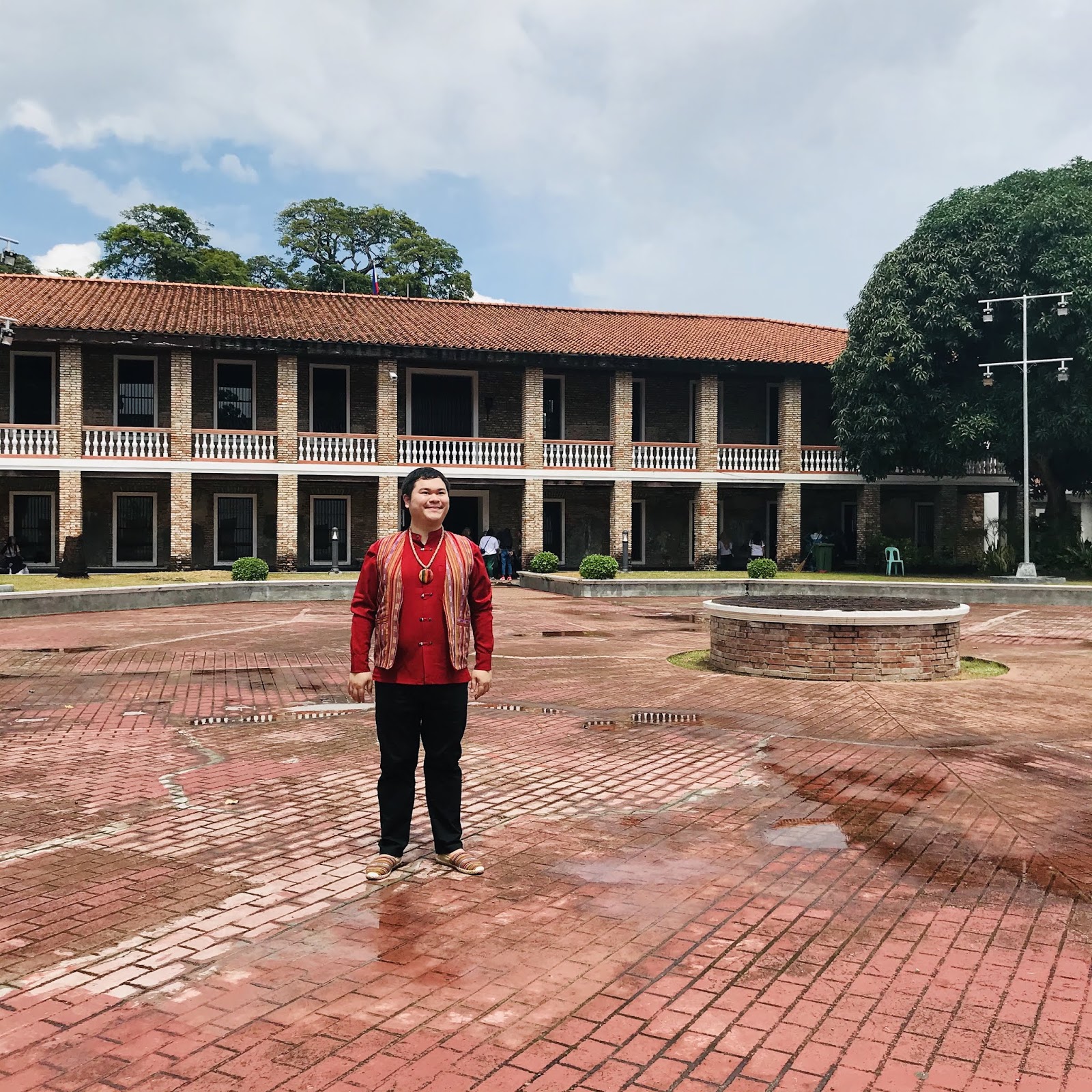
here), Fort Pilar was built to defend the city from pirates and other intruders. Originally, the fort was made of red-orange bricks, giving it that rustic Hispanic look. However, three out of four buildings were painted white during restorations, and only the entrance/main building was spared. This is only one of many restoration mishaps of historical buildings all across the country. (By the way, did I mention that entrance to Fort Pilar is free? Awesome, right?)
 |
| Fort Pilar - featuring my newly-bought Yakan palipattang (rainbow) vest and shoes. |
 |
| Entrance. |
 |
| One of the three repainted buildings (notice the well in the middle.) |
 |
| The only remaining brick building. |
 |
| Must have a photo with the building. |
 |
| At the fortress walls. |
 |
| The Queen of Spain visited the fort in 2012. |
 |
| Mandatory tourist shot. |
 |
| Of course, a brief visit to the altar was also mandatory. |
 |
| Another look at the altar/shine with more sunlight, since it rained the day before when I visited. |
- Finally, I was given a few minutes to spend at the Canelar Barter Center before ending my morning tour, and going back to my hotel to have my lunch and rest for a while. When I was all set, I had a walk around the neighborhood and saw the Zamboanga Cathedral (Metropolitan Cathedral of the Immaculate Conception), the main church of the city. Although this new cathedral was built in 1998 and opened in 2002, the cathedral's history dates back to the 1800s. It moved locations and had several incarnations throughout the years. The current cathedral's main window is said to be based on a candle.
 |
| Zamboanga Cathedral. |
 |
| Ateneo de Zamboanga University, located right beside the cathedral. |
- I later rode the tricycle to go back to Canelar Barter Center to shop some more. I actually was still a bit traumatized with what happened the day before when I sort of started a big fight that resulted in a commotion in the market (read Part 1
here to know what exactly happened because it was telenovela worthy.) As I walked through the endless halls of shops with colorful souvenirs from the region and neighboring countries like Malaysia and Indonesia, I passed by the stall of the older and the younger lady who fought the day before after I bought a pair of pants from the younger lady's stall but was entertained by the older lady who owned the stall beside. Both ladies apologized to me, separately, for probably scaring me away the barter center the day before (them ladies don't know that it's not easy to scare me away, especially when shopping is involved HAHAHAHA.) The younger lady told me that the older lady who sold me the pants I bought the day before was not discounted, and since she felt bad about what happened, she was willing to give me a bigger discount if I decide to buy from her store that day. Not feeling obliged, I thanked her and went around the market to look for things I needed, but I ended up buying once more from the younger lady - and this time directly from her - and indeed the prices she offered were lower than the usual after canvassing for similar items in other stores. (Good thing I really had to buy some stuff; she earned, and I got what I wanted haha.) However, because the commotion that happened the day before was quite a scene, some of the vendors there named me as "the guy who caused the fight" (verbatim "si sir, yung dahilan kung bakit sila nag-away.") Though of course it was understood that I was merely the unfortunate customer who happened to have caused the situation, and it could have happened to any other customer. The vendors who called me that long "title" just laughed about the situation.
- I later walked north from the barter center to a restaurant highly recommended to me by my tour guide Errold during my morning tour. He said that Bay Tal Mal, a restaurant that has been open in 1986, serves some of the best Moro food. Moro, or "moor" in English, refers to a collection of around 13 indigenous groups in the Philippines that live in the southwest, all of which were Islamized. (This is in contrast to the "Lumad" people, which has around 15 groups, who did not collectively convert to Islam, and for the most part of history, did not convert to Catholicism as well though some eventually did in recent history.) Moro food has plenty of influences from Malaysian, Indonesian, and to some extent even Indian and Arab cuisine, and can be described as spicy, tangy, sometimes hot. I had Tausug dishes called chicken piyanggang and tiyulah itum. Had I known that both dishes were related, I would have just ordered one (preferably the tiyulah itum.) Both dishes are black because they were cooked with roasted coconut. The tiyulah itum, in Filipino it would be called "tinolang itim," is a soup/stew, and I think I could taste the smokiness of the roasted coconut better in the tiyulah compared to the chicken piyanggang. Another reason to choose tiyulah itum is because it is said to be food normally served to the Tausug royalty, and is normally a dish served during big celebrations.
 |
| Tiyulah itum (right,) chicken piyanggang with rice and papaya salad (middle), and my fancy golden pot of....cold water (left.) HAHA. |
 |
| Aesthetics. |
 |
| Thank you for the good food!! |
- After my early dinner, I rode a tricycle back to my hotel so I can rest and prepare myself for an action-packed trip to one of Zamboanga's must-see islands where the sand is pink and the jellyfish like to hang out upside down - the Santa Cruz Island