Showing posts with label city. Show all posts

Wednesday, January 23, 2019

(Part 3) The Hills Are Alive in Salzburg: The Von Trapp House and The House of Puppets!!

- December 26, 2018, Wednesday.

- Salzburg may looks like a small compact city, and it is, but who would have thought that a tiny city can pack so many things to see and do - even during the winter holidays!! While most people decide to stay in Salzburg for a day or two, I was glad that I had one more day to spare since there were more things that I wished to see in Salzburg - the city made famous by "The Sound of Music."

- Although I had covered many of the places where "The Sound of Music" filmed (click Part 1 here, and Part 2 here), there was still one important landmark that I had not yet visited - the Frohnburg Palace. The facade of this former palace was used as the front side of the Von Trapp house in the movie, while the lake-facing backside of the Leopoldskron Palace was used as the backside of the Von Trapp house in the film. In short, two different palaces were used to show the Von Trapp house in the film (you can add in a third if you count the gazebo used in "Sixteen Going on Seventeen," which is currently located at Hellbrunn Palace.)

The Von Trapp Mansion Frohnburg Mansion.
I was told that I looked like one 
- The Frohnburg Palace was a summer palace in the 1600s. Currently it serves as one of the buildings of University Mozarteum, a school that teaches various forms of performing arts. As it is currently private property, people cannot enter the building unless they're studying or working there, or watching a performance in their auditorium. The pale yellow wall outside the former palace is a favorite photo spot by "The Sound of Music" fans because it was where the newly-hired Maria (played by Julie Andrews) sang the last few verses of the song "I Have Confidence" and danced with her big guitar on one hand and small bag of clothes in the other. By the way, this palace is located south of the city, between the downtown and Hellbrunn Palace further south; this is why it is often overlooked by tourists except for die-hard Sound-of-Music fans like me. It can be reached by riding a bus that reaches the Polizeidirektion bus stop (Bus 28, O-bus 3, O-bus 8).

"I have confidence in sunshine, I have confidence in rain, I have confidence that spring will come again - you'll have to agree I have confidence in me!!"
KNOCK KNOCK CAPTAIN VON TRAPP KNOCK KNOCK.
- After taking some photos outside the Frohnburg Palace, I rode the O-bus 3 back to the downtown area (closest stop is Mozartsteg stop if going to the downtown from the Frohnburg Palace). I cannot seem to get tired of the downtown area with all its maze-like streets, compact public squares, and colorful buildings. This time, I visited the Dom Quartier, which is the combined areas of the 12th-century Residenz (archbishop's residence) and the Salzburg Cathedral. Although the buildings do not look impressive form the outside, the winding halls that go up, down, around, in, and out (!!!!) make a visit to the Dom Quartier an adventurous (and time-consuming) one. Unfortunately, photography is not allowed inside; I was only able to take photos at the terrace that gives a festive view of both Residenzplaz and Domplatz, as well as the view from the second floor balcony of the Salzburg Cathedral overlooking the main prayer hall.         

Streets of Salzburg.
Domplatz.
Residenzplatz.
The Residenz from the outside. (Look at the creepy faces in the windows.)
From the Salzburg Cathedral's balcony.
Giant church organ.
- Next, I went behind the Salzburg Cathedral to visit the Salzburg Museum. The Salzburg Museum shows the city's history and artifacts such as antique musical instruments to Nazi-era objects. My favorite part of the museum was the well-preserved "stube" or farmhouse parlour or "stube" dating back to the 1400s.

A perfect museum for those interested in classical instruments.
Zither.
It is a giant old-school organ.
Theater costumes.
Fancy dining.
Roman era.
A perfectly preserved stube.
- That early afternoon, I decided to go to take a hike right after my light lunch. Although I visited the Hohensalzburg Fort on my first day in Salzburg (click for Part 1 here), I thought of going up by foot instead of the Festungbahn/funicular, and visiting other areas of the fort that I had not seen, as well as the Marionette Museum which I missed during my first visit. It was in a hurry during my first day because of the rain and the holiday schedule of all attractions in Salzburg (i.e. they would close way earlier than the usual.) The walk up was difficult because the path was inclined; if you plan to visit, make sure you have good walking shoes, and not right after eating a a meal!! However, the fort was a pleasant place to visit on a rather sunny day; I was still glad that I visited it a second time.

I am back!!
Sunny Salzburg.

Marionette Museum.
I noticed how Germans and Austrians love making scary-looking marionettes.
Marionettes based on the real appearances of the Von Trapp family.
Historical marionettes depicting historical events.
A marionette's anatomy.
OH LOOK!! The actual marionettes used for Mozart's "The Magic Flute"!!

Stairs.

- After my hike, I took the O-Bus 3 back to Salzburg Hauptbahnhof (main train station), and ended my day out early. I felt that I had seen pretty much all of what I wanted to see and experience in Salzburg, and decided to have some much needed rest. After all, I had to make sure that my things were ready for the last leg of my holiday trip - the Austrian capital city of Vienna!!

- Please don't forget to read about my other adventures in Germany, Austria, and Slovakia here:

GERMANY:

Berlin and Potsdam: Part 1 here, Part 2 here, Part 3 here, Part 4 here

Munich and Schwangau:  Part 1 here, Part 2 here, Part 3 here, Part 4 here

AUSTRIA:

Salzburg: Part 1 here, Part 2 here

Vienna: Part 1 here, Part 2 here, Part 3 here

SLOVAKIA:

Bratislava: Click here

Sunday, January 13, 2019

(Part 3) Germany's Bavarian South: Dachau, the First Nazi Concentration Camp

- December 22, 2018, Saturday.


- The atrocities of the Nazis during World War II cannot be erased from history, as well as the memories of those who directly experienced and escaped from the Nazis inhumane cruelties. Fortunately, Germany has recognized the errors of the Nazis, and has formally apologized to the world after World War II. Today, Germany is still doing its part in not only educating its own people about what the Nazis did during World War II, but German authorities have also preserved many historic sites related to the Nazis in order to constantly remind people of what humankind is capable of doing - not the good kind, of course. One of the Nazi-related sites that serves as a memorial park today is the Dachau concentration camp, which is the first concentration camp built by the Nazis in 1933.

- Going to Dachau from downtown Munich is quite convenient. You may take an S-Bahn metro to Dachau S-Bahn metro station, just make sure that you have a Zone ABC ticket since Dachau is already in Zone C, where Zone A refers to the central/downtown area of Munich. Afterwards, ride Bus 726 from the bus station right outside the train station; the bus stops directly in front of the concentration camp. The bus ride takes around 10 minutes or less. Entrance to the memorial park is free, and there is a visitor's center where people can rent audio guides or get park maps.

Dachau Concentration Camp.
Former factory where the prisoners worked.
Former guard house.
Entrance to the barracks and pirsons.
- The moment I arrived at the concentration camp, I already felt weird. I guess the cold wind, gray skies, and my knowledge of the place contributed to how I felt. I could just imagine how many people were sent to Dachau, or its bigger cousin in Auschwitz in Poland, and the things done to them there. One of the park's main icons is its steel door with the words "Arbeit Mach Frei," which means "works sets you free." This was used as a Nazi slogan. The Nazis, by the way, are part of or in some way serve and support the Nazi political party that believes in and practices an extreme form of socialism. These concentration camps were built in order to not only keep prisoners who defied the Nazis in some ways, but eventually, these camps were also turned into laboratories where scientists would experiment on "racially imperfect" or "racially undesirable" people like the Jews or disabled people. Speaking of the Nazis, the Nazis' most notable and infamous leader, of course, is none other than Adolf Hitler. Hitler's pose (raising/extending the right hand outward and just above the head,) is now illegal in Germany, and those who do this in public can be arrested and jailed by the police.

Entrance.
Gate.
Roll call square and barracks. The roll call square is an open space where prisoners were supposed to line up every morning and evening for a head count, and at times, where some punishments were done.
Maintenance Building. The exhibitions are inside this building.
- Today, the halls of the camp have been turned into museum halls. Apart from showing the different types or torture, punishments, or experiments done to the prisoners, I appreciated how the prisoners were also presented as humans. Some of their things were exhibited, and backstories of chosen prisoners were also told such as their lives with their families, lovers, and friends. Their lives inside the prison, apart from working or being tortured (or killed), were also shown, such as songs that they would sing, or how despite their condition in the camp, some prisoners still tried to find time to "rest" or have casual moments with other prisoners.

"Our last hope: Hitler."
This "no smoking" is original.
Museum.

A punishment stool.
The original gate.
- Outside the main buildings, there are some memorials and guardhouses, but the most important one, hidden at one corner of the concentration camp was the crematorium. Unfortunately, the crematorium was closed when I went there. Inside the crematorium, one would see the gas chambers and ovens where mass killings were done. I might not have seen the interior of the crematorium, but I had some idea of what things looked like thanks to my visit to the Holocaust Museum in Washington D.C. a couple of years ago (click here to see.)

Guardhouse.
That wire thing in the middle is an artwork called the International Memorial made in 2007.
Pathway.
See the deep trough? That was placed there to prevent prisoners from escaping. However, some prisoners who have "had it" pretend to escape so the guards would kill them, ending the prisoners' misery.
The crematorium; it was closed off for some reason so I wasn't able to go inside. It is usually open to visitors.
Russian Church.
- I had a quick lunch at the cafeteria beside the visitor's center and rode the train back to Munich Hauptbahnhof, and walked to the southern side of the old town to visit the Munich City Museum to take my mind off how I felt while walking through the Dachau Concentration Camp. At first the museum seemed OK, with many galleries telling the story of old Munich. Later on, I found my way to the puppets and marionettes gallery, which was eerily quiet and a bit dark. I swear I had the fright of my life going through that gallery. I was the only person there, and some of those things would even move just as I went pass by them! I am normally not afraid of puppets, but it was probably how they were exhibited. I remembered an episode of "Are You Afraid of the Dark?" that was set in an amusement park's horror house. I left the museum both horrified and amused (and despite this the museum is very much a must-see!!)

The museum has been open since the late 1800s. It used to be the royal armory and stable.

Model of the Frauenkirche (for reference, check Part1 here).
Armore.
A Nazi sash from World War 2.
How marionettes are made.
Dioramas.

Two of the scariest pieces in the puppets gallery.
Carnival-related things.

I like the fact that this was based on a cephalopod, but it still is creepy.
Oktoberfest

Nazi uniform.
Tools used to do experiments on people.
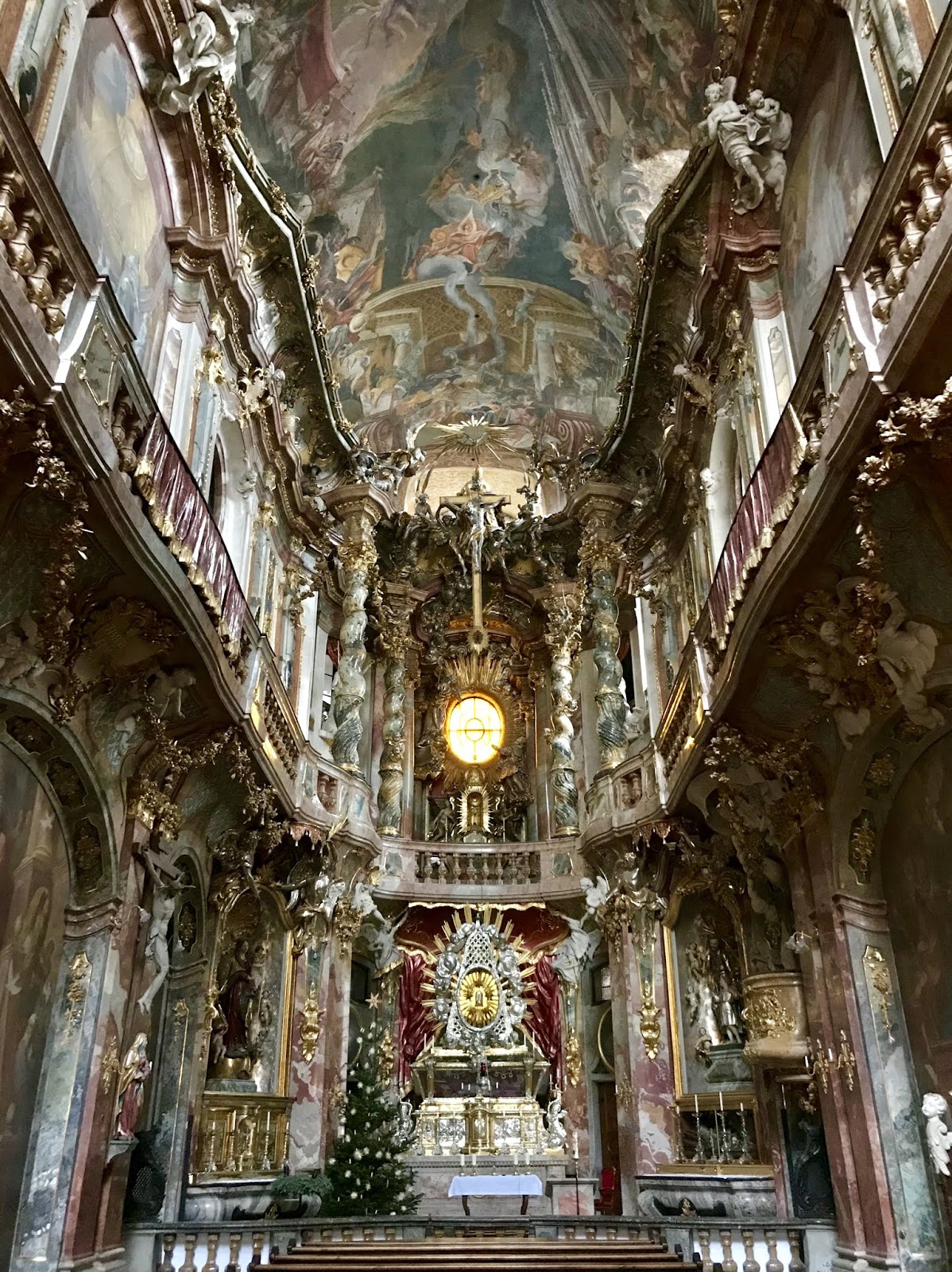
- To take my mind off the creepy marionettes, I went to Asam Church (Asamkirche) along Sendlinger Street, which is just behind the Munich City Museum. This 18th-century Baroque church is tucked into the middle of the busy street. It is not easy to recognize this church since it looks like most of the old buildings around it, and it also does not appear Baroque at first because it looks "squished" unlike most Baroque churches that are wide and gigantic. It is, however, similar to Baroque-era churches in its ornate appearance.

If you think it looks nice from the outside....
....wait 'til you see the inside!!
Life and death.
- Finally, I decided to have a second try at taking my mind off my visit to Dachau in the morning by visiting the Toy Museum or Spielzeugmuseum inside the old town hall (Altes Rathaus) in Marienplatz (click here to see the facade of the old town hall.) Compared to the scary marionettes in the city museum, I think they toy displays in this museum made be feel better. It was very interesting to see what kids even way back in the 1800s liked to play. What impressed me the most were the highly detailed train sets, ships, and doll houses (some dolls, however, were too realistic and looked a bit creepy like the marionettes in the city museum.)

Marienplatz from the old town hall.
Wow!! A collection of old Barbie dolls!!
Whoever owned this in the early 1900s was probably he coolest kid around.
Creepy dolls.
A detailed dollhouse.
One of my favorite parts of the museum.

Micky Mouse lookalikes.
- That night I also decided to eat at the German restaurant called Münchner Stubn. I had a veal steak, and a drink called Spezi. Spezi is a mix of a cola drink and orange soda, and it actually tasted good.

Veal goulash.
- Since I was able to visit one of the places that reminds everyone of one of Germany's darkest pasts, I was able to breathe deeply, shrug off whatever uneasy feeling I had from my visit to Dachau. and looked forward to visiting some of Munich's royal wonders - the Nymphenburg Palace and the Residenz Museum!

- Please don't forget to read about my other adventures in Germany, Austria, and Slovakia here:

GERMANY:

Berlin and Potsdam: Part 1 here, Part 2 here, Part 3 here, Part 4 here

Munich and Schwangau:  Part 1 here, Part 2 here, Part 4 here

AUSTRIA:

Salzburg: Part 1 here, Part 2 here, Part 3 here

Vienna: Part 1 here, Part 2 here, Part 3 here

SLOVAKIA:

Bratislava: Click here