- November 20-21, 2016, Sunday to Monday.
- Directly taking off from Part 2 (click
here), I arrived in Placa d'Espanya in the late afternoon of Sunday after a whole day's trip to Montserrat. Since I finished most of the essentials of Barcelona during my first two days (click
here for Part 1,) my remaining Sunday and my last full day in Barcelona were dedicated to visiting the rest of Barcelona, at least, the main tourist attractions that I think I missed out.
- Though my main mission for Sunday was accomplished (i.e. my day trip to Montserrat from Part 2,) I had some time to spare to explore Placa d'Espanya. This major square was built in 1929 for the International Exhibition. The two red Venetian Towers lead to the Palau Nacional, or "National Palace." The Palau Nacional was also made for the International Exhibition, and despite its name and structure, no royalty has ever lived there. Instead, since 1934 until today, this palatial building has been housing the National Art Museum of Catalonia. Due to bad timing, I wasn't able to enter the museum as it was already closed for the day, but the exterior itself was a feast for the eyes. I am also thankful that there were escalators built because it would take four flights of stairs (with big steps) to go up the palace from flat ground. The view of the Sants-Montjuic district (including the Montjiuc Castle) from the Palau Nacional was also a treat.
 |
| Venetian Towers. |
 |
| Palau Nacional. The Cheetah Girls also filmed part of their music video "Strut" here. |
 |
| The building on top of the mountain, not the point tower to the left, is the Montjuic Castle. |
- Near Placa d'Espanya, one can also see the Arenas de Barcelona, a former bullfighting arena built in 1900 which was turned into a mall in 1999 after its last bull fight in the 1970s (yes, there was a 20-year gap.)
 |
| Arena turned shopping mall. |
 |
| The actual Placa d'Espanya. |
- I celebrated my first successful day trip with a Basque-style tapa dinner near my hostel in the Passeig de Gracia area. The restaurant's name was Txapela. Apart from the usual tapa, the restaurant is famous for its bread-with-toppings, and apart from the quality of ingredients and taste, the best part about it was that it was cheap. Apart from being recommended by my hostel and apart from being visited by locals and tourists alike, I wanted to try Basque food since the Basque culture intrigues me. The Basque culture comes from the Basque Country region of Spain, and apart from having a distinct culture, the Basque people speak a language isolate. This means that the Basque language is (or most likely) a "special snowflake" in the language family as it is not related to any other language on Earth. The Basque people call their own language "Euskara."
 |
| This wasn't the only thing I ordered. HAHAHAHA. (And at least my glass of sangria isn't as big as my face anymore.) |
 |
| I sat at the bar for the "authentic Spanish experience." Look at the all those food!! |
- The next day I was met with morning rain showers. What a great way to spend my last full day in Barcelona, right? Still, that did not stop me from going to the places that I needed to visit. That rainy morning I took the bus to Park Guell (also spelled as Parc Guell,) Yes, this park was also owned by Eusebi Guell, the same person who owned/named his house Palau Guell (click
here to see Palau Guell.) Guell not only asked Gaudi to design Guell's house, but Guell also asked Gaudi to design this faraway park that opened in 1926. Park Guell is hard to reach not only because of a lack of metro station nearby (the nearest is still not too near) and the bigger challenge is that it's uphill, so much so that there are street escalators that not only help tourists go up and down the park to flat ground, but the escalators also help the locals move within their own area. This is why I chose to go by bus; the bus stops directly in front of the Park Guell entrance. However, the bus stop is at the side entrance, not the main entrance. Visitors will need to would a couple of minutes before reaching the main entrance. The main entrance is where the widely-photographed mosaic lizard is located.
- The rain slowed me down a lot even though it wasn't a heavy rain, mainly because the rain made the ground muddy and the cobblestoned paths (which covered most of the park) very slippery. Since some paths were sloped, I had to walk really carefully, or else I'll roll down - it could be a funny sight to see but it certainly won't feel fun.
- I arrived there around half an hour before the park officially opened, and it was then that I found out that the entrance to the park was FREE before its opening time; I saved myself a couple of euros. However, because the park isn't officially open for the day, the museums and the visitor centre (and most of the restrooms) are not yet open as well. However, my main goal in Park Guell was to see the mosaic lizard and other Gaudi mosaics, and appreciate the (dim and rainy) view from the park.
 |
| Gaudi's mosaic lizard. |
 |
| This would be a lot nicer one a fine sunny day. Well, it still looks nice. By the way, this is the main entrance of the park. |
 |
| Even the ledge is mosaicked!! |
- I left the park and rode the bus to the train station, and I was supposed to visit Casa Vicens, the first house Gaudi designed. However, the whole house was being reconstructed, and so I wasted a precious 30-minutes looking for the house for nothing (or, well, at least I now know where it is.)
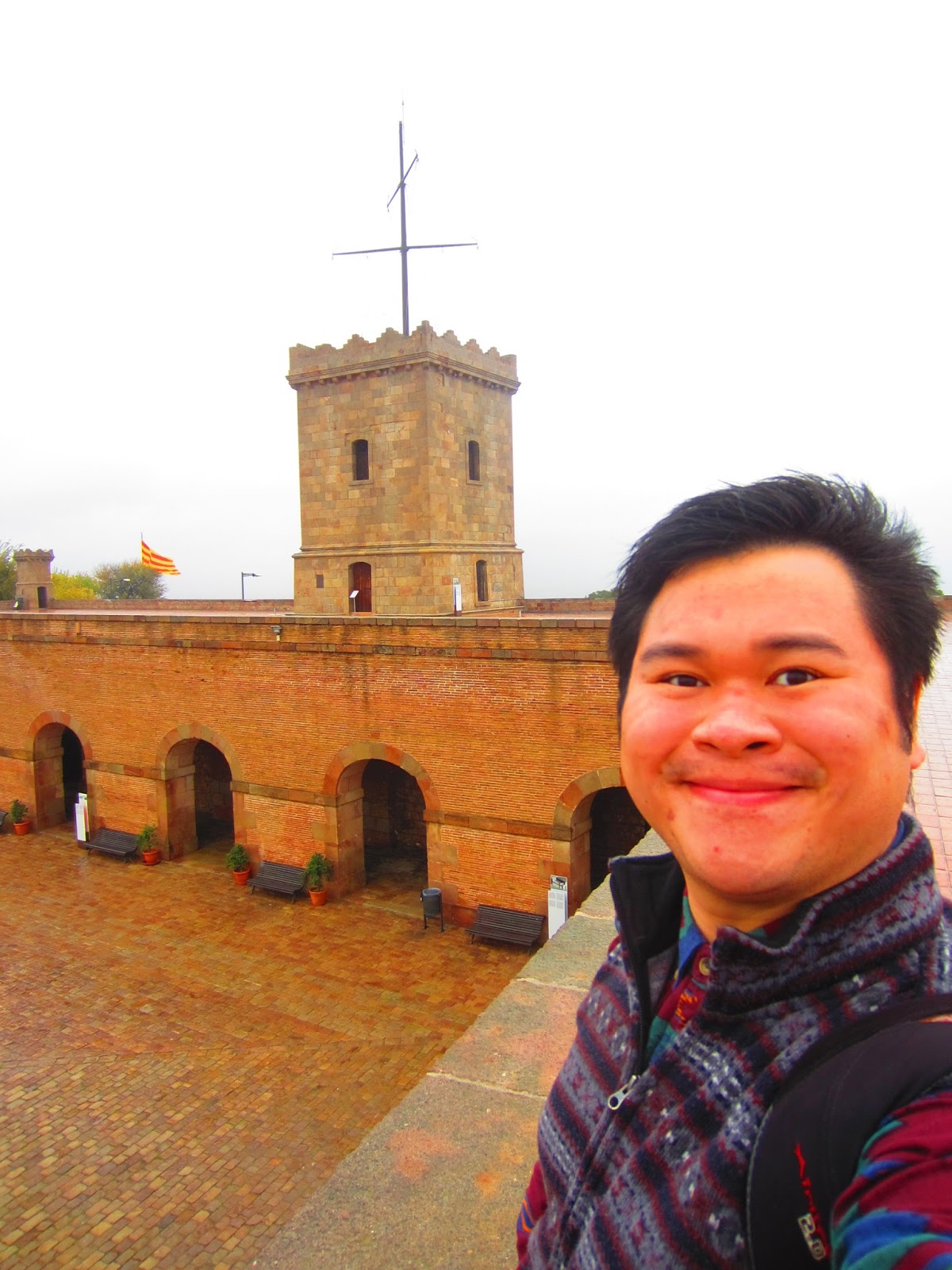
- I rode the train all the way to Placa d'Espanya once more, and followed the signs to the funicular to the Montjuic Castle. After riding the funicular, I went out the train/funicular station and went upstairs to ride the cable car that goes to the castle itself. The Montjuic Castle is both a famous and infamous landmark throughout Spanish history. The original castle (it's a fortress and not a palace by the way,) was built in the 1600s, but the current structure was built in the 1700s; the fortress was meant to protect Catalonia, and as most forts are, it also served as a dungeon and prison chamber. However, fastforward to the 1930s during the Spanish Civil War, the Montjuic Castle was also used as a prison and torture + execution chamber for political prisons. One of those executed here was the then President of Catalonia, Lluis Companys. Well, the number of people who have perished in the castle was probably why the castle had an eerie ambiance - and the rain wasn't helping in lightening up the mood.
 |
| The view from inside the cable car. Red roofs and red trees. Too bad it was raining. |
 |
| Montjuic Castle. It reminded me a lot of Manila's Fort Santiago. |
 |
| Flag of Catalonia. |
 |
| Spanish emblem, I think. |
 |
| It was empty and eerie. |
 |
| Empty hallways. Some of those rooms have exhibition galleries about the history of the castle. |
 |
| What Barcelona looked like a few decades ago. |
 |
| Lookout tower |
 |
| Main watch tower. |
 |
| Autumn leaves covering part of the fort. |
- I realized that at around noon, after visiting Montjuic Castle, my itinerary for Barcelona was covered. There were actually other items on my list that I wasn't able to visit, but I decided not to visit them anymore since they were quite far (and some of them uphill,) and the stubborn rain would not go away. I could have gone to the museums I missed like the National Art Museum of Catalonia (i.e. Palau Nacional,) but it was a Monday and most museums are closed on Mondays (as in many other countries.) Well, again, the major tourist spots and areas of Barcelona were already covered anyway, so I was quite satisfied. However, I had half a day to kill, so I had a more relaxed lunch at Txapela back in Passeig de Gracia, and I tried to shop, but alas, I had nothing to shop for.
- While strolling along Passeig de Gracia, I suddenly remembered the rather castle-like Casa de les Punxes and that it had a museum dedicated to St. George (Sant Jordi) inside; St. George is the patron saint of Catalonia. Since I had nothing better to do, I walked a few blocks north to visit this house-museum. The house was built by Josep Puig in the early 1900s as a combination of three houses for the three sisters of textile tycoon Bartomeu Terradas. Today, this castle-like house is a multimedia museum for St. George. It reminded me of Hong Kong's "Walk with Buddha" in Ngong Ping 360. Each room will show a snippet of the legend of St. George, and the door will automatically open to the next room/hall.
- To summarize the legend, there was a dragon that started terrorizing a kingdom, and the only way to appease the dragon was to feed the dragon two sheet everyday. When the sheep ran out and the kingdom started offering young women. When all the young women ran out, the king's only daughter, the princess, was the only choice. In the end, St. George, on his horse, saw the princess who was about to sacrifice herself, and St. George slayed to dragon on one condition - the people of the kingdom will convert to Christianity. The blood of the dragon that left stains on the ground later became red rose bushes, and is the inspiration for the later tradition of giving roses in exchange for books - a common tradition on the Feast of St. George, also known as "Dia del Libro" (International Day of Books.)
 |
| St. George and the dragon. |
 |
| It's not an actual river. If you look closely there are straight lines that are supposed to be the floor and a door leading to the next room. |
 |
| The king of the kingdom. |
 |
| The princess. |
 |
| The dragon. |
 |
| St. George (and the princess) facing the dragon. |
 |
| I have my mandatory automatic audio guide with me. |
 |
| Dia del Libro. |
 |
| At the roof. |
 |
| The avenuue of Barcelona. |
 |
| Casa de les Punxes. |
 |
| Castle-like, isn't it? |
- After I visited the multimedia museum, I walked back to Passeig de Gracia to have one last serving of churros con chocolate before I leave Spain the next day. "Until the next time we meet, Spain" I said to myself, though in truth I'd see Spain again five days after. For the meantime, I was quite excited to visit the western frontier of the Iberian peninsula - Portugal!! (Dont' forget to read Part 1
here, Part 2
here, Part 4
here, Part 5
here, Part 6
here, Part 7
here, Part 8
here, Part 9
here, Part 10
here, and Part 11
here!!)
 |
| Trinity (from Matrix,) is that you? |
 |
| My last churros con chocolate in Barcelona. |