Saturday, October 14, 2017

Dayaw 2017: Celebrating the National Indigenous Peoples Month

- Oct. 8, 2017, Sunday.

- I just had one of my dreams come true last October 8!! People who encounter me frequently like my friends or colleagues will know that I have interest in all things cultural, including the legacy of the Philippine indigenous cultures. As October is dubbed as the Philippines' "Indigenous Peoples Month," the National Commission for Culture and the Arts (NCCA) once again organized "Dayaw," the name given to this big festival celebrating the country's different indigenous groups. The three-day festival started with a big celebration gathering 45 indigenous ethnic groups from north to south, east to west. I can't tell you how much I looked forward to Dayaw 2017, and how much my fats wanted to explode in excitement when I attended the first day of Dayaw at the flower clock area of Manila's Rizal Park. The second and third days of Dayaw took place inside SM Mall of Asia, various high schools and colleges in Metro Manila, and at the Rizal Park as well. Although I would've wanted to attend all three days of Dayaw, I was only able to attend the first day, on a Sunday, since I had work on the latter two days. Since the first day fell on a weekend, it was the day with the most activities and the most participants (more on this later.)

Welcome to Dayaw!!
- "Dayaw" has been done almost annually since the early 2000s, and each year that the NCCA has organized Dayaw, the celebration - I heard - just kept getting better with more indigenous groups actively participating in this national cultural festival. The NCCA also invites a few foreign groups per year to present aspects of their cultures and to take part in cultural dialogues with the Philippines' indigenous groups. This year, on top of the 45 indigenous groups, participants from Indonesia, Lao PDR (aka Laos,) Malaysia, South Korea, Vietnam, and Thailand. 

- I arrived around 10ish in the morning and followed my way to the kulintang (i.e. gongs) music being blasted in the open exhibit area. Stalls were being set up by the different groups where they could sell their own handicrafts and traditional snacks. I darted my way to the T'boli stall since I am a big fan of T'boli jewelry, and because their stall was set up earlier than most other stalls. It was only later on that I realized that the opening ceremonies were on-going inside the ampitheater. I caught the latter half of the opening ceremonies where the different groups were being formally introduced. The second half of the opening ceremony was held outdoors at the exhibit area by the flower clock.

T'bolis and their elaborate garb.
With two T'boli women and two Tausug men.
Opening ceremonies.
Performers from Thailand; they were going to do a nora dance from Southern Thailand.
PARTEYHHHH.
Maguindanao dancers.
I never knew that the Rombloanon Tagalog people looked like this!! I like the big-leaf crowns!!
Presenting the saint.
Maranao people in a Marano house replica. (How appropriate haha.)
You can't make mistakes!! If you do, the knots won't look nice.
I got some free snacks just by allowing myself to be a "volunteer" after the dancers started looking for audience members to dance with them.
- I spent the rest of the morning taking photos with the other ethnic groups while they were still in costume, and of course, the more important part was interacting with the different groups to learn more about their culture. I also consulted them about the different ethnic jewelry I have at home, so I can explain them better when people ask me about them (take that, cultural appropriation!!) By the way, I also hoarded some stuff from them - it made me happy because I bought things to add to my collection of all things cultural (not to mention that I'll use them too!!) and it made them happy too because I was directly supporting their works.

Moana's homies. LOL I kid. These guys are Ivatans from Batanes (trivia: their people are closely related to the Tao people of Taiwan.)
With the Korean visitors.
Gongs galore.
Manobo women with giant geometric mats.
The man beside me is the "supremo" or the leader of the Lapaknon Manobos.
With an Ifugao dude. I'd love to have those feathers on my head.
This Gaddang girl looks freakishly similar to one of my students. I also adore her Gaddang outfit. She's a talented gong-player too!!
- Throughout the morning and afternoon, there were also impromptu performances by some of the groups present. Occasionally, they would ask people to join them as a way for people to learn about their culture hands on.

Caught the people of Mountain Province having fun!!

They asked other people (including other ethnic groups) to join.
Balance is the key.
- After having lunch at Jollibee (since it was the closest place with decent food, and food wasn't being served in the exhibit place,) I went back to enjoy the rest of the afternoon. I took photos by the replica houses that they had on display, and I either participated or observed the handicraft demonstration, traditional games, or the cooking demonstrations. For the cooking demos, they served food to everyone after each demo, and if they only did the demos during lunch, I didn't have to go to Jollibee. My favorite among the dishes served was the Ivatan party banana platter called "vunung." The vunung platter has "supas" (turmeric rice,) "uved" (a meatball-looking viand made from banana stalk; "ubod" in Filipino,) and "luñes," (pork cooked like dry adobo.)     

Inside the Maranao house.
Looking for food.
Waiting for food inside the Maranao house. (I was using my newly-bought ultraweight tripod to take this shot.)
Playing with native tops.
An event volunteer tries Ifugao stilts.
Let the natives show you how it's done.
Ifugao people "preparing" the chicken.
It was traumatic to see how they prepare the chicken in great detail (if you know what I mean.)
Must be a good dish. By the way, I hope you're not offended because this is the way the natives really prepare their food. (They also said this disclaimer to everyone who might have been "offended" with the way they've been preparing their food for generations.)
The young Gaddang girl from my photos above learning how to play the gong from an elderly Gaddang man. 
Apayao women teaching people how to do basketry.
My favorite part of the afternoon: IVATAN VUNUNG!!!! ("Supas" = turmeric rice, "uved" = the white-violetish ball made from banana stalk, "luñes" = the brown pork slice.) If only they served this for lunch!!
Kalanguya people teaching the art of making brooms (one of the reasons why the north is famous for selling native brooms.)
With Maranao men in front of the Maranao house.
The Lapaknon Manobo lady still has more things to sell. (I bought a pack of durian pastillas from them. The pastillas tasted awesome!!) 
House from the Visayas.
Aeta people teaching everyone how to make homemade shampoo from tree branches!! How cool is that!!
- At around 5:30 in the afternoon, I went back to the ampitheater to watch the evening performance by more than half the ethnic groups present. Needless to say it took a long time for the program to finish. I didn't even have dinner and I didn't get to finish the whole performance; I finished all the local ones and left for home at around 10ish in the evening just as the international participants were about to perform. After all, I've seen what they were going to perform in various international cultural events or venues either here or abroad - which says something not only about my exposure, but the exposure of many Filipinos to cultures. I realized that many Filipinos, particularly city-dwellers like me, have more opportunities accessing or experiencing foreign cultures than our own local ethnic/indigenous cultures since indigenous-themed events are rare in Metro Manila. This is actually one of the reasons why "Dayaw" was conceptualized in the first place. It is to give not only Manilenos, but also the different ethnic groups to come together and share their cultures to each other. I didn't feel bad about missing dinner during my regular dinnertime, since I knew that opportunities like the performances that night were rare, since I've always wanted to see these dances live, and not just in videos I see online. I saw some of my favorite dances, including the pangalay, igal, the singkil, and the kappa malong malong dance.

Mansakas from the Compostela Valley in Mindanao.
Manobos from Mindanao.
The Sama-Bajau people of southernmost Philippines and their theatrical igal dance 
The Manguindanaoans and their sample of various dances (including the kappa malong malong.)
The Maranao's singkil. One of my favorite dances everrrrrr!!
The Yakans and their dance-drama with the theme of friendship.
- I went home with the smell of rain, sweat, and Manila air. I had never stayed in Rizal Park that long before Dayaw. Although all I wanted to do after going home was to have a quick dinner and rest the whole night, I could say that I would most likely attend Dayaw again because of my eye-opening learning experience on the cultures of the country's indigenous peoples. I really just wished that Dayaw wold be done on both Saturday and Sunday and perhaps either Friday or Monday if NCCA really wishes to do it within three days, so more people can come. Well, I suppose NCCA has its own reasons why Dayaw was done Sunday to Tuesday. Anyway, I really do hope that more people will come and experience Dayaw in the coming years, not only because it makes people know about the various groups and cultures we have in the Philippines, but also to let people understand that regardless of these differences in cultures, the indigenous groups are also both "ordinary" (i.e. not to be isolated; they're also citizens and know "regular" things like popular culture) and "extraordinary" (i.e. talents, skills, etc.) Filipinos.

Saturday, October 7, 2017

All Aboard the Indian Coast Guard Ships!!: A Visit to Kadmatt And Satpura in Manila's Pier 15

- October 4, 2017, Wednesday.

- Whenever something Indian comes my way, I usually try my best to grab the opportunity to experience anything Indian. This includes the 4-day visit of two Indian coast guard ships from Oct. 3 to Oct. 6. The Indian coast guard ships Kadmatt and Satpura dropped their anchors in Manila's Pier 15 as part of the ships' three-month trip across the ASEAN countries, as well as South Korea and Russia. Their visit to the ASEAN countries marks the 25th anniversary of India and ASEAN's bilateral relations. I think this is significant not only because they've have diplomatic relations for quarter of a century, but more importantly because it strengthens the foundation of the historical relations of India and Southeast Asia since ancient Asia (and yes, the Philippines was indeed indianized before the Spanish came - remember that!)

Kadmatt in front, and Satpura at the back.
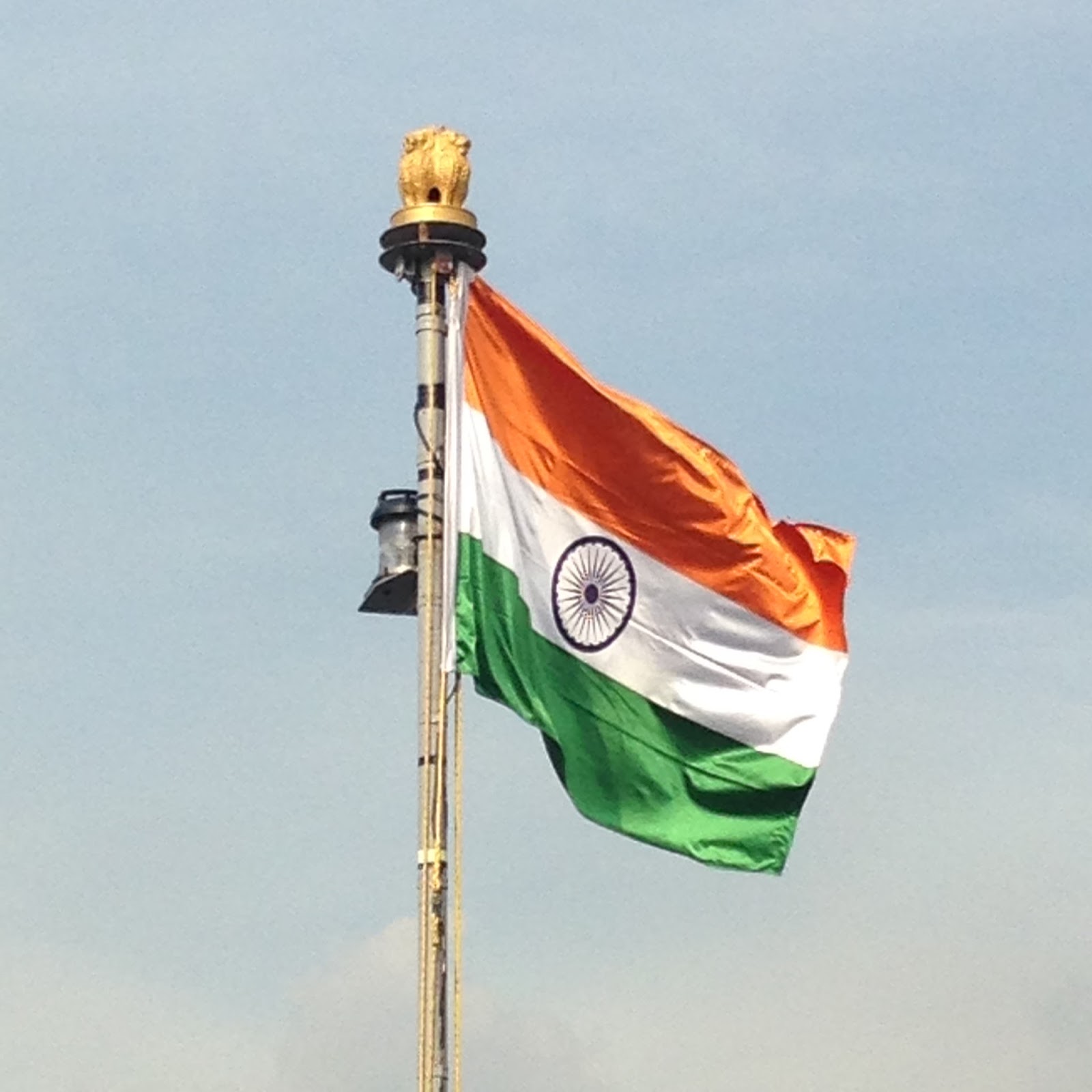
The Indian flag or the "tiranga."
- Even though I teach history in the university, I am not the best person to talk about when it comes to weapons, war ships, tanks, guns, or canons; I actually hate talking about wars even though it's inevitable in my classes. They're just not part of my interests. Perhaps my Indian past life was urging me to go after I heard of the public viewing schedule, which is why I decided to go anyway (I am an Indian specialist after all.) It would be a good opportunity to mingle with Indians, and at least know a little bit about their advances in technology through the coast guard ships. Also, I felt a bit nostalgic since I had my first Indian coast guard ship visit in 2012; the ship was named "Samrat" (click here to see my "VIP" visit to Samrat with the former Indian ambassador.)

Hello. Please take me to India.
- I arrived at Pier 15 a bit past 3 in the afternoon; the visiting hours were from 3pm to 6pm. Thinking that I would probably be alone, it surprised me to see a bunch of other people (both Indians and non-Indians) who took interest in viewing the ships. Some visitors who went were enthusiasts of anything military-related. I was happy when they asked if I was a blogger since I don't usually have that "blogger vibe" like some of my friends who blog professionally, but they seemed disappointed when they found out that I wasn't the blogger they wanted to mingle with (whoops sorry.) They thought I also blogged about military stuff like the blogs that they read, but I said that I specialized in travel and culture.

- INS Kadmatt was commissioned in 2016 and functions as an anti-submarine warfare ship. It is commanded by Commanded Nithin Cariappa. The ship is named after Kadmatt Island of India's Lakshadweep Islands.

Yay for bilateral relations!!
At the bow(?) of the ship. Look at 'em guns!! Ratatatatatatatatat.
- Too bad, photography was not allowed inside both ships, but all I can tell you is that Kadmatt has an awesome helicopter inside - just like the one I saw inside Samrat in 2012. Since photography was only allowed outside, I was able to take photos of the front of the ship. It was quite daunting with all the guns. The people on the ship were quite accommodating, and since some of them had a bit of difficulty speaking English, I had to adjust by speaking in Hindi. As usual I was barraged with questions, like if I was Northeast Indian (people there look Chinese/Burmese because of Northeast India's proximity to Tibet and Myanmar) since I was wearing my Indian kurta and coat, with a necklace bearing the national emblem and colors of India, or how I learned to speak quite-decent Hindi. I was very glad they understood me, at least I was able to talk to them a bit more. I also got to help them out with their shopping queries (yes, they're given some time to go around the city when they're not on duty.)

Emblem of the ship. "Kadmatt: Nirvighnamoo Karomi" (Kadmatt: Remover of Obstacles.)
With some of the nice people on the ship.
- I later visited INS Satpura, which is a multipurpose stealth ship. I learned that stealth ships are the kind of ships that are supposed to be hard to detect by most forms of radar or sonar methods. They're also supposed to be harder to spot visually. Despire this, Satpura is actually bigger and heavier than Kadmatt. Its captain is Captain Rahul Shankar.

I like the effect of the light and the reflection.
My photoshoot photo of the day.
See the logo of the hsip in the middle and at the sides of the swimming ring.
Spot the not. 
This cardboard guy was just welcoming people to the ship. :)) :)) :)) :)) (There's another one just like him towards the rear of the ship.)
 - Satpura also does not fall short in terms artillery compared to Kadmatt. Satpura can do land attacks too!! Also, before coming to the Philippines, Satpura had a month-long journey across the Southern Indian Ocean without any port calls (i.e. it traveled nonstop without docking); this shows the great advancements in India's naval technology. Despite all these features, my favorite part of my visit to the ship was that there were free Indian biscuits and Indian tea at the bow of the ship (such a person I am, huhu.)

Yes, you're the best ship, Satpura. (Just please, don't shoot me.)
Not to be messed with.
See 'em guns!!
- I finally left the pier after my little afternoon "field trip" to the two ships. I learned a bit more about naval stuff through my small chats with the people on board; it was still nice to learn something new even if it wasn't something that would normally interest me. What I am most happy about - aside from the free biscuits and drinks - is that there are continuous efforts to strengthen the diplomatic ties between India and the Philippines. I just hope that this strengthening of ties will expand to and be more apparent in other sectors beyond military, politics, and business.

Thursday, October 5, 2017

"Grave Hunting" in Paco Park and "Miracle Searching" in Malate Church

- Sept. 29, 2017, Friday.

- When one thinks of touristy things to do in Manila, the first two places that come to mind are Intramuros, and the adjacent Rizal Park. Both of these places are, of course, related to Manila's Spanish colonial past. While these two iconic places are definitely worth a visit - regardless if you're a resident or a tourist/visitor of Manila - there are other nearby places that add puzzle pieces to the narrative of what we know about our colonial past.

- My first stop for the afternoon was Manila's humble Paco Park. It can be reached by riding the LRT1 line to UN Avenue Station, then walking a couple of blocks along Gen. Luna Street (diagonal with UN Avenue.) This park was originally a cemetery named "Cemeterio General de Dilao" that was inagurated in the early 1800s. It was a burial site for the affluent of Manila, particularly those who lived in nearby Intramuros. After ceasing all interments in 1912, it was later used as an ammunition depot and some sort of fort by the Japanese. The park/cemetery's walls, after all, were so thick that the Japanese thought of repurposing the cemetery/park, this way. Also, the Paco Park's structure has an outer ring and an inner circle, which meant that there were two walls that protected the heart of this small space (one to protect the outer ring, and another to protect the inner circle.)

Most people today don't know that the park was once a cemetery.
The door to the inner circle.
The main attraction: St. Pancratius Chapel.
- Today, the Paco Park is not only for tourists, but a also place where students from nearby schools hang out and rehearse for their class activities, where people can just sit down and relax, or where people can shoot prenuptial photoshoots or actually get married. The main attraction can be instantly seen in this small park: the St. Pancratius Chapel, also known as the "Paco Church." This romaneque church was formally opened the same time the park/cemetery did. From what I understand it only opens whenever there's mass or special occasions, but I was able to take a photo through the slightly tinted and dusty windows of the main gate.

Close up of the chapel.
What it looks like inside, took a photo through the tinted/dusty window. The worst photo of the day turned out to be the best one (after a few adjustments to lighting and contrast.)
Beside the chapel; of course I didn't miss the opportunity to take this shot. By the way I'm wearing my Indian kurta that resembles the clothes Filipinos wore during the Spanish era.
- Going around the park can take anywhere from 30minutes to an hour (or even an hour and a half if you REALLY want to take your time,) because visitors can climb up the inner wall and see the whole park from the "second floor." I thought I liked the park already from flat ground, but boy did it look a lot more stunning from above the wall!!

Humpty Dumpty sat on a wall, thankfully he didn't have a great fall!!
- For history buffs, the park/cemetery's past won't be the only thing that will be of interest. In my case, the main reason for going to the park is not just to see the park, but to see two important tombs. The first one is the tomb where the three priests of Gomburza (Gomez, Burgos, and Zamora) were buried. The three priests were executed in Bagumbayan (now the Rizal Park,) because they acted against the Spanish authorities. Their "joint" tomb is located in the outer ring at the right side of the main entrance (while facing the Paco Church.) It's not hard to find because the park is small and their tomb has a big cross and a visible marker.

It wasn't much of a grave hunt actually since it was right there, before my very eyes.

- The more significant tomb - and the more controversial one - is the first burial site of Jose P. Rizal, the country's national hero. Although most Filipinos will know that the body of Rizal is currently buried underneath the ever-famous monument in Rizal Park, the first burial site was actually in Paco Park. (If the GOMBURZA one is to the right of the outer ring, Rizal's is at the left side of the outer ring.) Again, this won't be much of a "hunt" since the grave site is clearly marked. Now, this is how the story goes. After Rizal was shot in Bagumbayan (again, today's Rizal Park,) his body was hastily buried, and not even a proper burial (i.e. no coffin and all, and his body was just dumped in a hole) in Paco Park, which, if you've been following this post attentively, was a cemetery. Rizal's sister was looking for her brother's burial site, and eventually found her brother's grave in Paco Park. She then had a plaque placed on the grave, both as a marker and a sign of respect, with Rizal's inverted initials - "RPJ" (instead of "JPR.") Two years later, Rizal's family was granted permission to relocate the body (after identifying it as Jose Rizal's) first in their home in Binondo, and in 1912, the remains eventually found its way to the Rizal monument in Rizal Park after the statue was built. Today, the better-looking and well-labeled burial site in Paco Park still bears the inverted initials.

To be honest, you don't need much "grave hunting" to see this. This is said to be the original burial site.
Please read. :) :) :) :)
See the inverted initials??
Rizal's bust.
- Before leaving the park, I got to see the other burial areas of the park at the outer ring. Currently, there are people hired to restore the tombs by breaking and restoring the tombs' seals. I got to see an open tomb with a perfectly preserved Spanish-era coffin. Too bad I couldn't go near (and I wouldn't dare actually,) and I wasn't allowed to take photographs. There was also another empty tomb near that one that used to be infested with bees. How do I know this? The empty tomb had a large empty beehive. (Thankfully, the bees weren't there anymore!!) Of course, even if it was an empty tomb (or at least I thought it was empty since the beehive was blocking my view?) I was also not allowed to take photos of that. By the way, since the park/cemetery stopped interments in 1912, as mentioned a while ago, many tombs were relocated by the families, and so only a few tombs in the park today have coffins/remains in them.

- After my surprisingly informative and exciting "grave (not too much) hunting," I left and took an ever-reliable Uber to a lesser-visited historical church in Manila: the Malate Church. The church is this old and quiet church that has a stunning view of the Manila Bay since it was built in the late 1500s; it's a little bit more than 2 kilometers from Paco Park. (Bonus: this church is close to the original and still-open Aristoricat Restaurant, so maybe you'd like to have a meal after visiting the church?) The main entrance, from my understanding, is not used unless there is a mass or a big event; otherwise, only the side door is open for casual visitors of the church. There are people who visit it for weddings, masses, and other things, but it's just that it's quite rare for me (throughout the years!!) to hear people say that they'll go to Malate Church for whatever reason as compared to other churches in and out of Manila. Drawing from this, I developed enough curiosity to want to visit this church since I've heard of it and seen it from a distance, but never actually visited it ever in my life. (Such a Manileno I am.)

Visitors will be welcome by this plaque and the statue below.
Both are memorials to those who perished in WWII, including some Columban priests who kept the people company and died with them eventually.
 - The church interior might not seem as impressive as bigger and more prominent churches of the city, but its main wonder lies in the statue of the Virgin Mary at the center of the church. History says that the Virgin Mary statue, in her form as "Our Lady of Remedies" ("Nuestra Senora de Remedios,") was brought in from Andalusia, and enshrined in the church in 1624. The statue is said to bring miracles, particularly on thing relating to healing and blessing babies. Until today, the people who visit the Virgin Mary statue ask for blessings in the belief that she can make miracles happen. 

"Our Lady of Remedies" from Andalusia.
Interior.
- For me, the highlight of the Malate Church is not the interior (save the Virgin Mary statue,) but the facade that sets if apart from all the other churches that I've seen in Manila. At first glance, it looks like a typical baroque church - particularly "earthquake baroque style" (wider features as a way to better survive earthquakes) - but a closer inspection of the building shows that it incorporates a lot of moorish elements such as the "fake doors/windows" at the "towers" of the facade. This style of incorporating Muslim/Moorish elements to architecture is called "mudejarismo" (to see more of Islamic architecture in Spain, click here to see my trip to Cordoba!!) Another prominent feature would be the twisted columns that not many churches in the Philippines have; this is a baroque influence. Apart from Baroqie and Muslim influences, there are also aspects of the church facade that show influences of Renaissance architecture.

See everything I mentioned here? It really is a charming church.
The best place to take a photo with the church is in the plaza/square in front of the church. It's called Rajah Sulayman Plaza/Park.
- I finally had to leave Malate Church to go to another appointment for the day; I almost missed it because I had too much fun in my unconventional adventure to Paco Park and Malate Church. It is always fun to be a tourist in your own backyard. No matter how much you think you know the city you live in, give it a chance, know its (hi)story, and it will never cease to surprise you!!