- May 20, 2018, Sunday.
- Even on my first day in Hawaii (click
here for Part 1), I was already impressed by the cultural and royal richness of downtown Hawaii. To think that that was just the tip of the iceberg!! Looking at my tourist map, I realized that there was just too much to see and experience in Honolulu, the capital of Hawaii, even without setting foot on the beach. On my second day, I was more than ready to see more of Hawaii's royal past. One travel tip: unlike most countries or cities, most tourist spots in Hawaii are closed on Sunday or for both days of the weekend, so it was quite difficult to decide which places to visit on a Sunday while making sure that they're not too far apart or that they follow a certain path for efficient sightseeing (yes, I am THIS meticulous about my travels).
- That morning, I quickly rode an Uber to Queen Emma's Summer Palace, which is located a bit outside the downtown. Also known as Hamaiakamalama, Queen Emma's Summer Palace was a rest house for Queen Emma, husband King Kamehameha IV, and their son, Prince Albert Edward in the mid 1800s, and was used for around 20 or so years. Since it is located in a hilly area near the bigger mountain's forests, it is cooler than the flat lands near the sea. The museum is open from 10am-3pm every Sunday, but is open 9am-4pm on all other days. Since I arrived around an hour before opening time, I had some quality time by myself near the palace's porch, enjoying the same cool air that the Hawaiian royalty did centuries ago (it was probably even cooler back then, before global warning and stuff.)
 |
| Trying to do some hula stances outside the palace. Did you know that hula dancing is not just for women? Men would dance the hula too, and is actually a good training for warriors and warriors-to-be!! |
- The palace itself is small and quite cozy, and shows some things that Queen Emma and her family owned in the mid-1800s. However, originally, the land owned by the royals was even bigger. The palace can be covered in around 30 minutes or less, but make sure to spend a few more minutes in the garden or taking nice photos around the palace!
 |
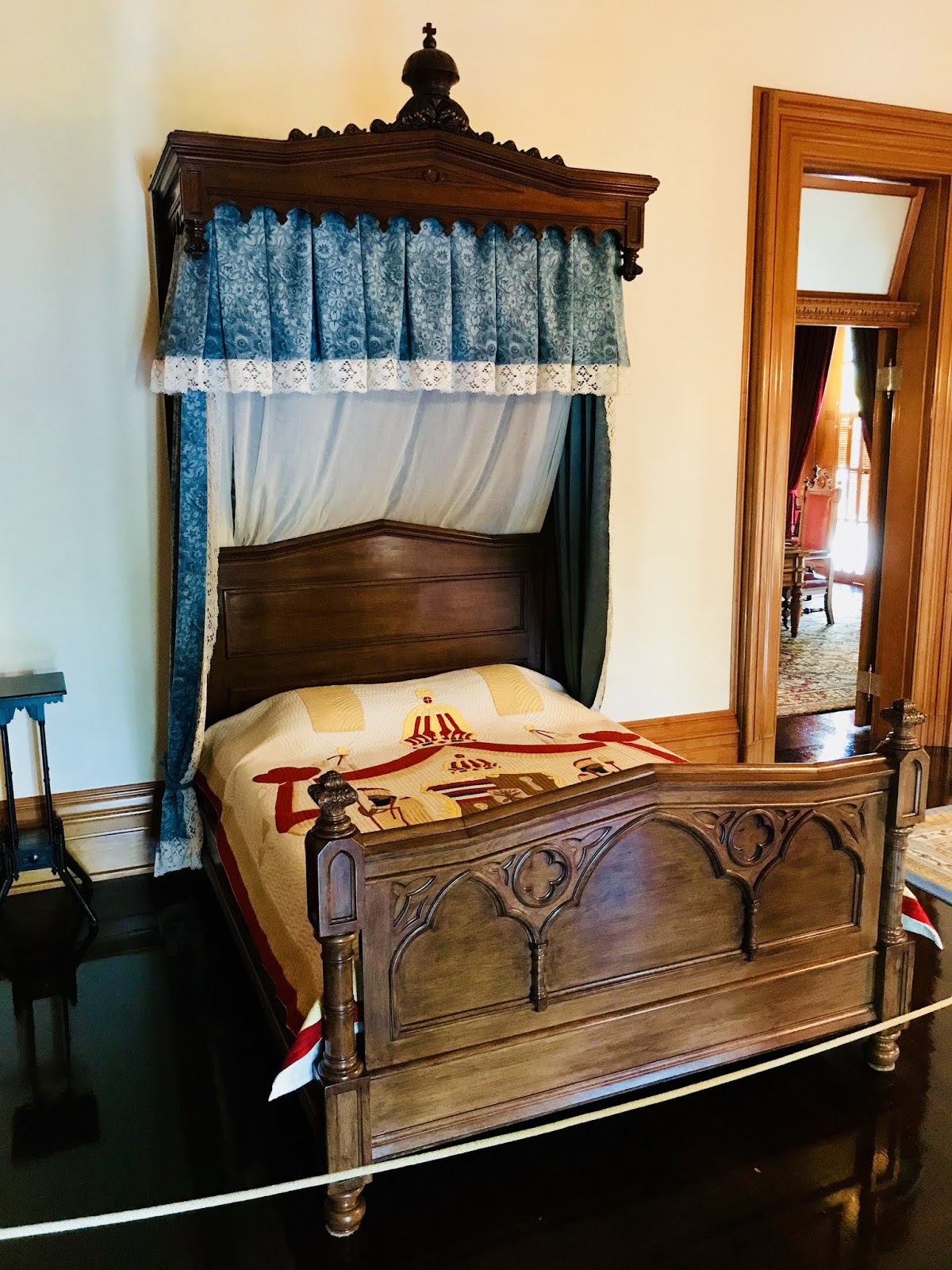
| The bedroom was right beside the door!! |
 |
| Old crib. |
 |
| Royal photos. |
 |
| This is pretty much the whole "palace." |
 |
| Ceremonial staffs. |
 |
| Prince Albert Edward's room. |
 |
| Prince Albert Edward's Mahiole (feathered headdress.) |
 |
| Prince Albert Edward's little boy things. Too bad he passed away at a tender age of 4. |
 |
| I love the fans!! |
 |
| The royal feathered cape. |
 |
| The main sitting room. |
 |
| Royal coat of arms. |
 |
| This is what it looks like from the outside. |
- After visiting the palace, I had to find a way to move around since taxis are quite rare in the streets, I had to either ride the bus or the trolley. Fortunately, the trolley and bus stops are conveniently located right outside the palace. I decided to take the trolley (formally called "Waikiki Trolley") since it is an efficient way to hop from one place to another, given that you can work around with the trolley's schedule and that you're interested to go to several stops within each line. There are 5 lines: red line (mostly historical places,) pink line (shopping places,) blue line (beaches and coastal areas,) purple line (main stop is Pearl Harbor,) and the green line (main stop is Diamond Head.) These trolley lines also stop in big hotels, one of which is our hotel, the Ala Moana Hotel (click
here for more information on the Waikiki Trolley.) You may buy tickets online or purchase from the driver once you hop in. A ticket lasts a day for each line, and costs around 25 USD (except for the pink line which costs 2 USD per way.) The link above has more information on combination tickets and other promotions. For this particular trip, I rode the red trolley, since it has all the places that I wanted to visit and more. (The trolley was air conditioned so it was a big plus for a sweaty guy like me!)
- En route to Bishop Museum, the trolley had to make a 10-minute stop at the Pali Lookout. Though supposedly not a part of my day's itinerary, I thought of this as a bonus trip; after all, the trolley really had to do a short stopover here. The Nu'uanu Pali Lookout is located on top of one of the moutnains of the Ko'oalu mountain range overlooking the northeast coast of Oahu. This spot is also very important since the climax of the Battle of Nu'uanu in 1795 happened here. Kamehameha I from the Big Island (that is, the Island of Hawai'i in the south,) wanted to conquer all the islands and absorb them in the Kingdom of Hawai'i. It is said that the skulls and bones found around the cliffs belonged to the warriors who were pushed off the cliff during the battle. Today, the Pali Lookout gives a breathtaking view of the cloud-covered mountain top, as well as the vivid greens and blues of the Hawaiian Islands. I also realized that the green velvet mountains in Hawaii look so "sculptured" that you just couldn't believe that they were real and natural. Just be careful when visiting Pali Lookout since the winds can be strong, and at times, visitors aren't allowed to visit when the winds are dangerously strong (like when a typhoon is about to come.)
 |
| Clouds covering the magical peaks of the mountain. (OK, not sure if the peaks are really magical I just made that up.) |
 |
| Can't imagine that a nice park like this used to be a place of bloodshed. |
 |
| Hello there, and also featuring my Hawaiian kukui-seed necklace. |
 |
| Panorama. |
 |
| The common backdrop when painting an image of the Battle of Nu'uanu. |
- I arrived at the Bishop Museum just before the show at the planetarium, so I watched the show first before eating lunch at the museum cafeteria. I enjoyed my lunch at the museum cafeteria because it was my first authentic Hawaiian meal: kalua pulled pork, lomi lomi (a tomato-based salad,), poi (a pasty staple food made from mashed taro), and haupia (traditional coconut pudding.) Poi is an acquired taste by the way, since it is bland with a hint of sourness (well, it's just mashed taro and water, nothing else.)
 |
| One of the people's favorite museums in Hawaii. |
 |
| Lomi-lomi at the top left, haupia at the top right (with slices of taro,) kalua pulled pork at the bottom left, and poi at the bottom right. |
- My early Sunday afternoon was devoted to enjoying the Bishop Museum. The Museum was built in the late 1800s by Charles Bishop, a businessman and philantropist and husband of Princess Bernice Pauahi Bishop. The museum was built, supposedly, to house royal paraphernalia handed down to Princess Bernice by members of the Kamehameha Dynasty.
 |
| A Hawaiian guardian arch, and yes, that's me attempting another hula stance. |
 |
| I like how it looks from the outside, and I'm sure what is has inside is even more awesome. |
 |
| A model of a Polynesian boat. |
 |
| Giant whale!! |
 |
| It looks like a good set for some kind of Indiana-Jones-like movie or series. |
 |
| A guardian tiki. |
 |
| These belonged to Princess Victoria Ka'iulani in the 1800s. |
 |
| Another model of a Polynesian boat. |
 |
| Various giant tikis. |
 |
| Moving dinosaurs at the special dinosaur exhibit. |
 |
| Its size would've been good as a palace too. |
- After visiting the museum, I rode the red trolley back to the downtown right outside the Kamehameha Statue and walked to the Honolulu Museum of Art. They're open from Tuesday to Sunday, but fortunately, I was told the day before (when I arrived a minute late after closing) that I could celebrate "Bank of Hawaii Family Sunday" that Sunday. It is a special event done every third Sunday of the month when the museum would organize some activities for the whole family, and the best part is that it's free on this day! Although I arrived after the family activities, I was still able to go around the museum. It looks small on the outside, but it is a maze of galleries inside, with a vast collection of ancient to contemporary art from all around the world; after all, it is one of the best "small museums" in the USA since it was built in the 1920s.
 |
| This is the City Hall by the way, right beside the Iolani Palace. It's called "Honolulu Hale." |
 |
| Inside the museum!! This is a Qing-dynasty gown. |
 |
| There was a gallery dedicated to Buddhism. |
 |
| Forever in love with Gandhara art. |
 |
| OMG they took a whole window from India and brought it to the museum!! |
 |
| One of my favorite galleries - one that has nothing but ornate kimonos!! |
 |
| Another favorite gallery, for obvious reasons. |
 |
| This Nandi head is around 6 feet. |
 |
| A naga statue at the Southeast-Asian gallery. |
 |
| A Vietnamese Dong Son drum. |
 |
| Wayang kulit from Indonesia. |
 |
| A wall full of Indonesian masks. |
 |
| A small replica of the Kamehameha Statue across Iolani Palace. |
 |
| Ottoman Turkish jewelry. |
 |
| Came all the way to Hawaii to see this. |
 |
| I have a friend who is terrified of religious statues. Well, this one's for him. |
 |
| I seriously thought that this man was part of the exhibit since he was sitting VERY still - until I realized that he was just a visitor like me. |
 |
| Here I am. |
 |
| The facade of the museum is nothing compared to what it has to offer to its visitors!! |
- From the museum, I had another scenic stroll of the downtown until I reached the Kamehameha Statue to ride the red trolley to Ala Moana Center to do some strolling before meeting the family for dinner. Since I got hungry, I decided to have an afternoon snack at the mall's food court. I saw that they have a Jollibee there so I decided to try a regular Chicken Joy mean just to compare. Now I like being Filipino and all that, but truth be told, I enjoyed Hawaii's Chicken Joy more because that chicken pieces were bigger, the skin was crispier, and the meat was juicier. Also, the chicken pieces weren't too salty. I mean, I still like the (original) Chicken Joy here in the Philippines, but I wouldn't mind having the one I had in Hawaii over what we have in the Philippines.
 |
| Sa Jollibee, bida ang saya!!!! |
 |
| BIG CHICKEN OMG. |
- That night, my family met some family friends in Hawaii and had dinner in a restaurant near Hilton Hotel. I had my first plate of authentic Hawaiian poke! Poke is a mix of rice, raw fish (usually tuna,) some vegetables and pickles, and other toppings. As a sashimi lover, it's no doubt that I like poke as well.
 |
| Poke!! |
- As much as we enjoyed the company of our family friends, we had to go back to our hotel to have an early rest. Not only would we have an early call time, but I also had to prepare myself psychologically for one of the most (in)famous place in Hawaii and world history - Pearl Harbor!!
- Don't forget to read Part 1
here, Part 3
here, Part 4
here, and Part 5
here!!