- October 30, 2019, Wednesday.
- "Don't have any other option? Should it really be there," my dad asked me when I told him that I decided to go to Zamboanga City for a short vacation for the holidays. Not surprisingly, some other friends asked me the same questions. Zamboanga City is the last frontier of the eastern part of mainland Mindanao, Mindanao being the Philippines' southern group of islands infamous for its terrorist groups. Despite that, I have seen people - through blogs/vlogs - visit Zamboanga City in the recent months, and have confirmed with friends from Zamboanga City that it was safe to go there, so I decided to book a trip to this beautiful city.
- Zamboanga City is part of the Zamboanga Peninsula, also known as Region IX (every mention of "Zamboanga" henceforth will refer to "Zamboanga City," unless otherwise stated,) and is currently known as "Asia's Latin City." Apart from the well-preserved structures dating back to the Spanish colonial era, the lingua franca of the Zamboangenos is Asia's only Spanish-derived creole called "Chavacano;" it's fondly described as "broken Spanish" peppered with words from Filipino, Malay, and other local languages from different ethnic groups in the area. However, I decided to go to Zamboanga mainly because of opportunities to interact with indigenous groups whose cultures were not too influenced by colonialism. It is a personal frustration of mine that the only things people see or know about the Philippines are eco-tourist spots, and structures that were either built during the Spanish colonial era or during times of war (ex. military barracks or bases from World War 2.) I think that the brilliance of the Philippine indigenous groups should also be highlighted as the essence of the "real"/pre-colonial Philippines can be found in these communities.
- I arrived around 10am Wednesday morning, and rode a cab to my hotel . The city center is just a 10 to 20-minute ride from the airport. If you want to ride a cab to the city, make sure you find the METERED cabs, as there are many drivers with private unmetered taxis who will insist you ride with them and charge you with a hefty price; a metered taxi ride to the city should cost around 100PHP. Riding a tricycle is also an option, but I opted to ride a cab since I didn't know before that the tricycles/autorickshaws in Zamboanga were fairly spacious compared to those in Manila (one person and one small luggage can fit inside; some tricycles also have a small secure storage place at the back.) A tricycle ride from the airport to the city center is around 40PHP (as of the time I'm writing this blog post.)
 |
| I love the aesthetics of this airport haha. It's a small airport though, but it does show aspects of Zamboanga's architecture. (Do you also see the colorful vinta sails below the airoprt's name? A vinta is a kind of boat.) Also, notice the welcome greeting, it's in Chavacano - Asia's only Spanish-creole language! |
- There are many cheap hotel options in Zamboanga's city center. I chose to stay at Winzelle Suites (click
here to see hotel's website.) It has 2 branches: a smaller and cheaper one alone Almonte Street, and a bigger one along Gov. Lim Avenue just around the corner of the smaller one. The smaller one is cheaper since it doesn't offer breakfast, but there are a lot of restaurants and fast food chains around the area so finding food is surely not a problem (speaking of fast food, I don't know why but there are so many Jollibees in Zamboanga, is probably is a Jollibee branch in every block, or perhaps every other block.) I liked my hotel; it was simple, generally clean, had amenities, had wifi, and was walking-distance (less than a kilometer to a kilometer) to many tourist destinations.
 |
| My single room. |
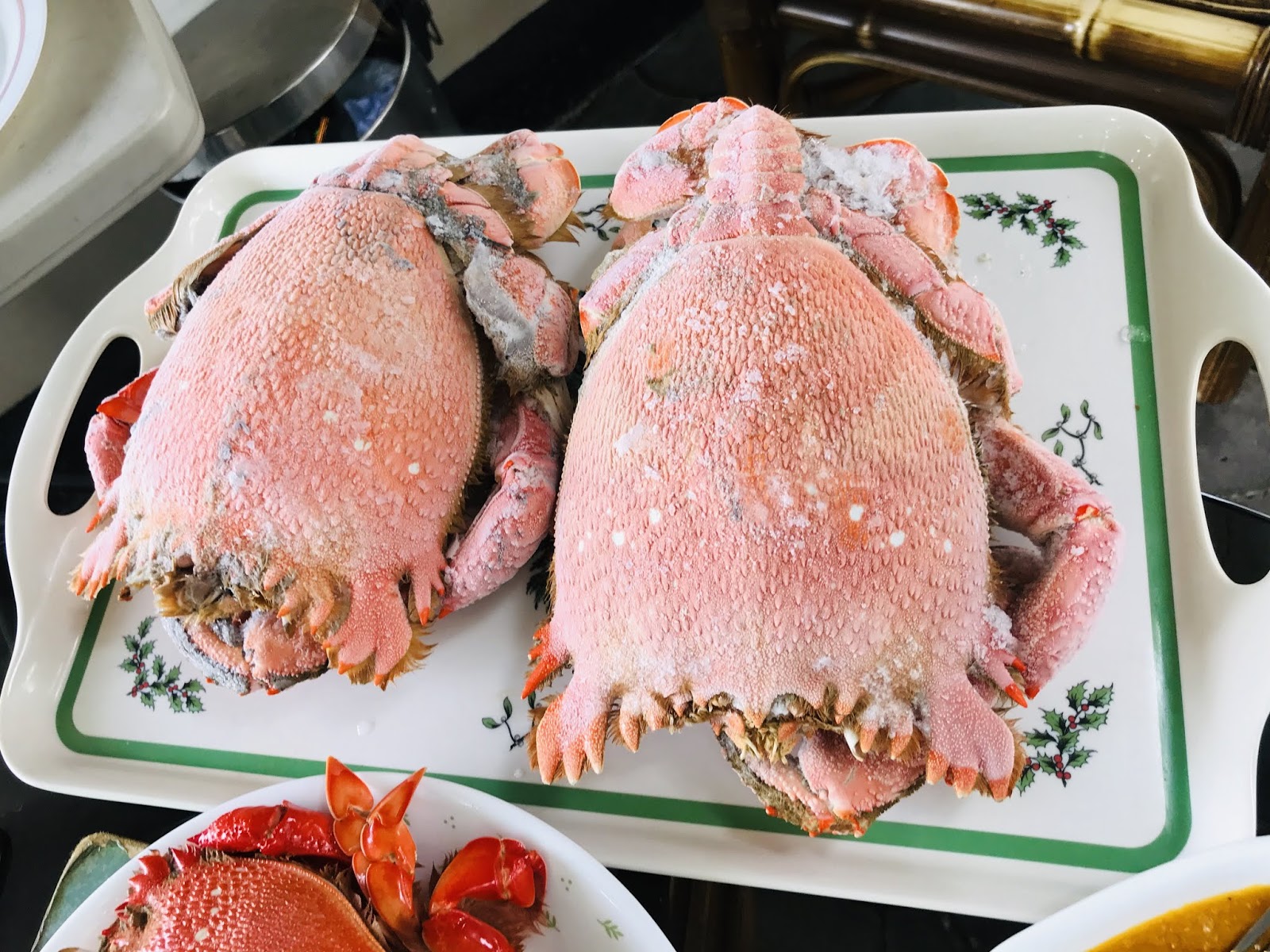
- My friend and student Ryan, together with his brother met me at my hotel and drove me to their house for a sumptuous lunch. I was ecstatic to finally try the famed "curacha," which although was derived from "cucaracha" or "cockroach" in Spanish, is actually a frog crab. They named this crab after a cockroach because the early Zamboanguenos thought that this crab looked like a cockroach (of the sea that is.) A frog crab or spanner crab is an elongated/almost circular type of crab, and it seems to have a softer shell than your regular crab. I found curachas easier to eat than a regular crab. I was told that curachas are best paired with the local "Alavar sauce," a sauce originally served at the Alavar Seafood Restaurant that contains crab roe ("talangka") and coconut milk ("gata.")
 |
| CURACHAAAAA. |
 |
| I would like to try a giant curacha one day. Heehee. By the way, the curacha is reddish orange even before it is cooked. Most crabs usually turn orange/red-orange only after they're cooked. |
- After lunch we had a brief drive to Fort Pilar, was a fortress built in the 17th century (during the Spanish era) as a protection against pirates from the nearby islands. Today, it is a public park (no entrance fee,) and houses the Zamboanga branch of the National Museum. Though the museum is currently under renovation, one wing was opened for a photography exhibit showing works by famed photographer Isa Lorenzo featuring Filipina leaders from various fields. (More on Fort Pilar in Part 2
here.) We were accompanied by Ryan's aunt, a true Zamboanguena, and was able to give me more insight on Zamboanga as a city and various trivia about the different tourist spots.
 |
| Photo exhibit inside Fort Pilar. |
 |
| Strong Filipina women. |
 |
| Paseo del Mar - a seaside park (currently under renovation) that has multiple food stalls and small restaurants that usually open at dusk. I heard that during the weekends, around 4-6pm, visitors can also experience riding vintas for a small fee. |
 |
| Thank you, Ryan, for taking time off your busy schedule just so you can make my first day in Zamboanga amazing!! :D:D:D:D |
- A highlight of Fort Pilar is the shrine dedicated to Mother Mary at the side/back of the fort. Mother Mary, as "Nuestra Senora de Pilar" (Our Lady of the Pillar,) is the patron of Zamboanga City. This form of Mother Mary is based on how she appeared before St. James of Spain while he was praying; it was said that this was the only time that she had an apparition while she was still alive.
 |
| With everything happening in my life at the same time, I need some positive divine intervention. Hahahaha. This is me lighting some candles as offering. |
 |
| A quick photo just as it was about to rain. |
 |
| For those who have asked me how I take my photos. Yes, I usually take them by myself (thank you Ryan for taking a behind-the-scenes phtoo.) |
 |
| I'm quite happy that I saw this without the big crowd. This place is normally packed with devotees. |
 |
| If you look at it closely, the image at the left (of the brown square in the middle) is St. James, and the image at the right is Virgin Mary on the pillar. |
 |
| Divine intervention please huhu. |
- I had some brief shopping time at the stalls across the fort before sitting down for an ice-cold "knickerbocker." This dessert is similar to the familiar halo-halo, but has no ice, with more fresh fruits and cream, and topped with a scoop of strawberry ice cream instead of ube/purple yam. However, while many establishments offer their own take on the "knickerbocker," they cannot use this name as a restaurant called Palmeras - inventor of this dessert - owns the name. Other establishments would usually use an alternative name instead.
 |
| A "not original" knickerbocker (but cheaper and still good.) |
- Hiding from the rain, I spent the rest of the afternoon indoors doing one of the things I love to do - shopping. The best place to buy souvenirs and other interesting stuff is at the Canelar Barter Trade Center. It is an indoor marketplace with stalls selling regular "Zamboanga" souvenirs (like t-shirts, keychains, or magnets,) malongs/sarongs from countries like Malaysia or Indonesia (and products made from these colorful malongs such as bags or pants,) indigenous handicrafts (mostly Tausug and some Maranao,) and edible dry goods from Malaysia and Indonesia (candies, Maggi noodles, Old Town Coffee, biscuits, etc.) and so on. These products cost cheaper here because of a certain trade agreement that makes it easier for Zamboanga to import these products from the neighboring countries. Also, speaking of prices....don't forget to haggle!! As far as I know, the market is open every from around 8am to around 5:30pm.
 |
| Inside the barter center. I wanted to buy everything if I could!! |
 |
| I really appreciate Ryan taking candid photos like this hahahaha. |
- Just to make my first day more exciting, I somehow started a fight at the barter center. I wanted to buy a pair of pants and I was entertained by this old lady. I bought the pants I wanted and the lady asked me to hold the pants I bought. She went inside the stall beside hers after getting my payment and another pair of pants from the rack to show to the person inside. That's when I realized that the pants I bought did not belong to the old lady's stall, but the stall beside. Sometimes this happens in barter centers/bargain markets/"tiangge," and while I don't like it when this happens, it does, sometimes, and is part of the experience of shopping at a bargain market. When this happens, the "middleman" from a different store sells the item at a slightly higher price or without a discount from the selling price, and usually gets a commission after helping the store sell the item. I couldn't tell at first that the pants didn't belong to the old lady's stall since the stalls were so close to each other and they all sold almost the same items. Just as I was about to move to another part of the barter center, the real owner of the pants (a younger lady,) started shouting at the top of her lungs. Not knowing why since the conversation was mostly in Chavacano (I understand Spanish but because the structure and vocabulary of Chavacano is a bit different from Spanish, I couldn't understand most of the conversation,) I asked another store what the fuss was. I later found out that the old lady showed the younger lady a cheaper pair of pants than what I bought, so the old lady could get a bigger cut on the pants that I bought. The two owners caused a commotion that some of the other shop owners started cooking instant noodles to have something to nibble on as the "shout fest" went on! I was a bit shocked, and traumatized to be honest, but later we got to talk to the younger lady, and she revealed to my and my companions that she erupted because the old lady had been doing this to her multiple times already. There is an epilogue to this story, do read it in Part 2
here! But just to tell you, for the next couple of days that I went back, I was known as the "guy who caused the fight." Also, I didn't feel too bad with the pants without the discount since the selling price was cheap to begin with (but if the price can go lower, why not, right?)
- I left Canelar Barter Trade Center recovering from what happened, but looking at the stuff I bought from the barter center made me feel a lot happier. I later had dinner at Ryan's house, and went back to the city center for my final meal of the day - an ORIGINAL knickerbocker from Palmeras! It was the perfect treat to end the day and a consolation for what happened at the barter center. By the way, many people have tried requesting for a different ice cream flavor other than the signature strawberry, and the answer is always a bit "NO." I support the strawberry ice cream complements the fruitiness of the whole dessert, and so when the ice cream is changed to another flavor like ube or chocolate, the whole dessert will taste completely different. I am actually unsure if this dessert was based on the English dessert called "knickerbocker glory" which almost has the same concept with slightly different toppings.
 |
| I'm here!! |
 |
| You can tell I've been eating all day. See that double chinnnnnnnnnnnnn???? |
 |
| The ORIGINAL knickerbocker!! |
 |
| Palmeras Restaurant (they also have a hotel by the way, in case you wish to stay here.) |
- Ryan drove me back to my hotel after a full day eating and shopping - and a bit of Fort Pilar. After experiencing a bit of Zamboanga, all I can say that I love the city so much and I was more than ready to explore the rest of Zamboanga City in the coming days. Oh and one last thing - the question of safety. As I mentioned at the beginning of this post, many people are scared to go to Mindanao, especially places like Zamboanga because of safety. The people of Mindanao understand the potential of Zamboanga as an entry point of various kinds of people such as terrorists or pirates (and they've actually acknowledged this since the early times and so we have Fort Pilar right?) and so a military base was formed in Zamboanga. There is a high presence of military people everyone, but this is just normal, and they can respond to any threat in a snap. Generally, Zamboanga City is a safe place, but like any other city, some crimes can happen. Things will be fine as long as you always be alert and use your common sense. Though it may not compete with other cities in terms of size, Zamboanga City, however, is one of the most colorful cities in the Philippines that I've seen!
- Don't forget to read about my other adventures in Zamboanga City!!
Part 2, Zamboanga's History, Society, and Culture:
here
Part 3, The Pink Sand and Colorful Vintas of Santa Cruz Island:
here
Part 4, Zamboanga's "Latin" City Center:
here