- April 1-2, 2023, Saturday-Sunday.
- Finally, I made it to Jakarta! A trip to this Indonesian megacity has been playing at the back of my mind for the longest time, but just didn't have the chance to go. Jakarta is the current capital of Indonesia, and is located in the island of Java. It has been the capital since Indonesian independence from the Dutch in 1945, but that might change in the near future as a new capital city is being built right at this moment. Although this is my first time to Jakarta, it is actually my second time to Indonesia as I had been to Bali almost a decade ago (see here and here). This time, my agenda was to visit Jakarta and the historic city (and former Indonesian capital of) Yogyakarta.
MUST KNOWS!!
- I flew to Jakarta in the evening of 31st March, and arrived past midnight of the first. The biggest April Fools surprise came to me immediately since all the money changers in the airport were closed, so I didn't have any money for a night. At the very least, sim card stalls were still open, and I was able to get myself a Telkomsel sim card. People will say that sim cards in the airport are quite expensive, and that's actually true, but since the best way to reach the city is through mobile car-hire apps like Grab or Gojek, it's worth buying a sim card immediately.
- Speaking of car-hire apps: Grab or Gojek? Grab is Southeast Asia's "Uber" (it actually merged with Uber a few years back), while Gojek is the local car-hire app. In Indonesia people often prefer Gojek for hiring either cars or motorcycles since it's cheaper and easier to get a ride. Gojek was my main mode of transportation in both Jakarta and Yogyakarta. Both cities have forms of public transportation, but I found Gojek more practical. I also wanted to avoid the Indonesian taxi scams, so Gojek provided a hassle-free way of getting around.
- In Jakarta, I stayed with Wonderloft Hostel (click here), which is located in Kota Tua. I absolutely loved my stay there! Dormitory-style rooms and private rooms are available, although all toilets/shower areas are for sharing. That was fine for me. (Unfortunately, I forgot to take a photo!)
- Before I go straight ahead, I'd just like to say that I initially didn't know that I was traveling to Indonesia DURING RAMADAN. Ramadan is a month-long period of reflection and fasting. Muslims break their fast each sundown, which they call "iftar" or locally known in Indonesia as "bukber" (from "BUKa BERsama"). Because Indonesia is not a Muslim-exclusive country, it is still possible to find food everywhere during the day. However, because Indonesia is a Muslim-majority country, there are some stalls or small restaurants that might be closed during the day. (Unfortunately, these are the ones I usually go for, since I like trying local food. Don't worry, I was still able to eat!) I also avoid asking people where to find food during the day.
ON TO THE ADVENTURE!!
- I started by morning in Kota Tua, where my hostel was. Kota Tua was the former downtown of Batavia (Jakarta's old name.) It reminds me a lot of Manila's Intramuros, so I immediately felt at home in Kota Tua.
- I took some photos at the square before having breakfast at Cafe Batavia. Cafe Batavia does not only serve great (and semi-upscale) Indonesian food, but its building itself is historical. Built in the 1800s, it was a residence and an office at some point, and eventually became Cafe Batavia in the 1990s. I adore the cafe's interiors, which is based on the 1920s/30s.
 |
| At Fatahillah Square, with the Jakarta Museum (formerly town hall) in the backgrond. |
 |
| Panorama of Fatahillah Square. |
 |
| Breakfast. |
 |
| I super super love the interiors! |
 |
| Nasi goreng and a fruity "healthy shake" topped with the biggest basil leaf I've ever seen in my life. |
- After breakfast I had to quickly hop over to the money changer (Dolarindo is often recommended) before continuing to go around Kota Tua. Its most prominent landmark is the Jakarta History Museum, formerly the town hall during the Dutch Colonial Era. It was built in the 1600s, and now shows both the ancient and colonial history of Jakarta. (The museum also has a reasonably-priced giftshop near the exit. Be careful: there are two gift shops: a more expensive one, and the reasonably-priced one. The reasonably-priced shop looks "simpler" but it does have a good variety of goods.)
 |
| Part of the Jakarta History Museum. |
 |
| This window at the second floor is a famous photo spot because it has both the Indonesian flag and a nice view of Fatahillah Square. |
 |
| Colonial glory. |
 |
| This mural was made by Harijadi Sumodidjodjo in the 1970s. It was left unfinished after he passed away in 1997, and due to water leaking through the walls. The mural showed how life was for the residents of Batavia back in the day. |
- The square also has two other museums: the Wayang Museum and the Ceramic Museum. The former was an old Dutch church from the 1700s. The latter was the Court of Justice from the 1800s. Both became museums in the 1970s.
 |
| Former church turned into the Wayang Museum (Puppet Museum.) |
 |
| These two puppets were probably 10 feet tall! |
 |
| Typical wayang kulit. |
 |
| Wayang figure designed with Arabic calligraphy. |
 |
| I find this interesting: wayang kulit of Christian figures. (Jesus is the one at the far right.) |
 |
| At the Ceramic Museum, located across the Wayang Museum. |
 |
| Contemporary ceramic art. |
- I had a bit of rest in my hostel after going around Fatahillah Square, trying to recover from my late night flight the night before. I later decided to spend the rest of my afternoon in Thamrin City, a mall in central Jakarta perfect for buying batik, accessories, and perhaps some souvenirs. (It reminds me a lot of Metro Manila's Greenhills Shopping Center!) It was overwhelming, and I suggest spending a good number of hours there as there are just too many things to see. (Make sure to haggle!!)
 |
| Thamrin City. It is a very big mall. |
 |
| This is not even half of it. There are two basement levels omg. |
- That night I had dinner at KFC in Kota Tua, since it was closer to my hostel, and I often like trying out menu items from international fastfood chains that seem more "local." In Jakarta, I was able to try their chicken rendang with avocado shake meal. I like it, especially as someone who likes spicy food.
 |
| Chicken rendang meal with avocado shake. |
- The following day I explored Central Jakarta where most of the main tourist sites are. I first had to visit Jakarta's most iconic monument: the National Monument or "MONAS" ("MONumen NASional"). It was constructed in the 1950s after the capital moved back to Jakarta after Yogyakarta's short stint as the country's capital. The monument was finished in 1975. The park where the monument is is free, but a ticket is necessary to go inside the monument. It was the brainchild of President Sukarno right after Indonesian independence.
 |
| MONAS. I also decided to wear something close to Indonesian colors: red and white. My pants are green though. Let's just say that my green pants represent the ecological diversity of Indonesia HAHA. |
 |
| Merdeka Palace (Presidential Palace) from the top of MONAS. |
 |
| Itstiqlal Mosque from the top of MONAS. |
 |
| Another view of MONAS. |
- Near MONAS is the National Gallery, originally an 1800s Dutch residence. The gallery had both permanent and temporary exhibits. The gallery wasn't as big as I had imagined, and so it didn't take me long to finish going around the gallery.
 |
| National Gallery. |
 |
| I appreciated the full-blast air conditioning. |
- I took a Gojek to Istiqlal Mosque after visiting the gallery, which is located northeast of MONAS. The Istiqlal Mosque is the largest mosque in Southeast Asia. A design competition was announced after Indonesian Independence, and a Christian architect was proclaimed the winner. Having a Christian architect design a prestigious mosque, as it seems, is a reflection of Indonesia's pluralistic society. The mosque formally opened in 1978.
 |
| Mosque. |
 |
| Interior. |
- Since I wasn't a Muslim, I was led to the cultural office where mandatory guided tours are done. This was, people will be able to understand the basics of Islam, as well as the history of them mosque. This also ensures that the sanctity of the mosque is preserved, and that devotees are not disturbed while praying.
 |
| My mosque tour guide took this nice photo. |
 |
| Minaret. |
 |
| A giant drum that Indonesians in the past would use to call people to pray. |
 |
| Mosque, with the spires of the Jakarta Cathedral at the back. |
- I passed by the 19th-century Jakarta Cathedral, which was packed as it was Palm Sunday. I didn't stay long as the mass was about the start, but at least I was able to get a few photos.
 |
| Cathedral. |
 |
| The cathedral is air conditioned! |
- I walked all the way to Pasar Baru, which is one of the oldest surviving shopping streets of Jakarta. It is vibrant and filled with textile stores, and other specialty shops, as well as thrift stores. (If you're from Manila or have been to Manila, it feels a lot of Carriedo in Quiapo, but a lot less crowded.) Pasar Baru is also known as Jakarta's Little India, and has parallelisms to Manila's own Little India in terms of ethno-linguistic make-up and history. This is why, apart from shopping, I tried to look for some Indian landmarks in Pasar Baru. They were quite scattered, and most were not open.
 |
| Southern gate of Pasar Baru. |
 |
| Mahatma Gandhi School. |
 |
| Pasar Baru. |
 |
| A nice batik store. Bought a couple here. |
 |
| A big department store chain. Although "Ramayana" is an Indian epic, it is actually owned by an Indonesian tycoon. Indonesia is highly Indian-influenced. |
 |
| Sathya Sai Study Group. |
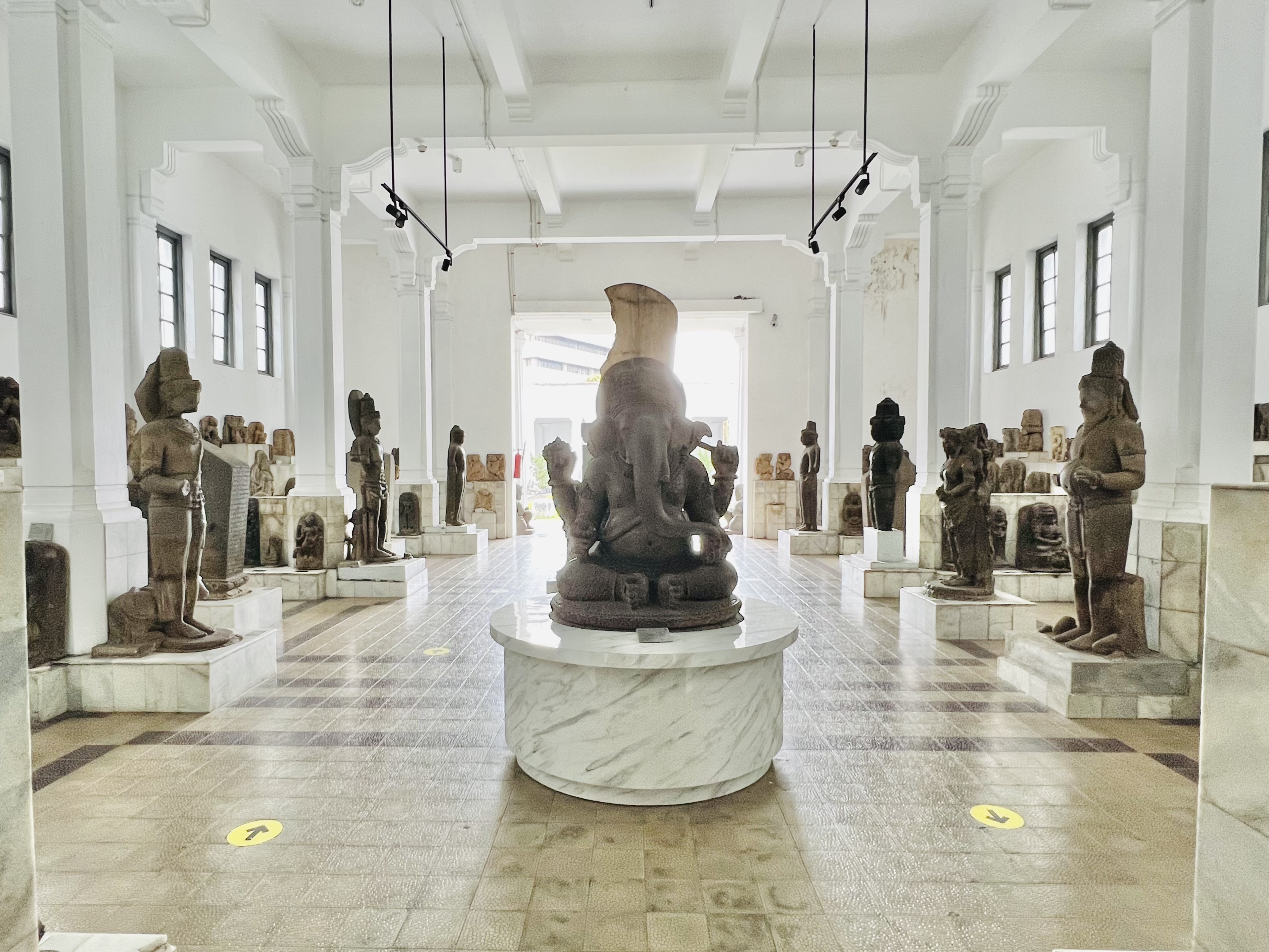
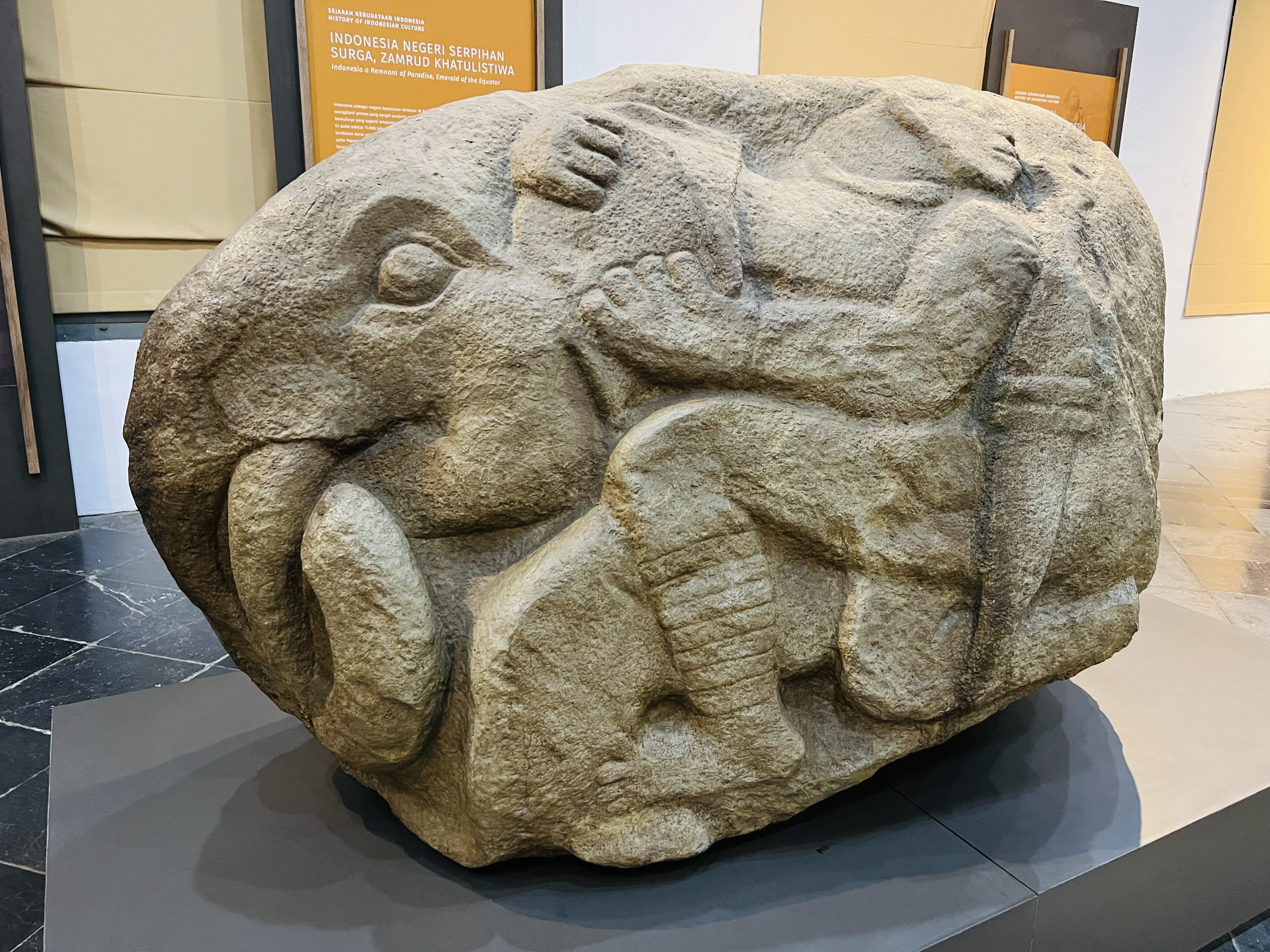
- From Pasar Baru, I went back to the MONAS area to visit the National Museum, located east of MONAS. It was established in the 1700s, and is the foremost institution in the study of Indonesian history and culture. The museum also has a new wing with more exhibits. Among the museums I visited in Indonesia, it was perhaps one of my favorites because it was the kind of detailed cultural exhibit that I always look for in a national museum (apart from the air conditioning!!)
 |
| So many Hindu-Buddhist statues OMG. |
 |
| Various Indonesian religious textile. |
 |
| Giant elephant carving. It's around more than 5-feet tall. |
 |
| Map of Indonesia with pictures of its different ethnicities. |
 |
| Traditional toy made from palm leaves. |
 |
| Museum. |
- I spent the rest of the late afternoon back in Kota Tua and going around Fatahillah Square. I found out that the square is even more alive at night with people just sitting on the square just talking and chilling with each other.
 |
| Fatahillah Square at dusk. |
- My first two days in Jakarta had been eventful, a good warm up for the bigger adventures to come in Indonesia. However, the places I wanted to visit the most were in the next leg of my trip to Indonesia - Yogyakarta!
- Don't forget to check out my other adventures in Indonesia this trip!!
Part 2 (Yogyakarta - Borobudur and Prambanan): here
Part 3 (Yogyakarta - Downtown): here
Part 4 (Jakarta - Glodok, Taman Mini): here