- Nov. 19, 2023, Sunday.
- Kyoto is an amazing place with a rather laid-back feel. However, it does have its own air of splendor as it was Japan's former capital of a thousand years (794AD to 1868). Because of that, Kyoto actually has too many places of interest. Most people I know often go to Kyoto for a day trip from nearby Osaka, but as a history and culture person I knew I had to take my time in Kyoto. There was just too much to see!
- That morning I hurriedly grabbed an Uber taxi to Hokan-ji. (By public transportation, you may ride a train to Kyoto Kawaramachi station and walk south, or to Kiyomizu-Gojo station, or Gion-Shijo station.) Hokan-ji used to be a temple from the 6th century AD, but only its 5-story pagoda remains. The neighborhood around Hokan-ji has traditional Japanese houses, which makes the area the perfect spot to make you feel like old Japan. Best tip is to go really early for good photos as there are other people who are also keen to get their perfect photos with the area. This includes wedding prenup photoshoots!
 |
| Entrance to the old streets. There were actually other people, my big bodehh just covered them! |
 |
| I love this rustic look. |
 |
| This is the main angle shown in most photographs or postcards. Too bad there was a bit of scaffolding behind me that sort of ruined the view. At least most of the pagoda can still be seen. |
 |
| This is the famous Starbucks at Ninenzaka Street. It's a Starbucks made to look like an old Japanese store. The food, however, is normal Starbucks. I wasn't able to eat/drink there since there were too many people (locals and tourists alike) having breakfast there. |
- From Hokan-ji I made my way to Kiyomizudera after a short walk. (If going directly, you may take the train to Kiyomizu-Gojo station). Built in 780 AD, the temple's name literally means "Pure Water Temple" because the water at the temple is said to be clear and pure. Some believe that the temple's waters have healing and wish-granting properties.
 |
| Fall at Kiyomizudera. |
 |
| To the ponds with holy water. |
 |
| Main temple. |
 |
| Kiyomizudera's iconic view. |
 |
| This is my personal kimono set by the way, so I didn't rent it like most of the tourists did. |
 |
| Just showing you how chaotic it always is at Kiyomizudera. |
- After visiting the temple I went to Sanjusan-gendo (Bus 206 or 208 to Hakubutsukan-Sanjusangendo-mae bus stop, or take the train to Shichijo station). This temple is named as such because of the 33 ("sanjusan" means 33 in Japanese) spaces between the columns of the temple. It was built in the 100s. This temple may be small but it is one of my favorites in Kyoto. I actually visited this temple in 2013 during my first trip to Japan, but I wanted to see it again, so I went anyway. Unfortunately, photography is not allowed inside. However, I must tell you that the main hall has seemingly infinite rows of golden Kannon statues with guardian deities standing in front of them.
 |
| A few proofs I have of visiting Sanjusangendo. |
 |
| Konnichiwaaaa. |
 |
| Walls from the outside. |
- I transferred hotels after my visit to Sanjusangendo. I checked in that early afternoon at Len Kyoto Kawaramachi, which is a cozy hostel near the lively (and touristy) Kawaramachi area. After a quick check-in, I rode an Uber taxi to Nijo Castle (but you can ride the train to Nijojo-mae station, which is beside the castle). Nijo Castle is famous for its Ninomaru Palace where one can experience stepping on the "nightingale floors" (unfortunately no photos/videos allowed in the Ninomaru Palace.) The wooden floors creak or chirp when someone walks on them. Some say this wasn't intentional, other claim that this was created as a security system as no one could walk the halls without being heard.
 |
| Palace entrance. |
 |
| Ninomaru Palace exterior, where the nightingale floors are. (Note: Nijo Castle isn't the only place that utilizes this early technology.) |
 |
| View from the Nijo Castle's observation deck. |
- A few blocks away from the Nijo Castle is the Kyoto Imperial Palace (or ride the train to Imadegawa station). It had been the official residence of the Japanese monarchy since the 1300s to the 1800s, when the capital was moved to Tokyo. The palace is occasionally used today for royal ceremonies. If not, the palace grounds are open to visitors.
 |
| The main hall peeking behind red pillars. |
 |
| Shishinden, or the Hall of Ceremonies. |
 |
| Seiryouden, the Hall for Rites and Rituals. |
 |
| With some objects used for rituals. |
- My feet were killing me (actually, it was more of my wooden geta slippers) by the time I finished walking, so I had to take a cab to the Heian Shrine (Heian-Jingu) (can take the train to Higashiyama station for those who wish to take public transportation). The Heian Shrine is a major Shinto shrine established in 1895. However, what is special about this shrine is that its architecture was based on an ancient Heian-era palace from centuries prior. As shallow as the reason is, one of the reasons why I love this shrine is because it's orange and green, a color pair that I love so much. Given more time, I would have loved to explore its vast Japanese garden (which requires a modest entrance fee.) But because I didn't have too much time, going around the main temple was enough for me.
 |
| Main gate to the Heian Shrine. |
 |
| Modeled after an ancient Heian palace. |
 |
| Look at the colors! Very me. |
 |
| Not sure what ritual was being done, but it was still cool to see! |
 |
| The sun was too bright OK. I could've smiled. Hahahaha. |
 |
| Giant torii gate. (Like, literally GIANNNNT.) |
- From the Heian Shrine, I passed by a bazaar in front of the temple and bought myself a more comfortable pair of geta, this time, with soft rubber soles. Thank goodness, because it would have been harder to walk a lot more if I had to wear my wooden geta for a lot longer.
- I soon found my way to the Yasaka Shrine, after several blocks of walking. (Take train to Gion Shijo train station, or Kawaramachi station.) The Shrine was founded in the 600s during the Heian era, and is known for the Gion Festival, which is a summer festival.
 |
| Shinto devotees. |
 |
| So many people. |
- I did not do much in the Yasaka Shrine, other than eat eat eat eat, and look at the nice things being sold in the marketplace in the temple grounds. However, after having almost 30,000 steps in a day, I think food is a good reward, no?
 |
| The 10-Yen cake. I actually thought it was worth 10-Yen, but it's called such because it only looks like the 10-Yen cake. The cake was worth 500 Yen. HAHA. It's like a pancake with some filling. The filling can be cheese, chocolate, or custard, depending on your choice. |
 |
| One of the entrances of the Yasaka Shrine. |
- From the Yasaka Shrine, I walked towards Kenninji Temple (closest train stations are Gion-Shijo Station and Kawaramachi Station). The Kenninji Temple is the oldest Zen Buddhist temple in Kyoto. The temple is also known for the twin dragon ceiling painting of Koizumi Junsaku. He made the painting in 2002 for the 800th anniversary of the temple.
 |
| One of the halls of Kenninji Temple. |
 |
| Junsaku's twin dragon ceiling painting. |
 |
| It is stunning. |
 |
| Zen garden. |
 |
| Trying to look serene. But I feel like, I just look constipated. |
 |
| The patterns on the rocks look hypnotic. |
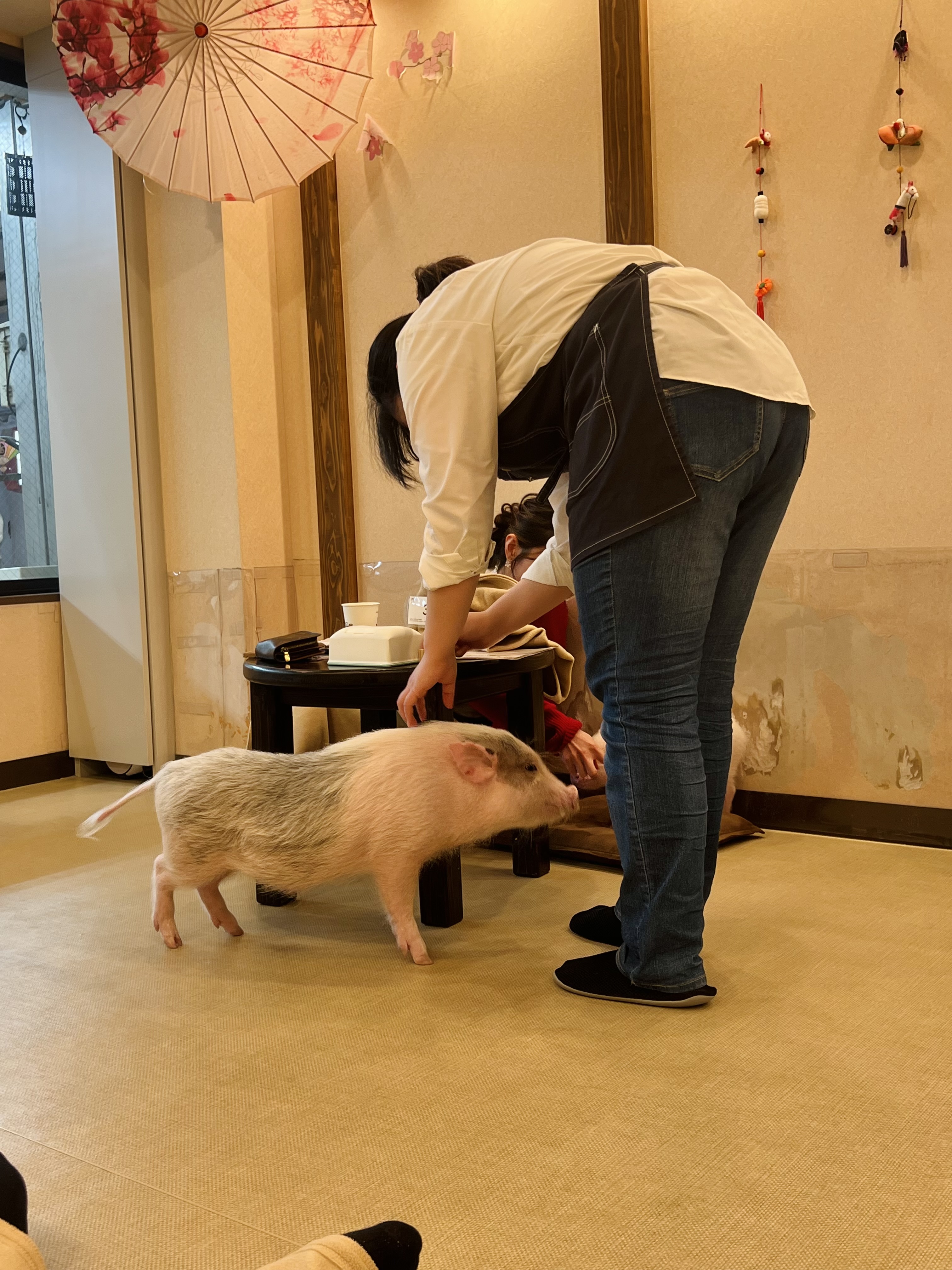
- I went back to my hostel after visiting the temple to finish my check in process, and to rest my feet after a day of walking in a kimono. That evening I got lost at Shinkogyoku Shopping Street (near Nishiki Market, near Kawaramachi Station) looking for the Mipig Cafe. The Mipig (Micro Pig) Cafe is a cafe where one can interact with pigs and have some (non-alcoholic) drinks. It truly is as remarkable as it sounds, and the best part is that Mipig Cafe has branches all over major cities in Japan (click here to see their official website.) Make sure to reserve your slot, and decide if you want to have a 30-minute or one-hour session since that is needed in the reservation.
 |
| MY HOME. <3 <3 <3 <3 |
 |
| PLEASE I WANNA TAKE THEM HOME. |
 |
| RUN LITOL PIGGY RUN. |
 |
| This big guy just took over. |
 |
| Ohana means family. |
- In Mipig Cafe, guests are supposed to sit down in their designated tables, and cover their legs with store-provided towels. The pigs will just approach the guests, and guests can pet the pigs (not carry or hug too tightly). Since I brought my pig hat, which I bought in Vienna some years back, the pigs probably thought I was one of them and they all ran to me.
 |
| PLEASE. |
 |
| This pig used my leg as a chin rest. I couldn't move my leg for a good while. |
 |
| That's me (left), and my new friend a pig (right). |
 |
| Family portrait. |
- Kyoto should truly be seen for more than a day because there are just so many things to see and do. It is a former capital after all! The only thing I didn't like too much about Kyoto was how spread out the tourist spots are, even those that are within the same area. However, this did not stop me from exploring the splendor of Kyoto. There was a lot more left to see!
** Check out the other legs of my Kansai trip!
Part 1 (Kyoto): here
Part 3 (Kyoto): here
Part 4 (Osaka): here
Part 5 (Osaka): here