- July 17, 2019, Wednesday.
- I went to Ghent at the advent of an event that led to my merriment becoming a lament, so I just need to vent. (Whew, that rhyming thing was tough!) This sums up my visit to Ghent. Don't get me wrong, I absolutely loved Ghent, but perhaps my timing was a bit off. Read on to find out why.
- Historically, Ghent was a progressive trading city and also known as the birth place of Charles V (Charles I of Spain,) and for the Filipinos, it is also the place where the national hero Jose Rizal published one of his two main novels - El Filibusterismo ("The Filibuster.") Today, Ghent (also known as "Gent" in Dutch or "Gand" in French,) is a popular day trip destination from Brussels as it only takes around 35-40 minutes by train. Just like in the Netherlands, pre-booking tickets for trains that go around the country are not necessary, so in our case, my mom and I just went to Brussels Centraal Station and bought day return tickets from the ticket counter (cash and credit are accepted) and hopped on the next train going to Ghent. Just like in the Netherlands, day return trips can only be bought if you're going back to the same station within the day; you cannot buy day return tickets if you plan to return to the same station on a different day. As for Ghent, note that there are two main stations in Ghent: Gent Dampoort Station and Gent Sint Pieters Station. Ideally, visitors should get off at Gent Dampoort as it is closer to the central part of the city. However, direct trains going to Gent Dampoort usually come from the Antwerp line. Trains coming from Brussels only stop at Gent Sint Pieters Station as there are no direct trains going to Gent Dampoort Station from Brussels. However, this should not be a problem. After getting off at Gent Sint Pieters Station, just take a tram 1 to Korenmarkt stop and from there, everything is walkable. The historical center of Ghent is so small, the tourist/historical spots are literally right beside each other. By the way, tram tickets can be bought at the tram stops. The ticket machines accept cash, but prepare coins to be sure.
- Once I reached Korenmarkt stop, I was amazed at how close everything was, though a bit suffocating as the buildings appeared too close to each other. However, I later realized that the reason I felt "suffocated" in the place was because all the open spaces were being turned into concert and event venues in preparation for the "Gentse Feesten" (Gent Festival,) an annual event that lasts around 10 days with concerts and other performances. Mini-festivals are also held within the same period, and so even open spaces a bit out of the center are also being converted to event venues. I suppose that on a normal day, I wouldn't feel suffocated as I could see how many public squares there are, usually right outside churches. Because of this, virtually every picturesque view has been "photobombed" by all these things (scaffolding, giant trucks, etc.) Of course, do understand that I am talking as a frustrated tourist who only had one day to see the city. However, I also understand that this is an annual tradition, and I appreciate how much Ghent - like many other European cities - honor and celebrate art in many ways, such as what Ghent does during Gentse Feesten. Despite this, I still found ways to appreciate Ghent.
- We first passed by the 13th-century Castle of Gerard de Devil (Geeraard de Duivelsteen.) This castle served as an armory among many other ways it was used throughout history, though it intrigued me when I found out that it was also used as an asylum at some point. It is currently not open to the public so I could only admire its Gothic beauty from the outside. By the way, the building was named after a knight named Geeraard the Devil, who was called such because of his dark skin.
 |
| Castle of Gerard de Devil. |
- Later on, we admired the beauty of the 13th-century St. Nicholas' Church and the 15th-century St. Michael's church across the bridge. The bridge between St. Nicholas' Church and St. Michael's Church, called St. Michael's Bridge ("Sint Michielsbrug") connects the banks of Korenlei and Graslei, the prettiest and most iconic view of Ghent - something you'd think came from a fairytale book. However, my view was a bit ruined by the cafe/restaurant floating extensions they built to accommodate more people for the upcoming festival. (I'd like to think that this is a reason for my to go back to Ghent some day, and hopefully I can time my trip better.) The Korenlei and Graslei quays were ports, which is why the buildings lined along the quays were significant in terms of politics or trade.
 |
| St. Nicholas' Church. |
 |
| St. Michael's Church. |
 |
| Graslei. But huhu the view. :( :( :( :( |
- A bit disappointed, my mom and I had a mid-morning snack at a Nepalese restaurant before going to Gravensteen a bit north of the center. The 12th-century Gravensteen (Castle of the Counts) was used as residential castle of the counts (hence its name,) but it was also used as a dungeon and court. The audio guides provided after purchasing tickets at the ticket counter not only give plenty of background information on the rooms and the objects found in each room, but it also gives instructions on which room to go next (and it's important because the castle has many ups, downs, which may make you get lost.)
 |
| Gravensteen. |
 |
| The canal outside the Gravensteen. |
 |
| From the courtyard. |
 |
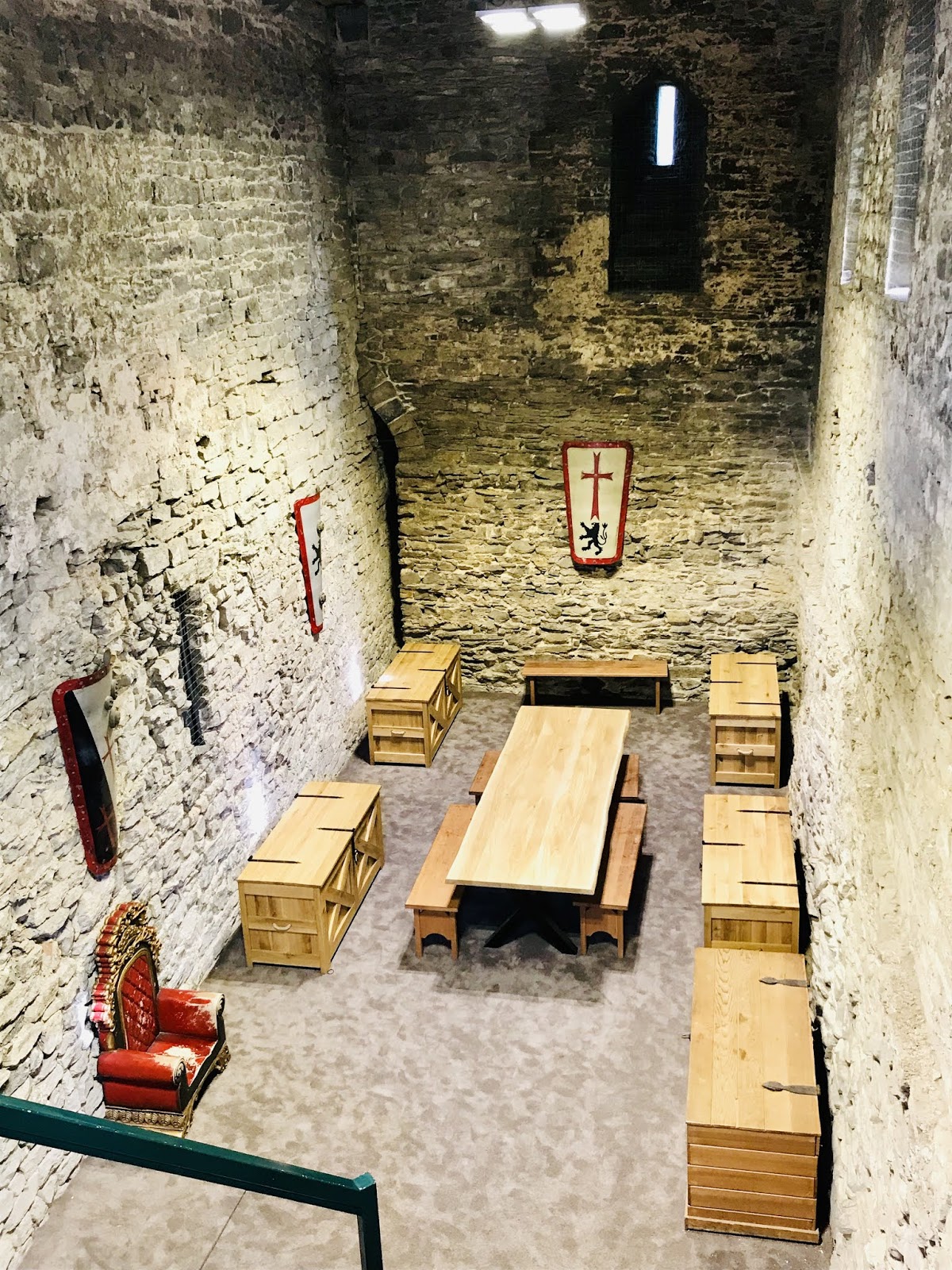
| One of the main halls. |
 |
| They're called "lovers windows." You will most likely become lovers with the person who sits across you (sigh, if love were that easy.) |
 |
| If you have see a lot of my previous posts, you'll notice that I have an affinity for crossbows. I just find them unique. |
 |
| Rooftop! |
 |
| Prince's residence. |
 |
| Dungeon. |
 |
| I like how it looks like a "typical castle," ones I used to see in my storybooks. |
 |
| At the outer wall. |
- After visiting the Graventeen, we walked around the city center taking photos at various spots. Speaking of taking photos, one hidden street is a popular spot for admiring street art and taking photos. Werregarenstraat, also known as "Graffiti Street," is, well, an alley that has graffiti made by different Belgian street artists. Although the colorful graffiti does give a different vibe to the "prim and proper" Ghent as seen in the city center, I felt that it was a bit "messy-looking" as compared to other places where graffiti and street art can be seen, such as Berlin's Easy Side Gallery in Germany (click
here to see.) Despite this, there was a rugged and liberated charm in the street's colorful chaos.
 |
| Korenlei Quay. |
 |
| At least the Korenlei side view still looks fine (the Graslei view is better though huhu.) |
 |
| Former meat hall. |
 |
| City view. |
 |
| You'll see this at the entrance of Graffiti Street. |
 |
| Beautiful chaos |
 |
| Atomium with faces. |
- We later visited the 11th-century St. James' Church (Sint-Jacobskerk), which is the oldest Romanesque church in this part of Belgium. However, due to renovations, we were not able to go inside. The church is located a bit north from the center, in a quiet but not sketchy part of town.
 |
| Sint-Jacobskerk. |
- It was a warmer the day we went to Ghent, and the temperature rose to the mid-20s. It was a perfect day to eat lunch al fresco - and mainly because we found a bakery that sold really cheap meals that included a thick foot-long sandwich with a drink of choice, but the bakery did not have chairs or tables. Thankfully there was a mini-park right behind St. Nicholas' Church where we could sit under a tree and eat. Eating al fresco isn't a thing in Manila because it's simply too polluted, and the weather's usually too hot or too rainy. The park also had a good view of the 14th-century Belfry of Ghent, which is the tallest belfry in Belgium.
 |
| Belfry of Ghent. |
 |
| I tried my best to look traditionally Belgian. |
 |
| The Shadshall or City Pavilion, a modern canopy of sorts, and the Belfry of Ghent. |
 |
| If you go around the Belfry's base, you're see this. Called the "Mammelokker," it shows the statue of a man who was sentenced to die of hunger, but survived because his daughter came everyday to breastfeed him. |
- After lunch we went inside St. Bavo's Cathedral, which was built in the 16th-century. It holds some amazing work of art, the most important of which is the Adoration of the Lamb (photography is not allowed inside the room with the Adoration of the Lamb.) The Adoration of the Lamb, wrapped in symbolism and artistic metaphors, is a multi-panel work of art.
 |
| Inside the spacious main hall. |
 |
| Main altar. |
 |
| Left: Belfry of Ghent, Right: St. Bavo's Cathedral. |
- Just before the day became even warmer, it was about time for us to head back to Brussels. Although I was half disappointed with my trip to Ghent mainly because a lot of the city's views were "ruined" by the people setting up for the Gentse Feesten, I liked the coziness of the city and the way it has preserved its grandeur through the centuries. Maybe next time I can visit Ghent again, because I really really do admire it, but perhaps at a time when no big festival is going on, so I can better see Ghent's beauty!
- Please don't forget to read all about my other adventures in the Netherlands, Belgium, and Luxembourg here!!
THE NETHERLANDS
Part 1, Amsterdam:
here, and
here
Part 2, Zaanse Schans:
here
Part 3, The Hague/Den Haag:
here
Part 4, Haarlem:
here
Part 5, Hoorn:
here
BELGIUM
Part 1 and 5, Brussels:
here, and
here
Part 3, Bruges/Brugge:
here
Part 4, Antwerp:
here
LUXEMBOURG:
here