- April 18-21, 2014, Friday to Monday.
- We had an early morning trip to the Piraeus (pier,) to catch our ferry to Mykonos, our first island in the Cyclades archipelago. The term "Cyclades" has been used by the Greeks to refer to the group of small islands in the middle of the Aegean sea; this group of islands is called as such because the positions of the islands roughly form a circle ("Cyclades" or "Kiklades" in Greek, comes for the word "kiklos" meaning circle; think of the word "circle" or "cycle.") All these islands have the same style of houses by order of law to preserve the "look" of the Cyclades architecture (blue-and-white houses, 2-stories the most, with small windows and doors) and are famous for their beaches, making them popular summer destinations for Europeans, as well as everyone else around the world. The most popular island from the Cyclades is probably Santorini; plenty of advertisements or references to Greece usually use photos shot in Santorini.
- We rode a three hour ferry to Mykonos from Athens, and we almost got off at the wrong port since we were not informed that the trip from Athens to Mykonos was not a direct one; good thing someone asked the usher, and told us that we had to get off after two more stopovers. Upon arrival, we were greeted by our guide upon arrival. We rode the bus to Ano Mera, the largest and central city of Mykonos. The island was small, so by the end of our "half-day" tour, we have seen "around 60%" of the island, according to our guide. Since it was Holy Week, and it still wasn't the peak season for Greece, going around Mykonos was fairly easy; it was very quiet, and relaxing because it had significantly less people. During the peak seasons, Mykonos is a "party island."
 |
| Cute child in the ferry. |
- We visited the Monastery of Panagia Tourliani in Ano Mera, but it was crowded with people because of the frequent Holy Week masses. While I was there, I wanted to look for a restroom, but instead found a quiet spot, and did an impromptu photoshoot.
 |
| Monastery of Panagia Tourliani, Ano Mera |
 |
| Found my own empty spot while looking for the restroom. Haha. |
- We went to see some beaches, and while I thought the Greek waters were amazing, my sister (who is a beach person, unlike me,) told me that the beaches in the Philippines were better. I don't think I could disagree though, but still, I felt that the Aegean Sea had its own personality, probably one that reflected Poseidon.
 |
| Octopus being dried. |
 |
| The "Hills of Aphrodite," and they are named that way for obvious reasons. |
 |
| A windmill near the beach. |
 |
| Twin churches of Agios Stefanos and Agios Giannis. |
 |
| A quick shoot. |
- Our bus went around the island until we reached Mykonos Town, the central hub of the island. We had to go by foot afterwards, since the streets were too small for cars; Mykonos Town was a maze of shops, cafes, and restaurants. We also visited the famous windmills at the far (but not really that far) end of Mykonos Town. The windmills were built in the 16th century, and were used to mill wheat. Today, the windmills are not being used anymore, but still serve as icons of the island.
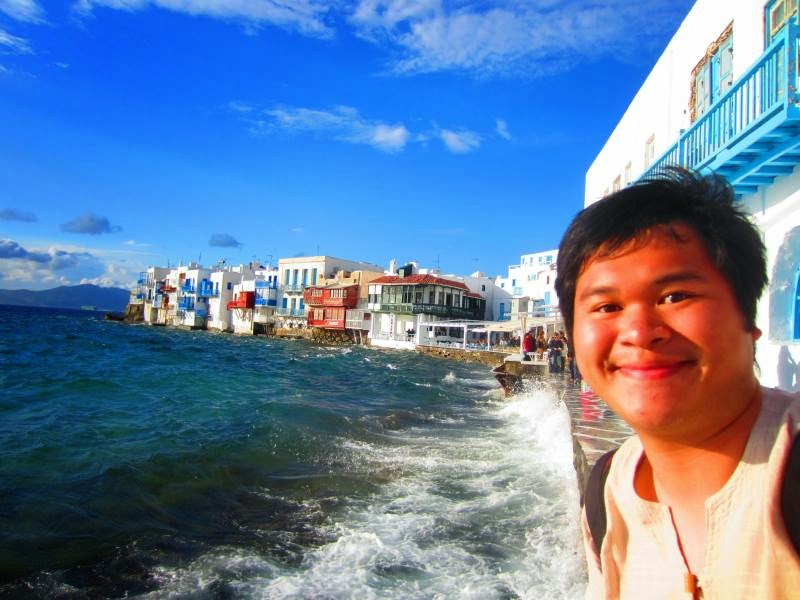
- On the way to lunch, we also had to pass by Mykonos' Little Venice, a group of Venetian-style structures that are mostly coffee houses and restaurants by the seaside. The taverna we went to was close to the Church of Panagia Paraportiani, an all-white church built in the 1400s, and another religious icon of Mykonos.
 |
| Windmills. |
 |
| Little Venice. |
 |
| Paraportiani. |
 |
| Quick shoot again!! |
- We walked all the way to our hotel after our late lunch, Porto Mykonos, and were left alone for the rest of the day. Our hotel was nice, but since it was built in a resort style, the rooms were built on separate buildings (by buildings, I still mean the two-story structure,) going from one part of the hotel to another was a bit of a hassle, but the view of the pier and Mykonos town from the hotel was nice anyway. Free wifi was available in all parts of the hotel, including the rooms.
 |
| View from out hotel. |
 |
| Spring love?? |
- My agenda for the afternoon was to do my photoshoot back at the windmills, and probably shop a little since the stores in Mykonos close later than the ones in Athens. On the way up the windmills, I saw a pelican named Petros, the official mascot of the island. The original Petros was a wild pelican saved by the people of the island in the 1950s. Petros passed away after a car accident, but since then, a few pelicans live on the island, and one of them was officially named Petros, the successor of the first pelican.
- While doing my photoshoot, the wind became a bit violent, good in such a way that it added some wind effect to my chlamys (a kind of cape used by Greek men) in the photos, but bad in such a way that the wind sometimes went opposite of the direction I wanted, and one dog even came, chased my chlamys, and almost ate my clothes while I was wearing them. Greek dogs (even the stray ones) were huge and fat; Greek cats were fluffy too. Besides these, the shoot was fairly easy to do because of the lack of big tourist groups, and it was nearing dinner time too.
 |
| Petros!! |
 |
| A "fan" from Greece. |
 |
| "Fans" from Singapore. |
 |
| Was trying to do this shot when the dog came and tried to eat my clothes. |
 |
| PETROS!! |
 |
| Little Venice and the Greek flag behind me. |
- After my long photo shoot, I passed by the bust of Manto Mavrogenous at the town square on the way back to the hotel. Manto Mavrogenous was a rich woman who used her wealth to help Greece during the Greek War of Independence in the 1800s.
 |
| Bust of Manto Mvrogenous. |
- We slept for a night in Mykonos, and had some free time in the morning before checking out for another ferry trip. I left the hotel early to explore Mykonos Town more. Fortunately, despite being Black Saturday (as the Holy Week is one of the most important religious holiday season in Greece,) most of the museums in Mykonos were open. The nearest museum from our hotel was the Mykonos Archaeological Museum. The small museum exhibited pottery, statues, jewelry, and other things excavated from Mykonos, and the archaeological island of Delos off the coast of Mykonos; we weren't able to go to Delos, so the archaeological museum was the "closest" I could get to appreciating Delos.
 |
| Inside the archaeological museum. |
 |
| Pottery with orientalist inspirations. |
 |
| Hercules. |
 |
| Trojan Horse!! |
 |
| Aphrodite. |
- I walked to the Mykonos Folklore Museum beside Paraportiani, but it was closed; too bad, I was very keen on visiting that museum. Now with more time on my hands, I decided to go deep into the heart of Mykonos Town to look for the Aegean Maritime Museum/ Nautical Museum. After getting lost for a few minutes, I found the small museum, still closed, and waited for the caretaker to arrive. He later came carrying two cups of Greek coffee, and opened the museum quickly when he saw that I wanted to visit the museum. Since I still am a student, I was able to avail the student discount, just like when I was in Hong Kong for a conference a month ago.
- The Aegean Maritime Museum exhibited models of different forms of aquatic transport since the early civilizations until the modern era. Other memorabilia, such as coins, seals (no, not the animal,) letters, telescopes, photos, compasses, and hats, were also there. It was a tiny museum, a bit difficult to locate, but it was very worth finding.
 |
| Fat cats. |
 |
| A nice small street on the way back to the port. |
- I met my family and the whole group just in time for lunch, and after that, we went to the port for our three-hour southward high-speed catamaran ride to Santorini. My goodness. The ferry ride was the worst ride I've had in any form of transportation, although it probably wasn't the captain's fault. It was an extremely windy afternoon, and the tides were high. The catamaran was going up and down, and I had a taste of what Elsa and Anna's parents went through in the movie Frozen. I had the brilliant idea of going to the restroom. Unsurprisingly, it was my worst trip to the restroom, and my pee was too scared and anxious to come out.
- I finally made my way back to my seat, and tried to sleep to prevent myself from being dizzy, and so I wouldn't think much about the very tidal trip. We wanted to rejoice upon seeing land, but like our trip to Mykonos, we had several stopovers before reaching Santorini. Well, at least we were able to rest our panic-stricken hearts during the short stopovers.
- After three long hours, we arrived at Santorini, alive and dizzy. As we were on our way to the exit, we saw a woman lying on the floor, puking in her barf bag, while a friend of hers tried to comfort her. The ferry ride was THAT bad (and again, it was most likely due to the strong winds and the big tides.)
- We were met by our local guide, and off we went to Oia to catch the sunset. Oia, read as "Ia" (/o/ + /i/ =
/i/ in Greek,) is home to the blue-domed churches that are usually used to promote tourism in Greece. While used as a Grecian symbol, the churches, as well as the name "Santorini," are both Italian in nature. The name "Santorini" came from "Sant' Irene" (Saint Irene.) Officially, it is known as "Thira," but "Santorini" is still the more popular name among tourists.
 |
| The central church. |
 |
| The photo spot. |
 |
| Sunset. |
 |
| On the way to the bus, right before the "incident." |
- Oia's small streets were a bit crowded that afternoon, and the sunset, I felt, was overrated. The sunset was nice per se, but it wasn't as special as all the other sunsets I've seen. It also wasn't comfortable watching the sunset with a billion other tourists.
- Our tour group got separated on the way back to the bus, because two families took a bit of their time in Oia, while my family and another one went ahead; our tour guide waited for the other two families. Just as we were nearing the parking lot, we took some normal photos, and realized that there was a group of Caucasian tourists, around twenty-somethings in age, who were trying to poke fun and annoy my family and the other family. We were not sure why, but after poking fun at us, they'd pretend to be very kind and come to us and ask where we were from. Since I was their last "victim," one girl approached me as we were about to leave and asked the same thing with her feign kind smile. She asked where I was from, and I asked her back after replying. She told me she was Greek, and so I talked to her in Greek in the most fluent basic Greek I could. Of course, her unpaintable face showed signs of surprise, confusion, dissonance, and a bit of admiration. She quickly told me that I spoke Greek well (again, I only knew basic Greek,) and went away full of shame. Honestly I was a bit unaware that this group of Greeks did their childlike ways to the other family, and possibly to other non-Caucasian tourists, until my family and the other family discussed about the matter after we made ourselves comfortable in our bus. It was a small victory for our group that day.
- We drove to Fira, the capital of Santorini, where many stores were, as well as our hotel, El Greco. El Greco looked like microcosm of Santorini, with many pools, sans the blue-domed churches. Free wifi was available throughout the hotel, even inside the rooms, and was a few minutes away from the Fira bus-and-taxi station by walking.
- Because the Greeks consider Easter to be their biggest holiday, there were some fireworks when midnight struck. Midnight masses and bell-ringing were also done in all Greek churches.
- Easter Sunday was full of surprises for me, at least. In the morning, we passed by the Orthodox Metropolitan Cathedral (the biggest church in Santorini) on the way to the cable car station to the old port, and back up via donkey (too bad I didn't have photos on the donkey since it was really difficult to take photos on a donkey going uphill.)
 |
| Orthodox Metropolitan Cathedral. |
 |
| Just like in the postcards. |
 |
| Fira. |
 |
| Some of Santorini's cave houses. |
 |
| A gypsy playing her accordion with her pet hedgehog. |
- After lunch, we headed to one of the black-sand beaches of Santorini; the beaches in Santorini have black san, because they came from the black volcanic ashes; present day Santorini, made up of five islands, used to be one big circular island, but a large volcano erupted, sank, and affected the whole island. This volcano erupts once in 20000 years, so they say, but Santorini has other smaller above-sea volcanoes too. Many Greeks claim that they prefer to swim in Mykonos because of the better-looking beaches instead of Santorini.
 |
| Reminds me of the flag of Estonia. |
- We were scheduled to have our wine-tasting after our short beach visit, but due to a slight error in coordination, the winery was closed because they did not like to serve wine on Easter Sunday. In another miscommunication with our group, the bus drove us directly back to Oia, instead of stopping by Fira to drop off people who wanted to shop in Fira, and drop by those who want to go to Oia in Oia. Since more people wanted to go back to Fira, I opted to stay behind. It was easy to travel in Oia anyway, and since it was the low season, taxis were easy to grab in case I missed the last bus going to Fira from Oia.
- Easter Sunday and a lazy afternoon meant that the nice photo spots in Oia were deserted. This was the nicest surprise of the day. I did my photoshoot there in peace. I did encounter a peculiar Russian couple, where the girl wanted the guy to take the "perfect" photo of her, since she was "obsessed with the location," as she said. The guy was probably not too good at handling a DSLR, so the girl was directing the guy throughout her own photoshoot. Whenever the guy would take a decent photo of her, the girl would give the guy a long and passionate kiss. This went on for around an hour or two. When I left Oia after my photoshoot, they were still there, taking photos and kissing.
 |
| "Fans" from Hong Kong. |
 |
| Successful shot. |
- I got back to the hotel after riding a cab (the last bus would arrive after sunset, and I didn't want that since I might be late for dinner at the hotel,) sun-burnt, and I learned that we would be able to go to the winery on Easter Monday morning, right before lunch.
- The winery was named Santo Wines, and is famed for making "Vin Santo," or the local dessert wine. Vin Santo was sweet and light, so I liked it. They also served Nykterinos, or nectarine wine, and dry wine.
 |
| Wine barrels. |
 |
| Vin Santo. |
 |
| Nykterinos, dry wine, Vin Santo. |
 |
| Fira and Oia. |
 |
| Oia from afar. |
- We had lunch afterwards in another small taverna, and went to the airport for our flight back to Athens. We had no choice but to take the ferry on the way to Santorini, since Mykonos did not have an airport of its own, and the only way to Santorini or Athens from Mykonos was through maritime travel.
- The flight back to Athens only took a mere 45 minutes.