- July 10, 2019, Wednesday.
- A trip to the Netherlands will never be complete without a visit to its famed windmills! Though Amsterdam has a few windmills across the city, they're mostly far from the historic center, and quite scattered. Kinderdijk, near the city of Rotterdam in South Holland, is probably the most ideal place to see many historical windmills within one area, but can be hassling to visit from Amsterdam as it requires multiple modes of transportation to get there. For those coming from Amsterdam, the best place to see historical windmills and experience local life and industries would be the neighborhood of Zaanse Schans (read as "Zaanse S-hans" with the "s" and "h" pronounced separately.)
- From Amsterdam Centraal, I went to the ticketing office to purchase round trip day-return long-distance train tickets to Zaanse Schans (conveniently, that's the name of the station too), though people who have credit cards with passcodes may simply opt to buy a ticket from the ticket machines found everywhere in the station. Do note that round trip tickets are only applicable if you're going and coming back WITHIN THE SAME DAY. If you wish to go to another place and come back on another day, you need to buy the tickets separately (i.e. buy a one-way ticket today, and buy another one-way ticket on the day you plan to come back.) One thing I like about traveling around the Netherlands is that its long-distance trains were so fast and efficient, and perhaps owing also to the shape of the Netherlands, going to another city would normally take around 30 minutes to an hour; Zaanse Schans is only a mere 15-minutes away from Amsterdam! From the train station, the windmills and all the attractions are just a short 15-minute walk.
 |
| Platforms of Amsterdam Centraal Station. |
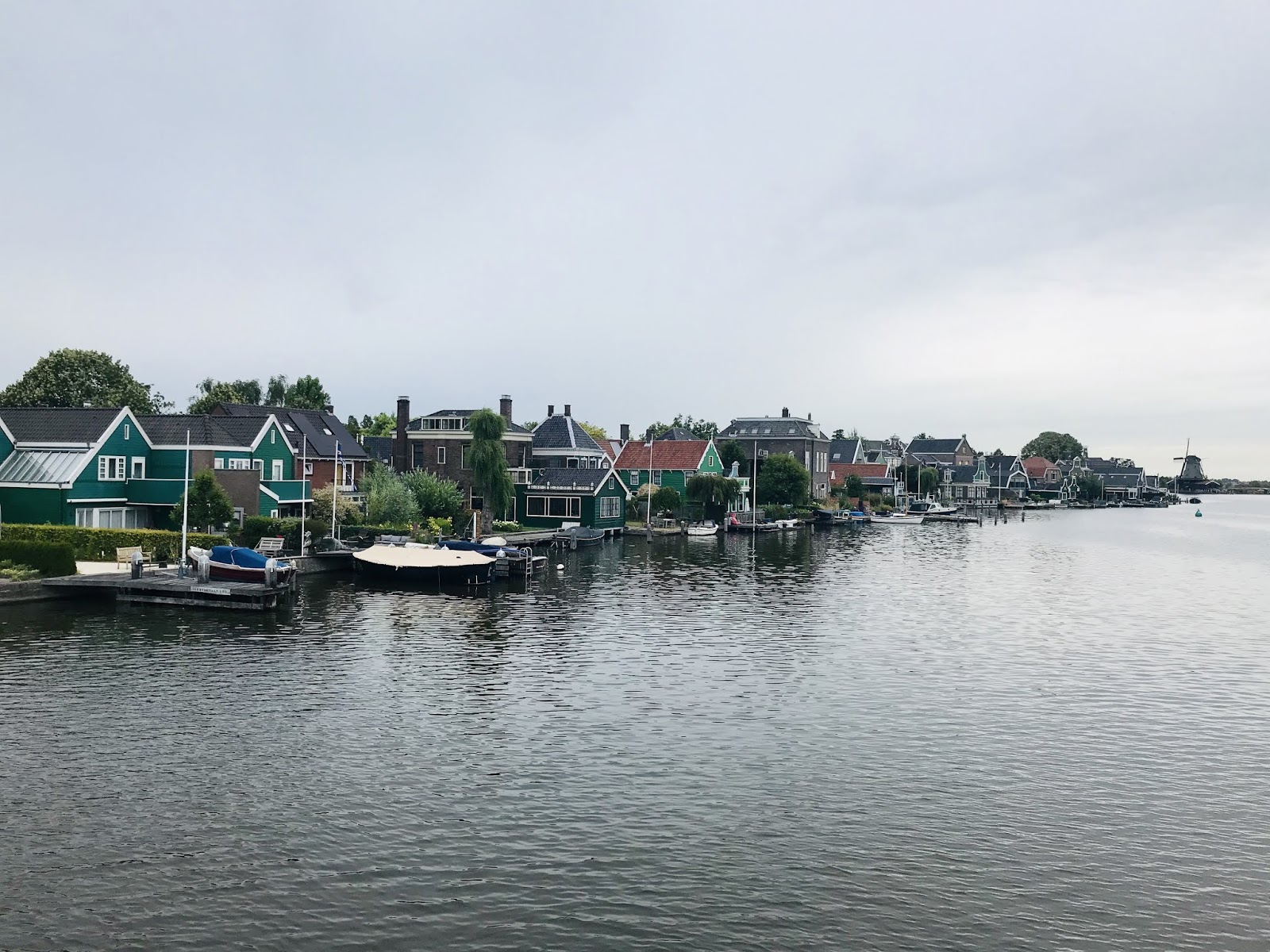
- Zaanse Schans is a neighborhood in the city of Zaandam across the village of Zaandijk in the municipality of Zaanstad - yes, apparently this area likes the letter "Z" at lot. Though this is technically a residential neighborhood, I'd call this a "pseudo theme park" because of what the place offers and how it is marketed. Apart from the windmills dating as far back as the 1600s and 1700s, there are workshops that show various local handicrafts, some museums that were opened around the 1990s, snack stalls, souvenir stores, a slightly fancy restaurant, and a few accommodations for those who plan to stay longer. There is no entrance fee to enter the area, but each attraction may need an entrance fee, so it would be better if you take a look at the map and decide which one's you're truly interested in if you're on a budget.
 |
| There are maps every few blocks from the train station to the neighborhood. |
 |
| The village of Zaandijk. |
 |
| See the windmills from afar? |
 |
| Saw this adorable traditional-style house. |
- One important tip I can give is to arrive REALLY EARLY. The attractions open around 9 or 10, and my mom and I were there around 7:30AM. We had the windmills all to ourselves for a long time before the tourists started rushing in. Speaking of windmills, ever wondered why they exist in the first place - and of all places, the Netherlands? Well first, there are different kinds of windmills that function in various ways, and the earliest ones existed somewhere in Egypt. However, the ones in the Netherlands and even neighboring Belgium function as machines that drain the land from too much water as these places are below sea level. Machines inside the windmill may also help grind certain things, such as mustard seeds, stones and plants to be made into dye, chocolate, and so on.
 |
| Please notice my traditional wooden clogs. HAHA. I bought them from a souvenir shop in Amsterdam the day before. Also, this is my rendition of a traditional Dutch costume, based on my research. |
 |
| These windmills can rotate, depending on where the wind is blowing from. |
 |
| Chicken on steroids. (I'm kidding!! Haha. But look how furry/fat its legs are!!) |
 |
| I went crazy when I saw these animals. I felt like I was 5 again. |
 |
| Peeping toms. |
 |
| My milkshake brings all the boys to the yard, and they're like, it's better than yours. |
- When the workshops opened, I visited the wooden-clog workshop since I wanted to know how the Dutch make them and why some of them wear these until today. (The best part about it was that entrance was free.) Apparently, there are so many types of clogs depending on region and occupation. They're worn mainly because they're durable, and especially for those who use them for working, protection. Before, it would take around 4 hours for a person to make just one pair of wooden clogs, but because of technology, a pair of clogs can be made in just a matter of minutes. Also, the perfect clogs should be slightly bigger, in such a way that your index finger can fit between your heel and the back of the clogs. (I'm glad I bought the right size from the souvenir store before knowing this!!)
 |
| As you can tell, this is the clog-making workshop. You can't miss it. HAHA. There are wooden clogs EVERYWHERE. |
 |
| Different types of wooden clogs. |
 |
| Clogs turned into fiddles!! |
 |
| Machines used to make clogs. |
 |
| 4 hours to make a clog - at least back in the day!! |
- We later visited one windmill, the one that makes dyes, as it is the only windmill left in the Netherlands that dedicates itself to grinding dye. I didn't realize how big the interior of hollow windmills was! The best part was going outside and seeing the view under the giant vanes (the paddle like structures going around)!!
 |
| This is outside the cheese store, by the way. Just had to go back and take another photo of this view. |
 |
| Cocoa seed juice. It tastes NOTHING like chocolate - more like lychee and lime combined (sweet and sour!!) |
 |
| The machines that make a windmill work. |
 |
| Giant windmill vanes!! |
 |
| More gears here and there. |
 |
| Dyes made inside the windmill. |
 |
| The stairs leading to the higher levels and the workshop where the dyes are made. |
 |
| Can't get enough of these windmills!! |
 |
| BUZZ BUZZ BUZZ. I AM A GIANT BUMBLEBEE. |
 |
| More traditional houses. Some are museums, some are cafes or souvenir shops, and others are people's homes. |
- We had lunch at the only restaurant in Zaanse Schans; it was a bit fancy but we needed a proper place to hide from the heavy noontime rain. I guess the restaurant was not too pricey, at least by Dutch standards, but I'd rather look elsewhere to eat even though the food was good. After lunch we rode the train to Zaandam station. Since Zaandam station is along the way of our Amsterdam-Zaanse Schans train route, we did not need to purchase a separate ticket.
- Zaandam is home to much history, as it was prominent in several industries like whaling or milling, but today it is known for its distinct old-meets-new blue-and-green buildings. Some of these peculiar-looking structures include the city hall and some surrounding government buildings, but the main eyecatcher of the city is Inntel Hotels Amsterdam Zaandam. It looks like a bunch of Dutch houses stacked on each other like blocks, giving it the nickname "lego house" or "lego hotel," after the Lego bricks. These green and blue houses are all located right outside the train station, so visitors do not need to go far. Apart from taking photos at these structures, visitors may also like to hang around the area as there are various stores and restaurants for those who'd like to shop or eat. By the way, speaking of eating, Zaandam was also the place where McDonald's first opened in Europe in the 70s!!
 |
| Inntel Hotels Amsterdam Zaandam. Just look at that!! |
 |
| I still can't believe it's an actual building. |
 |
| City hall. |
- We ended the day early and headed back to Amsterdam around 3pm, and rested the rest of the afternoon as we were still a bit tired from our long flight to Amsterdam a day before, and we were still adjusting to Amsterdam's timezone. However, we were just starting to warm up with our adventures in the Netherlands!! Next stop - the Hague!!
- Please don't forget to read all about my other adventures in the Netherlands, Belgium, and Luxembourg here!!
THE NETHERLANDS
Parts 1 and 6, Amsterdam:
here, and
here
Part 3, The Hague/Den Haag:
here
Part 4, Haarlem:
here
Part 5, Hoorn:
here
BELGIUM
Parts 1 and 5, Brussels:
here, and
here
Part 2, Ghent/Gent:
here
Part 3, Bruges/Brugge:
here
Part 4, Antwerp:
here
LUXEMBOURG:
here