- April 18, Thursday.
- When one thinks of Siem Reap, temples are the first thing that come to mind. While Siem Reap really is well-known for its endless temples, there are other places to see and experience in Siem Reap.
- On a happy sunny Thursday morning, I was whisked off by my tuktuk driver to see....the killing fields of Siem Reap, which now is occupied by a temple and memorial called Wat Thmey. Cambodia has more than a hundred killing fields all throughout the country. These existed during the mid-1970s Khmer Rouge Era, when the Cambodian genocide happened. Those who were suspected of defying communist rule, or being in touch with and form of capitalism, were tortured and eventually killed in masses. Today, apart from the temple with the bones of the victims that were found in the location, a photography exhibit on the communist era can be found, as well as an orphanage and school.
 |
| Wat Thmey. Look very closely because.... |
 |
| ....there are bones inside. |
 |
| Memorials. |
 |
| Pol Pot, the man responsible for the genocide. |
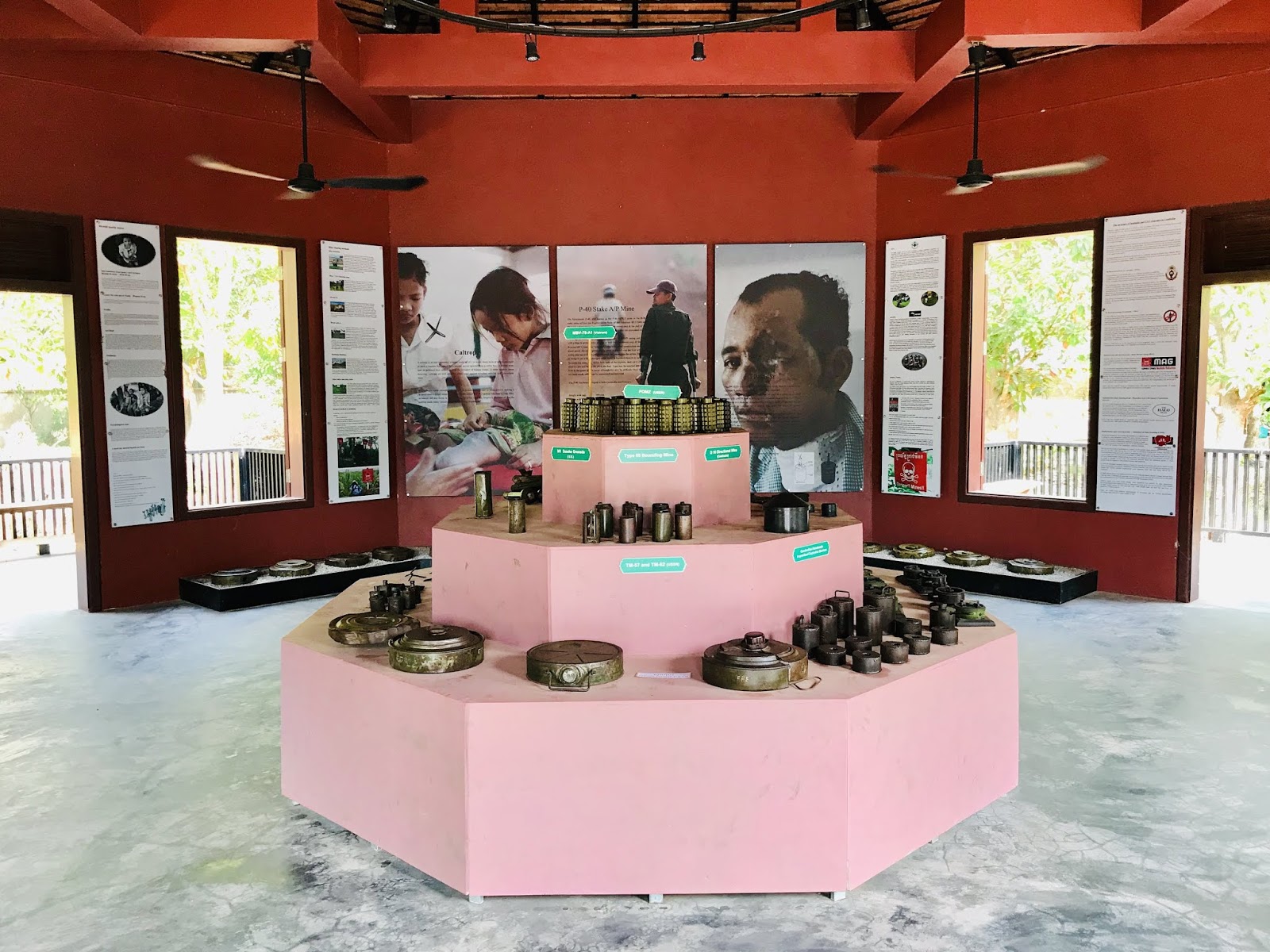
- From the killing fields, I was driven to the War Museum of Cambodia, which was opened in 1999. Some of the exhibit items were from World War II, but most were things that were used during the Khmer Rouge Era. This museum was also unusual as the exhibit is generally outdoors! Apart from guns, landmines, and other war-related stuff, the biggest items being exhibited were tanks, jeeps, and even a war helicopter!
 |
| A helicopter that has built-in guns!! |
 |
| War plane. |
 |
| Guns. |
 |
| War-era unifroms. |
 |
| Not sure if this is a real landmine warning sign or part of the exhibit. -____- |
 |
| Saw this fella hiding behind an ant's nest (or at least I think it's an ant's nest?) |
 |
| Landmine exhibit. |
- To lighten up my mood, I decided to visit the Artisans Angkor silk farm. Artisans Angkor is a social business organization that focuses on producing high-quality Khmer crafts. It has employed many Cambodians, especially those residing in the provinces, giving many Cambodians a source of income while preserving the cultural heritage of this royal country. The silk farm is one of the two main centers open to the public across the country, and is a good way to understand how Cambodia produces world-class silk. Apart from seeing the silkworms and their cocoons, I also appreciated how traditional weaving tools and techniques are being used. For me the most unique kind of silk products that they produce would be the "hol lboeuk"or those that combine the brocade embroidery and ikat (tie-dye) techniques. As two kinds of techniques are needed to finish "hol lboeuk" products, these of course would cost a lot more than usual silk products.
 |
| Silkworms. |
 |
| Cocoons. |
 |
| Silk-thread makers. |
 |
| A half-finished ikat silk cloth. |
 |
| A weaver ties a design using small pieces of rope on the thread that would be tie-dyed and woven later on. This is the ikat technique. |
 |
| Artisans Angkor - silk farm. |
- To end my morning tour, I visited the Cambodian Cultural Village. The village is actually a theme park opened in 2003 to celebrate the cultural diversity and historical legacy of Cambodia. It has a wax museum showing life-like figures of people in Cambodian history, villages representing each ethnic group in Cambodia, and an area with miniature of some significant Cambodian landmarks. Performances are held throughout the day, though I only saw the Khmer wedding ceremony (it's just a demonstration, not an actual wedding.) I do know, however that their most majestic show on King Jayavarman happens every Sunday night; too bad I wasn't able to see that!
 |
| Apsara at the wax museum. |
 |
| Lieou Ye, the probably first ruler of 1st-century Funan-era Cambodia. |
 |
| King Norodom Suramarit and Queen Sisowat Monivong, one of Cambodia's prominent royal couples in history. |
 |
| Traditional wedding demonstration. |
 |
| Scary giant Buddha head. |
 |
| Freaky Buddha balls on a tree. |
 |
| There were plenty of peacock statues/sculptures in the park. |
 |
| Giant reclining Buddha. |
 |
| Miniature Grand Palace; the original is located in Phnom Penh. |
 |
| Miniature Independence Monument, the original is also located in Phnom Penh. |
 |
| Traditional-style huts. |
 |
| So true. |
 |
| I wish my mind was at peace just like this frog. |
 |
| Entrance/exit. |
 |
| Main gate of the theme park. |
- After I was dropped off at my hostel, I big farewell to my friendly tuktuk driver who patiently drove me around Siem Reap in the unforgiving heat, and retreated into my air-conditioned hostel room for a while, until I decided to have lunch and visit the other main center of Artisans Angkor located in downtown Siem Reap. This other public center makes various types of sculptures and paintings. It was interesting to watch the students/employees turn a block of wood or stone into something holy, graceful, or just plain cute. By the way, this workshop does not only make sculptures as souvenirs, but this workshop has done big projects, such as restoring broken statues, doorways, and other carvings of ancient temples all across Siem Reap.
 |
| It takes great skill to get the shapes right. |
 |
| How a block of wood turns into a sculpture. |
 |
| I was temped to ask the sculptor if I could have this little piggy. HAHA. |
 |
| Painting on silk. |
- I once again hid in my hostel for a good hour or two until I felt the sun was not too harsh for a short walk around the area. I passed by the Made in Cambodia Market, which sells artsy and contemporary Cambodian souvenirs. It is located near the Siem Reap Art Center Market.
 |
| Made in Cambodia Market. |
- Later on, I found myself at Wat Preah Prohm Rath (sometimes spelled as Wat Preah Prom Rath.) This colorful temple which was built in the 1500s contains the statue of a reclining Buddha, which has been in the temple since the temple was built. Today, this tranquil temple is frequently visited by local devotees, as well as wandering tourists like me who stay near the area.
 |
| Buddha's encounters: an old man, a sick man, and a dead man. |
 |
| I would have wanted to do a photoshoot inside this colorful temple, until I realized that many of the stupas (not in the photo) are memorials. |
 |
| With plenty of Buddhist flags. |
 |
| Buddha inside the main hall. |
 |
| The historic reclining Buddha near the backdoor of the main hall. |
- That evening I had nothing much to do and wanted to just absorb much of Siem Reap's vibrant energy. As with previous nights, I did my rounds in the night markets, since it was my final night in Siem Reap, and although I nearly regretted my journey to Siem Reap because I almost died from the heat, I was still able to maximize my time in the ancient capital of Cambodia. Next stop - the modern capital of Phnom Penh!! (Read Part 1
here, Part 2
here, Part 3
here, Part 5
here, and Part 6
here!!)