- February 24, 2019, Sunday.
- Before anything else, I can assure you right now that the Philippines is an amazing country to explore, even though I haven't traveled much around the country in the recent years. The main reason why I haven't really gone around recently was because of too much eco-tourism and colonial-era tourism; for me, I personally would like to see more of the Philippines' indigenous cultures to learn more about "native" Philippine cultures, like what I did in Lake Sebu last year (click
here and
here). However, places such as Manila's Intramuros or Vigan City's Calle Crisologo that not only showcase but also immerse tourists in Spanish-colonial Philippines do interest me because they make me feel like I have traveled in time. This was why it did not take long for me to say yes when my dad asked the family if we wanted to go on a day trip to Bataan's Las Casas de Acuzar.
- Las Casas de Acuzar has always been on my local travel bucket list because it is a "heritage resort" currently has around 30 heritage houses mostly from the Spanish-era and a handful from the American-era, with some being used to host overnight guests. Those not used to host overnight guests function as museums, restaurants, and offices. The resort was the brainchild of Jose "Gerry" Acuzar, who started building the resort in 2003, and opened it to the public in 2010. Bataan itself is no stranger to historical sites as many events have happened in this province, and Las Casas just added more "history" to this land.
- After almost a 3-hour drive from the heart of Manila to Bataan, including a 1-hour breakfast stopover, we were finally able to reach Las Casas de Acuzar; Bataan isn't that far from Manila; after all, the Bataan Peninsula forms the northern frontier of the Manila Bay. The whole area of Las Casas de Acuzar was a lot smaller than I expected, but it wasn't underwhelming as the houses were still impressive. Imagine, all these houses were transported and rebuilt from nearby provinces and cities, most of which were about to be demolished, (mis)used by illegal settlers, or with parts even found in junk shops!!
 |
| Bienvenido as Las Casas the Acuzar!! (Welcome to Las Casas de Acuzar!!) |
 |
| Hotel de Oriente at the back. |
- After paying a 2500PHP entrance fee (full weekend rate), which includes a 500PHP food stub that can be used in any restaurant, one-hour tour, and use of other amenities (click
here for the Las Casas website), we were free to roam around the whole place. Just to avoid the harsh sun, we decided to take the 10AM walking tour of some houses. By the way, tourists can go around by riding a jeepney/shuttle for free, or the best way - by foot.
- We first visited Casa Biñan, from Biñan, Laguna. This 16th-century house was the house of the mother of national hero Jose Rizal, Teodora Alonso. This house was said to be a "tragedy" in preserving houses as the house that stands in Las Casas today is just half of the original house. The other half remains in Laguna today. This house is also familiar to some keen eyes as its courtyard was used as a filming location of the 2015 period film "Heneral Luna." Also, another part of Casa Biñan houses the resort's Italian restaurant.
 |
| Jose Rizal. |
 |
| Remember "Heneral Luna"? |
 |
| Rizal's sisters. |
 |
| Elias....o Simoun?? (Hello Noli Me Tangere and El Filibusterismo.) |
 |
| You know those usual looking-out-the-window-from-some-old-house paintings? Yeah, that's the inspiration. |
 |
| Casa Biñan. |
- Two doors away, is Casa Quiapo from Quiapo, Manila. It used to be located along Hidalgo Street, which today is still filled with poorly-maintained heritage houses. This house from the mid-1800s was the first building of the University of the Philippines, particularly its School of Fine Arts. Today, the building houses some contemporary traditional-themed artwork by Filipino artists. Some national artists like Fernando Amorsolo and Carlos "Botong" Francisco studied arts in this particular building decades ago.
 |
| UP seal. |
 |
| Interior. |
 |
| Replica of a page from the Boxer Codex. The Boxer Codex is a book from the late 1500s that has illustrations of the different indigenous people and migrant communities in the country. |
 |
| Artttt. |
 |
| Photographs of Aetas. |
 |
| Casa Quiapo, also known as Casa Hidalgo. |
- From Casa Quiapo, we passed by Casas Bizantina and Casa Mexico. Casa Mexico, from Mexico, Pampanga, has an interesting story. Its parts were found in a junk shop, and it was reconstructed based on the only surviving photo of it. Casa Bizantina from the late 1800s was a house from the heart of Binondo, Manila that turned into a school, and eventually, a house for informal settlers. The name comes from the word "Byzantine" as the building borrows certain Byzantine architectural styles. Today, the Casa Bizantina is one of the houses that hosts overnight guests, so we were not allowed inside. (By the way, can I just say how expensive a night's stay in any of the houses is. The cheapest stay in a basic room would cost around 10,000PHP - what more if you book the whole heritage house.)
 |
| Casa Bizantina. |
 |
| Casa Mexico. |
- We later visited Casa Luna, built in the mid-1800s, and named after the famous Luna Brothers (Juan and Antonio,) as their mother was related to the owners of the house. The most prominent part of the house was called the "volada," or the corridor/passageway used by the "aliping sagigilid" ("slaves" who lived in the house of their masters; the term "slave" here is not an exact counterpart of the slaves in the Western world.)
 |
| Heroes' busts. |
 |
| "I'm an alipin 4 u." - Spanish-era Britney Spears. (Also, we had to remove our shoes whenever we'd visit a house.) |
 |
| Various woodworks. |
 |
| Old ice crushers for halo-halo/ |
 |
| View from Casa Luna. |
 |
| Casa Luna. |
- Finally, we visited Casa Lubao, from Lubao, Quezon. This young house, being built in 1920, was owned by the Arrastria family who put through a then-penniless Diosdado Macapagal to school. Of course, for those of you from the Philippines reading this, you'd know that Diosdado Macapagal later became the 9th president of the Philippines and is the father of 14th president Gloria Macapagal-Arroyo.
 |
| Passed by Hotel de Oriente, which used to be located in Binondo. It used to be the country's top hotel, and was second to have a telephone after the Malacanang Palace. |
 |
| "Ito....ang Bayan ng San Diego." (Or at least that's how I imagined this town from Noli Me Tangere would be.) |
 |
| Casa Lubao. |
- To cap off the tour, we were invited to watch a short presentation/play about the sufferings of the Filipino people during the Spanish era (I'm not sure how this will go if Spanish visitors would see this. Then again, the play was in Filipino so they might not understand.)
 |
| Rizal's mother. |
 |
| The shooting/death of Rizal. |
 |
| Finale. By the way, this is the courtyard of Casa Biñan (yes, the place where "Heneral Luna" filmed.) |
- While waiting for our turn to eat at Casa Unisan, which houses the resort's Filipino restaurant, I had some time to roam around and take photos. I visited the church in the middle of the river, Santuario de San Jose, saw the river-side view of Las Casas, and even took a photo with one of the old trams from the bygones of Manila that would go to Tutuban and Binondo! (What has happened to transportation in Manila, huhu.)
 |
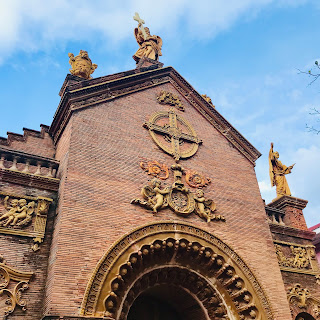
| Santuario de San Jose. |
 |
| River-side view. |
 |
| Tram!! |
 |
| Oh, and there were calesa rides too. |
- After lunch we had a long scenic stroll back to Casa Alcuaz, which now serves as the resort's reception and ticketing house. We passed by the Lola Basyang Statue, and the bridge with Philippine mythological creatures that have appeared in Lola Basyang's stories like the kapre (giant tobacco-smoking creature) and the tikbalang ("werehorse" or as I like to call it, a "reverse centaur.") We also passed by the Casa Ladrillo, which interestingly was a house only found in a century-old blueprint but was never built. There were also canals between houses that reminded me a lot of the ones in Venice (see and compare
here). I was about to give-up walking because the afternoon sun had become too proud of itself, but thankfully an empty resort jeepney appeared out of nowhere and took us back to Casa Alcuaz (again, resort shuttle/jeepyney rides are free.)
 |
| Lola Basyang telling stories to children. Lola Basyang, however, wasn't a real person, and was just a pen name of Severino Reyes. Severino Reyes, who by the way was a boy, was a founder of the Liwayway magazine where the Lola Basyang stories would be featured. |
 |
| The Lola Basyang Bridge. |
 |
| Casa Hagonoy, from Bulacan. I actually wanted a photoshoot with this house but there were too many eyesores around the house that time - including a sprinkler. |
 |
| Casa Ladrillo. |
 |
| Casa Lemery, from Batangas. |
 |
| I should have done a photoshoot here, #regrets. |
 |
| Just like Venice. |
- My dad was all set to go back home, I had one special request. Throughout grade school, my history and social studies books would always talk about the "Dambana ng Kagitingan" (Shrine of Valor,) also known as the Mount Samant National Shrine, which I had never seen in my life. It was made in the 1960s by former President Marcos to honor Filipino and American soldiers who fought against the Japanese forces in World War II. On the way to the shrine, which was a few mountains away, I noticed that the roads were filled with Death March markers, marking the route of the Bataan Death March where tens of thousands of soldiers were forced to walk from Bataan to Tarlac (which was a really long journey on foot by the way) by the Japanese in 1942.
- I got to Mount Samat in no time as there wasn't any traffic in Bataan - it was a good breather from what I'm used to in Manila. The Dambana ng Kagitingan was a larger-than-life cross on a mountain, and visitors may explore the grounds including taking the elevator up the cross after paying a 30PHP entrance fee. Since my parents coudln't walk up the flights of stairs BEFORE reaching the elevator, we just appreciated the cross from the outside, and just went inside the shrine's small museum on World War II.
 |
| Dambana ng Kagitingan. |
 |
| A better angle. Thank you wind for cooperating. |
 |
| All about the war. |
 |
| Japanese-era uniforms. |
 |
| Flags. |
 |
| Another Japanese-era uniform. |
 |
| "Mickey Mouse Money" bills issued by the Japanese government. These were bills that had no real value. |
 |
| Altar. |
- On the way back to Manila, I had some rest in the car, before stopping over for dinner. Surprisingly we didn't arrive home too late in the night, which my family usually does (and which I hate.) I don't normally like day trips or super short trips, and despite certain person concerns about Philippine tourism which I had stated above, I had no regrets saying yes to this day trip to Bataan. I do hope to have more chances to rediscover more of the Philippines in the near future, especially places that can shed more light on early/pre-colonial Philippine history, which not many Filipinos know about.