- Dec. 1, 2018, Saturday.

- What's the first thing that comes to mind when you think of Indian dancing? Unless you've seen one, or are exposed to Indian culture and society, you probably have wrong impressions of what Indian dances are. Most people I talk to usually bring up "belly dancing," which isn't actually Indian at all!! (Its roots are in West Asia and North Africa.) "Indian dance" is actually an umbrella for a variety of folk and classical/court dances that originate from the different regions of India, one of which, is the ancient-but-still-popular South-Indian dance called "Bharatanatyam." These dances, for me, are important vehicles of culture, as they not only teach performing arts, but they also carry other aspects of culture like language, music, clothing, literature, history, and much more. Here in the Philippines, there is only one Indian dance school that strives to share the art of this dance, especially to Indians who are far away from the motherland - Natya Mandala. This school is headed by the award-winning Bharatanatyam and Kuchipudi dancer, Mrs. Shanti Sreedhar.
- I have personally seen performances by Natya Mandala throughout the years, the first one being in 2013, during the 150th birthday of Indian thinker and revolutionalist, Swami Vivekananda (click
here to see). This time, Natya Mandala is staging an "Arangetram" of one of its young but talented students, 13-year old Roshni Sandhu. It was held at the University of the Philippines Diliman's Aldaba Hall. An "Arangetram," which means "ascending the stage," is a kind of rite of passage ceremony in the world of Indian classical dance. It is a debut solo performance by a disciple; think of it as the solo performances students of music conservatories do, or solo exhibits that art students organize before they graduate. How long does it take before a student can do an "Arangetram" performance? Well, for Roshni, it took 7 years under the tutelage of Mrs. Sreedhar; she started when she was 6 years old, and never stopped learning and persevering. Once the student or disciple has successfully done this performance, the student "graduates" a level and can actually perform by themselves. However, in order for them to professionally teach or choreograph, they have to continue learning and understanding other principles and nuances of the dance form. They must learn other forms of "margams," or the traditional path of the Bharatanatyam repertoire; it is a course or a set in which several Bharatanatyam numbers are arranged in a particular way.
 |
| A well-decorated venue. |
 |
| Like I said, well-decorated. |
 |
| Had to dress for the event, in a pink South-Indian kurta with an orange dupatta. Upon entering, the welcoming committee had to put tilak marks on the visitors' foreheads (the red dot.) Thank you also Mrs. Sreedhar for inviting me! |
- This Arangetram was not only a milestone for Natya Mandala and Mrs. Sreedhar, but also for the Indian community as a whole. It was attended by many big names, such as His Excellency Jaideep Mazumdar (ambassador of the Republic of India to the Philippines,) Dr. Ramon Acoymo (Program Director of the Cultural Center of the Philippines National Music Competition for Young Artists (NAMCYA); and Member and Chair of the Philippine Commission on Higher Education (CHED) Technical Panel for Music,) and Dr. Ramesh Subramaniam (director general of the Asian Development Bank). This was a big deal with the community since preserving and passing on culture and traditions to the younger generation is not only a general challenge for many societies, but there is an added layer of complexity when it comes to overseas/diasporic communities. It is because overseas or diasporic communities always need to negotiate and recognize their in-betweenness; they negotiate identities, ideologies, space, opportunities, and so on. (This is significant especially for overseas Indians, many of whom become twice- or thrice-migrants in their lifetime.) By having this Arangetram performance, it shows that there are still people like Roshni who are lights of hope when it comes to not forgetting their roots despite living in a foreign place. ("Roshni," by the way, means "light" in some Perso-Indian languages.) Natya Mandala's students, however, are not only limited to Indian students, but also Filipinos and non-Indian foreigners who are also enthusiasts of Bharatanatyam.
 |
| Our beloved emcee, and in front of the podium are statues of Shiva (in his Lord of the Dance or "Nataraja" form), and Ganesh, the Lord of Knowledge and Remover of Obstacles. These two Hindu gods are very important for those excelling in performing arts. |
 |
| The event's VIPs, including the parents of Roshni. |
- Bharatanatyam is a difficult dance to master. This dance, which is more than 2000 years old, was originally danced by temple dancers or "devadasis" in what now is the southern Indian state of Tamil Nadu. Like many classical dances in India, the techniques, rules, and principles are drawn from the Natyashastra, which is an ancient book/manual on dance and performing arts. The manual does not only teach postures or poses, but specific guides on rhythm, footwork, expression, costume and jewelry, and my favorite, the hand gestures. The hand gestures all symbolize certain things, which is why those who have some knowledge of these gestures can make out a story from the dance even though the dances does not say anything. (The song that accompanies the dance can help too, at least, for those who can understand the language used in the songs.)
 |
| I may not be a professional dancer, but I can say that the emotions that she showed during her dances very sincere and convincing. |
 |
| This is the standard Bharatanatyam costume by the way. |
 |
| Was trying so hard to take a shot of this, since this is one of the most popular postures of Indian dance. This posture shows the Shiva Nataraja dance. There is a photo of him above, compare Roshni's posture with the statue's posture. |
- Though most Bharatanatyam numbers tell stories, there are also some numbers which are quite abstract since the focus would be on the postures and rhythm. However, the ones that tell stories interest me the most. Stories in Bharatanatyam numbers usually come from Hindu tales, such as the "Churning of the Ocean" or scenes from the Ramayana and Mahabharata.
 |
| Her second costume fort he night. Pay attention to the hair details. |
 |
| To those like me who did not know Roshni personally, one would think that she was not a 13-year old girl simply because she was able to show emotional maturity in he performances. |
 |
| She was supposed to portray the god Krishna in this number. |
 |
| Bharatanatyam costumes are also known for their "fans" between the dancers' thighs. |
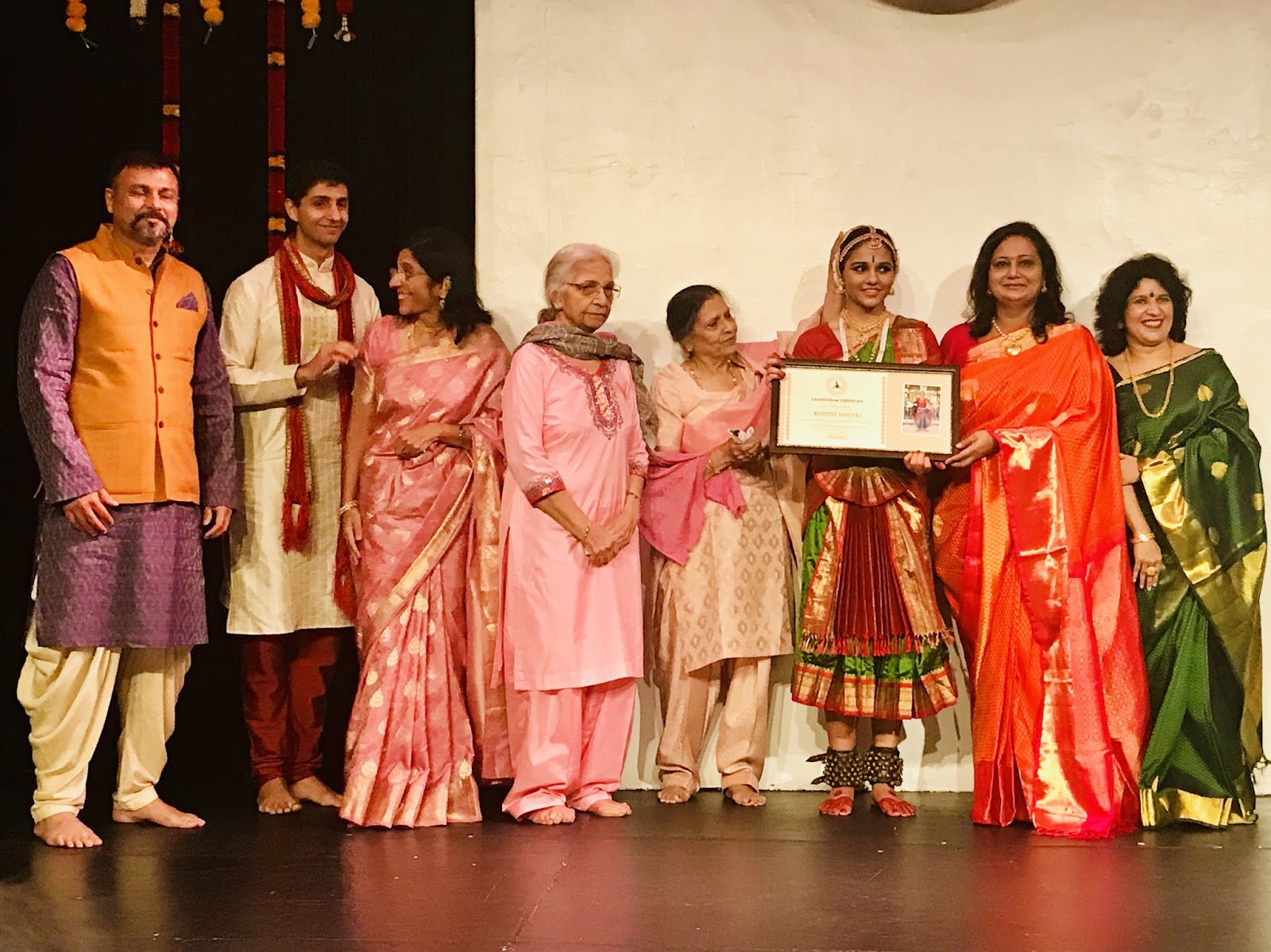
- After all the impressive dance numbers, Roshni was finally awarded with her certificate. However, this does not mean that she should stop dancing and learning from Mrs. Sreedhar. This Arangetram was only Roshni's stepping stone in becoming a better dancer, setting an example of perseverance and maturity not only to young Indians, but to the youth in general.
 |
| It is common for Indian students to bow like this as a way to pay respect to their guru. (This is also done to people that one would perceive as highly respectable, like an elderly family member or a monk, etc.) |
 |
| Student and Teacher. |
 |
| Roshni and her proud family members. |
 |
| The proud grannies in pink. |
- The night ended with a sumptuous Indian vegetarian buffet dinner. It had been a while since that last time I had Indian food, and so you could just imagine how happy I was to see naan, daal, pani puri, and other dishes that I longed to eat for many months now. I was also glad that I had time to catch up with the ambassador himself, H.E. Jaideep Mazumdar, my Hindi-language teacher Mrs. Goswami whom I have not seen in a couple of years now, and my student Sparsha.
 |
| With H.E. Jaideep Mazumdar and his wife, Mrs. Parvati Mazumdar. |
 |
| Didn't know that Mrs. Sreedhar and I wore matching attires. Pink and orange were the colors of the night!! |
- There is always an unexplainable happiness whenever I attend cultural events like Roshni's Arangetram by Natya Mandala. Perhaps, this is because I too come from another diasporic community, and so I can relate to the significance of staging these kinds of performances. With people like Roshni and Mrs. Sreedhar, and with institutions like Natya Mandala, some aspects of Indian culture are now more accessible to the Indian community here in the Philippines, and more people in the Philippines will have the opportunity to explore and experience other cultures as well!!