- What's the first thing that comes to mind when you think of Indian dancing? Unless you've seen one, or are exposed to Indian culture and society, you probably have wrong impressions of what Indian dances are. Most people I talk to usually bring up "belly dancing," which isn't actually Indian at all!! (Its roots are in West Asia and North Africa.) "Indian dance" is actually an umbrella for a variety of folk and classical/court dances that originate from the different regions of India, one of which, is the ancient-but-still-popular South-Indian dance called "Bharatanatyam." These dances, for me, are important vehicles of culture, as they not only teach performing arts, but they also carry other aspects of culture like language, music, clothing, literature, history, and much more. Here in the Philippines, there is only one Indian dance school that strives to share the art of this dance, especially to Indians who are far away from the motherland - Natya Mandala. This school is headed by the award-winning Bharatanatyam and Kuchipudi dancer, Mrs. Shanti Sreedhar.
- I have personally seen performances by Natya Mandala throughout the years, the first one being in 2013, during the 150th birthday of Indian thinker and revolutionalist, Swami Vivekananda (click here to see). This time, Natya Mandala is staging an "Arangetram" of one of its young but talented students, 13-year old Roshni Sandhu. It was held at the University of the Philippines Diliman's Aldaba Hall. An "Arangetram," which means "ascending the stage," is a kind of rite of passage ceremony in the world of Indian classical dance. It is a debut solo performance by a disciple; think of it as the solo performances students of music conservatories do, or solo exhibits that art students organize before they graduate. How long does it take before a student can do an "Arangetram" performance? Well, for Roshni, it took 7 years under the tutelage of Mrs. Sreedhar; she started when she was 6 years old, and never stopped learning and persevering. Once the student or disciple has successfully done this performance, the student "graduates" a level and can actually perform by themselves. However, in order for them to professionally teach or choreograph, they have to continue learning and understanding other principles and nuances of the dance form. They must learn other forms of "margams," or the traditional path of the Bharatanatyam repertoire; it is a course or a set in which several Bharatanatyam numbers are arranged in a particular way.
A well-decorated venue.
Like I said, well-decorated.
Had to dress for the event, in a pink South-Indian kurta with an orange dupatta. Upon entering, the welcoming committee had to put tilak marks on the visitors' foreheads (the red dot.) Thank you also Mrs. Sreedhar for inviting me!
- This Arangetram was not only a milestone for Natya Mandala and Mrs. Sreedhar, but also for the Indian community as a whole. It was attended by many big names, such as His Excellency Jaideep Mazumdar (ambassador of the Republic of India to the Philippines,) Dr. Ramon Acoymo (Program Director of the Cultural Center of the Philippines National Music Competition for Young Artists (NAMCYA); and Member and Chair of the Philippine Commission on Higher Education (CHED) Technical Panel for Music,) and Dr. Ramesh Subramaniam (director general of the Asian Development Bank). This was a big deal with the community since preserving and passing on culture and traditions to the younger generation is not only a general challenge for many societies, but there is an added layer of complexity when it comes to overseas/diasporic communities. It is because overseas or diasporic communities always need to negotiate and recognize their in-betweenness; they negotiate identities, ideologies, space, opportunities, and so on. (This is significant especially for overseas Indians, many of whom become twice- or thrice-migrants in their lifetime.) By having this Arangetram performance, it shows that there are still people like Roshni who are lights of hope when it comes to not forgetting their roots despite living in a foreign place. ("Roshni," by the way, means "light" in some Perso-Indian languages.) Natya Mandala's students, however, are not only limited to Indian students, but also Filipinos and non-Indian foreigners who are also enthusiasts of Bharatanatyam.
Our beloved emcee, and in front of the podium are statues of Shiva (in his Lord of the Dance or "Nataraja" form), and Ganesh, the Lord of Knowledge and Remover of Obstacles. These two Hindu gods are very important for those excelling in performing arts.
The event's VIPs, including the parents of Roshni.
- Bharatanatyam is a difficult dance to master. This dance, which is more than 2000 years old, was originally danced by temple dancers or "devadasis" in what now is the southern Indian state of Tamil Nadu. Like many classical dances in India, the techniques, rules, and principles are drawn from the Natyashastra, which is an ancient book/manual on dance and performing arts. The manual does not only teach postures or poses, but specific guides on rhythm, footwork, expression, costume and jewelry, and my favorite, the hand gestures. The hand gestures all symbolize certain things, which is why those who have some knowledge of these gestures can make out a story from the dance even though the dances does not say anything. (The song that accompanies the dance can help too, at least, for those who can understand the language used in the songs.)
I may not be a professional dancer, but I can say that the emotions that she showed during her dances very sincere and convincing.
This is the standard Bharatanatyam costume by the way.
Was trying so hard to take a shot of this, since this is one of the most popular postures of Indian dance. This posture shows the Shiva Nataraja dance. There is a photo of him above, compare Roshni's posture with the statue's posture.
- Though most Bharatanatyam numbers tell stories, there are also some numbers which are quite abstract since the focus would be on the postures and rhythm. However, the ones that tell stories interest me the most. Stories in Bharatanatyam numbers usually come from Hindu tales, such as the "Churning of the Ocean" or scenes from the Ramayana and Mahabharata.
Her second costume fort he night. Pay attention to the hair details.
To those like me who did not know Roshni personally, one would think that she was not a 13-year old girl simply because she was able to show emotional maturity in he performances.
She was supposed to portray the god Krishna in this number.
Bharatanatyam costumes are also known for their "fans" between the dancers' thighs.
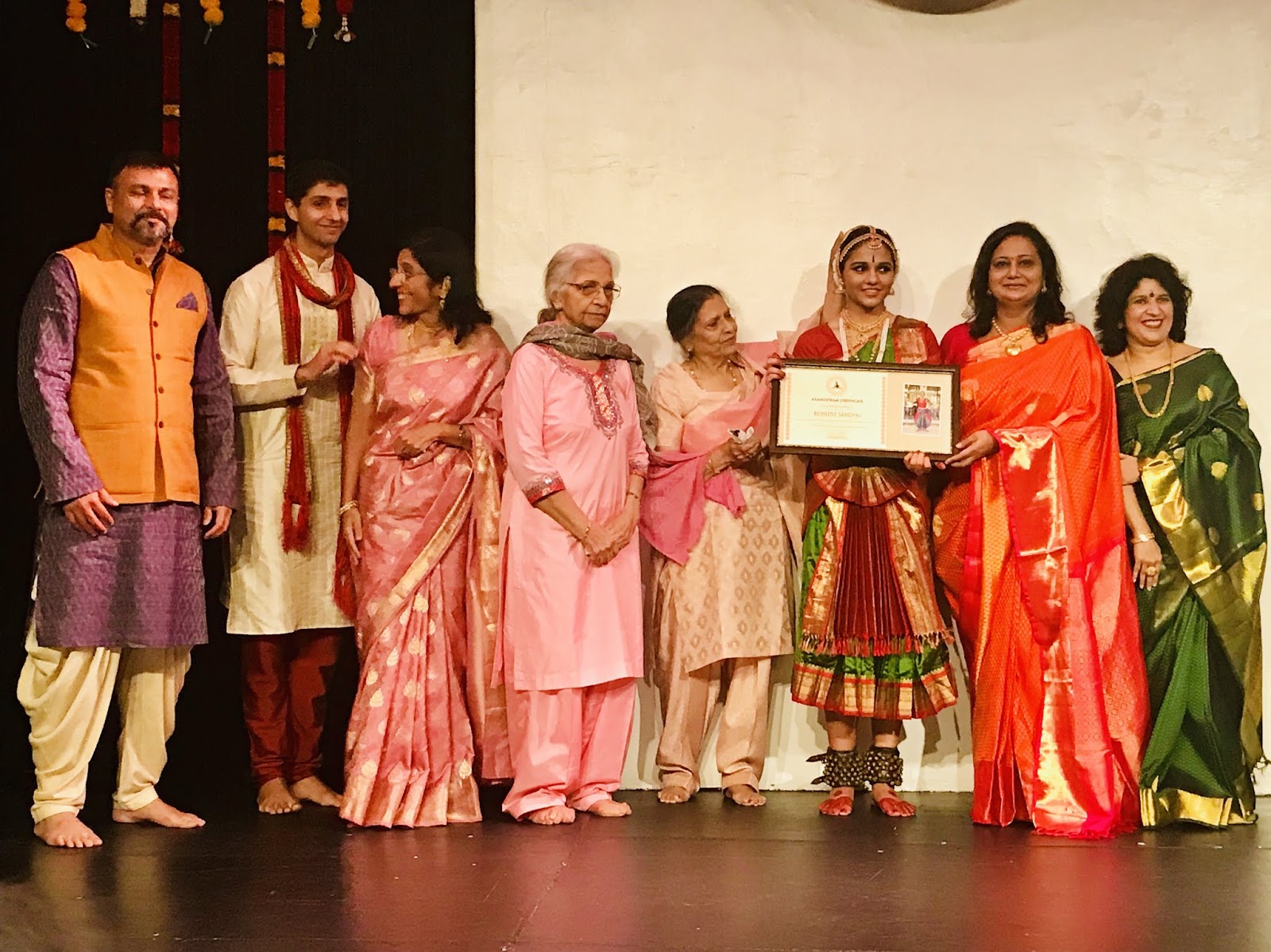
- After all the impressive dance numbers, Roshni was finally awarded with her certificate. However, this does not mean that she should stop dancing and learning from Mrs. Sreedhar. This Arangetram was only Roshni's stepping stone in becoming a better dancer, setting an example of perseverance and maturity not only to young Indians, but to the youth in general.
It is common for Indian students to bow like this as a way to pay respect to their guru. (This is also done to people that one would perceive as highly respectable, like an elderly family member or a monk, etc.)
Student and Teacher.
Roshni and her proud family members.
The proud grannies in pink.
- The night ended with a sumptuous Indian vegetarian buffet dinner. It had been a while since that last time I had Indian food, and so you could just imagine how happy I was to see naan, daal, pani puri, and other dishes that I longed to eat for many months now. I was also glad that I had time to catch up with the ambassador himself, H.E. Jaideep Mazumdar, my Hindi-language teacher Mrs. Goswami whom I have not seen in a couple of years now, and my student Sparsha.
With H.E. Jaideep Mazumdar and his wife, Mrs. Parvati Mazumdar.
Didn't know that Mrs. Sreedhar and I wore matching attires. Pink and orange were the colors of the night!!
- There is always an unexplainable happiness whenever I attend cultural events like Roshni's Arangetram by Natya Mandala. Perhaps, this is because I too come from another diasporic community, and so I can relate to the significance of staging these kinds of performances. With people like Roshni and Mrs. Sreedhar, and with institutions like Natya Mandala, some aspects of Indian culture are now more accessible to the Indian community here in the Philippines, and more people in the Philippines will have the opportunity to explore and experience other cultures as well!!
- What makes Asia so unique? One thing for sure is its unparalleled diversity. Being the biggest continent, its diversity can be seen from its flora and fauna, to human features, to culture. Recently, the University of the Philippines Asian Center - one of my alma maters - celebrated the diversity and color of Asia on its 63rd anniversary. Entitled "Mauzek," the Hindi word for "mosaic," the week-long celebration took various forms - from talks, to cooking demonstrations, to an exhibit of all things Asian. I was fortunate enough to be invited to be a contributor to this collaborative exhibit, but with a special request - that I specifically contribute part of my vast collection of costumes to the exhibit. Other professors and students contributed more costumes, mini-statues, carpets and other textiles, paintings, religious paraphernalia, and other amazing things from all over Asia.
Event poster. (See that talk on "The Semiotics of Fashion in Asia"? That's my talk!!)
- A common question I get from people is why I started collecting costumes and why I wear them regularly, and the exhibit was a way for me to explain this. I started collecting them because of my deep appreciation of the world's cultures. I feel that if I wear these things, I am embodying a different truth or thought as taught to me by the people I encounter in my adventures and travels. So yes, I do get my costumes whenever I travel, or whenever there's a chance to buy them locally, such as in international bazaars. I wear them because of my advocacy of cultural understanding. I like it when people ask me what I wear and where they come from. It opens up an chance to engage in discourse on the quest for understanding cultures different from what we know and are used to. I am quite happy that so far, I have not been called out for "cultural appropriation." This is because I never claim the things I wear to be "my own style," as I always acknowledge the cultures where my costumes and accessories come from. I also try my best to be responsible in knowing how the clothes are to be used (ex. in which events, or degree of formality,) and if there are symbols or patterns on the fabric, I also ask what they mean. I am happy that despite what regular people may call an "eccentric lifestyle," this has been helping my family, friends, and students to learn more about the world that we all live in. (In case you're wondering, yes, I do have "regular/normal clothes.")
Almost finished setting up the day before the opening. All the clothes that you see displayed are mine, and I have worn all of them. You can also see some of the other exhibit items on the table, which were generously contributed by the center's professors and students.
Of course I had to fix my part of the exhibit in - gasp - a costume.
- Speaking of fashion and understanding fashion, on the first day I had a talk on "The Semiotics of Fashion in Asia," where I talked specifically about the Indian saree, and how this long piece of cloth defined and redefined identities and gender roles throughout the history of South Asia. Apart from a symbol of Indian femininity, other things that it defined through time include caste and class, nationalism, feminism and women empowerment, Hinduism, Catholicism (i.e. Mother Teresa and her followers,) women's occupations, and so on. Perhaps the favorite part of everyone was when I did the saree-draping demonstration, because I like being extra like that.
Left top and bottom: Thai suea praratchathan, Tibetan unju. Center: Malaysian baju melayu with sampin. Right: Vietnamese aodai.
Left: Vietnamese aodai. Right top left/right: T'boli t'nalak vest, Igorot vest. Right bottom: Taiwanese Seediq-inspired coat.
Of course I had to pay homage to my first love and my specialization: India. I'm wearing a South-Indian kurta with North-Indian jutte (shoes), a Jaipuri pagri (turban,) and a Jaipuri bandhani dupatta (tie-dyed scarf). The one I have on the exhibit is a Jaipuri block-printed kurta with another Jaipuri bandahni dupatta.
Left: Burmese costume, full set. Third panel top: Javanese batik polo. Third panel bottom: Balinese-style checkered sarong.
Thank you so much for helping me out Jane!! (Jane works for the Asian Center.)
Academic duties.
This is how long a saree is.
Wazzup wazzup my student volunteered to be my model/mannequin.
I hope the drape is up to Indian standards haha.
Thank you Dr. Joefe Santarita, current dean of the Asian Center, and my beloved adviser (and the whole talk felt like I was doing another thesis defense. Haha.)
- On day four, I went back to the exhibit and did a walk-through of my costumes. Apart from telling them about the nature of my costume collection, how and why I got them, another question that came up - which usually comes up even when talking with my friends - is how many costumes I have. Currently I have around 200 pieces in my closet, although it's hard to really count them so I just counted the tops (around 170) and additional pieces that may be worn by themselves or as a part of a bigger costume like my sarongs (tube skirts,) and vest. Of course I would look like I have more costumes since I can mix and match them, or accessorize them with different things (like jewelry or scarves.) Don't worry the costumes, while difficult to get since I get them while traveling, are not usually expensive. I see to it that the price of the costume is reasonable and within my budget, and I also see to it that I will use it multiple times. After thinking about those things, that's the only time that I buy the costume. So far, the newest piece in the exhibit would be the t'nalak vest which I got from my very recent trip to Lake Sebu in South Cotabato (click here, here, and here for my recent trip to Lake Sebu).
Thank you best friend Evan for supporting.
I love you both huhu.
Doing two things I love the most: wearing a costume, and talking.
I am not really too sure what point I was trying to make, by my friend Jinwei took this hilarious photo of me as I was explaining my costumes very animatedly.
I was talking about this Sarawak hat that doesn't belong to me by the way, although I have a hat exactly like this. It was a generous gift from my Bruneian friends during my trip to Brunei in 2013 (click here to see my trip to Brunei.)
Thanks for coming Jinwei!!
- On a separate note, I was sad that I missed the cooking demonstration because I was doing my walk-through. After the walk-through, there was no more food. Huhu. I wanted some samosas for myself.
- Finally, I went back again on the last day, to do another walk-through, mostly to some students of the Asian Center, and some of my other friends who were able to go to the exhibit (huhu thank you friends.) Other exhibitors were also able to explain some of the items they contributed, and I learned a lot from them as well!! Also, just to show you how awesome my friends are, they even helped me pack up after the event. (Really, you guys should not have, but I highly highly appreciate the help!!)
Thank you for coming, Steph (and your mom too!!)
Crystal wanted to try on the saree, which I allowed her to since I was about to pack up anyway. She enjoyed her saree so much that she wore that to lunch at Via Mare next door.
My friend Janus, who works in the Asian Center, conceptualized this photo. (Left to right: Jaipuri kurta, Japanese yukata with obi sash, Japanese haori/kimono outer coat, Mongolian deel, Crystal wearing my South-Indian saree, Korean hanbok, and Qing-Dynasty-style/Manchurian-style changshan with vest.)
I AM READY TO GO HOME.
Thank you UP Asian Center, and thank you friends for helping me pack!!
- My first experience as an "exhibit contributor" was a tiring but valuable one. Apart from being ecstatic that I finally checked one item off my life's bucket list - which is to have my costumes exhibited - the more important part is to share knowledge and experiences on cultural understanding. Of course I was not just there to educate, but also to learn from friends and colleagues who not only contributed to the UP Asian Center's exhibit, but were also able to share their knowledge and passion on paintings, statues, or even culture and national identity as presented in the souvenirs that we buy when we travel (who ever thought that there was academic depth in souvenirs, right? It's amazing, really.) I hope that I will have more opportunities like this in the future, so I may further share my passion to a wider audience!
- Of course, finally, thank you very much UP Asian Center (especially to Dr. Joefe Santaria, Dr. Jocelyn Celero, Janus, Jane, and everyone else,) for not forgetting about one of your most eccentric students ever, and happy 63rd anniversary!!
- The graduation rites of the University of the Philippines (UP) Diliman is not an ordinary ceremony. Compared to other universities, more media people flock the university during this season because of many reasons. One, the road towards the main ampitheater are lined by fully-bloomed sunflowers that tower any average East/Southeast-Asian person; the sunflowers in UP only bloom once a year - during graduation season. Two, there are VIPs who may attend the event as speakers, or serve as special graduates (i.e. Ms. Tiffany Uy, the amazing summa cum laude from BS Biology with the highest GWA after World War II.) Three, the presence of surprising events, knowing of course that UP is the land of unpredictability. As for me, I attended the event because it was my own graduation.
They're as big as my face.
Hello Caroline!!
With the oblation.
Moaaaar sunflowers.
With my friend Bianca.
- This year, UP had its first June graduation. The university just finished its first school year with the academic shift (i.e. school started in August instead of June,) and so the graduation moved from the usual April to June. The ceremony was done in the university ampitheater, open air as before. However, it was done in the morning instead of late afternoon due to the possibility of rainfall in the afternoon, as with most days in June are. The sun was bright, competing its yellowness with the equally radiating sunflower petals. The sun grew from warm, to hot, and later, burning.
"Asian Center."
"Serve the public."
With my former ASEAN-India co-delegate, Rachel.
Dean of the Asian Center, and my adviser, Dr. Joefe Santarita
- The opening remarks was done by the current chancellor, Dr. Michael Tan. He welcomed everyone and told us the differences in preparations this year due to the academic calendar shift, and joked about the burning morning heat. (His funny jokes made the heat more tolerable, even for just a second.) Later on Philippine national anthem was sung by none other than Gerphil Flores, second runner up of Asia's Got Talent. This soprano singer's voice was indeed more jaw-dropping when heard live, than in videos or the television. I would have loved to hear her sing more.
Dr. Michal Tan, the current chancellor.
Gerphil Flores and the stupid mic blocking my view.
Quezon Hall in front of the ampitheater.
- Secretary Armin A. Luistro, FSC, from the Department of Education was the guest of honor of the morning. His speech on rootedness, connectedness, and growth was made alive through his anecdotes of being a freshman in UP, and his fond memories of his grandmother. I wasn't able to take a photo of Secretary Armin because my camera was nearly overheating from the sun's heat, and because I, along with my other fellow graduates, were on the verge of melting or being roasted. The deans had to suffer more since they were seated directly facing the sun. I was also too tired to listen the the speeches at some point, because I spent some time wondering if I would be roasted alive, or if I would make it until noon. (I even had to buy cold bottled water just to place it on my face, my neck, my cheeks, since I have an unforgivingly low tolerance for heat.)
- The university graduation held thousands of graduates from the undergraduate to the graduate levels, so much so that only the summa cum laudes and the PhD graduates were the only ones to march, while all the rest were simply presented by the college deans to the chancellor. Despite my camera almost melting, I was able to take photos of Ms. Tiffany Uy, the "summa" among the summa cum laudes.
Ms. Tiffany Uy, the celebrated summa of summas.
- The highlight of the morning, of course, was the shifting of the sablay. The sablay is a sash that serves as a unique academic garb. (For non-Filipino speakers, "sablay" can also be a verb that means to fail in or miss something, so much so that many puns are made about these 2 meanings of "sablay"during the UP graduation season.) Although some schools have also took on the use of the sablay as an academic garb, the UP system is the largest network of schools (i.e. UP has plenty of campuses around the country) that uses the same sablay design. The UP sablay has the school colors (maroon, green, gold/yellow,) and has baybayin (ancient Filipino letters) that spell out "U" and "P." The UP sablay is properly worn on a white, beige, or ecru barong for men, and Filipiniana dresses for women. The sablay is first placed on the right shoulder, and is changed to the left, like how one would change the tassel of a graduation cap.
Shifted my sablay. :D:D:D:D
- After the sablay shifting and the oath-taking, we supposed to sing the university hymn when a group of students came out of nowhere to rally against the implementation K to 12 education system. I was too shocked to take a photograph of it, and needless to say the media people flocked to the rallyists to interview and document them. I was later told that rallying during the graduation is part of the UP university graduation tradition. I didn't know if I should be happy about it, but it was definitely an unusually interesting experience.
- I later had some more photos taken at the UP oblation behind the ampitheater. The oblation is the most iconic statue/symbol of the university. Afterwards, I had lunch with my family before attending my thankfully-indoor college graduation.
With my shifted sablay.
- In UP, there are two graduations held. First, the university graduation is held, which was the one for all graduates where I burned myself crisp. Second, is the college graduations, which are mini-graduation ceremonies held by each college/institution/center of the university; they may or may not be be held on the same day as the university graduation (but definitely not conflicting with the schedule of the university graduation.) All the graduates are able to march in the college graduation, and proper awards and recognition are done to those who need to be awarded or specially recognized. The UP Asian Center, where I'm from, acts as an independent "college" or center, so our college graduation was one of the smallest and coziest among all college graduations. We held the college graduation at the GT Toyota Auditorium, and is part of the Asian Center compound.
With co-graduates Melanie and Kat, and friends Ivy and Wayne.
If selfie sticks don't work....
....do it Gibby's selfie's way. :)) :)) :)) :))
TADA!!!! Perfect shot. :)) :)) :)) :))
Finally got to march.
Sitting like a good little boy.
Dr. Santarita's welcoming remarks.
- Our guest speaker was Dr. Elena Mirano, former dean of the College of Arts and Letters. Her message was to root our future researches in Philippine Studies, as more about the Philippines are to be discovered and unearthed, apart from the current growing significance of the Philippines in the world and the many issues that envelope the country.
Dr. Mirano.
- We got our diplomas and medals after Dr. Mirano's speech; all graduates were given medals, especially since we were only 11 graduates total: 6 from the master's level (2 from the thesis track - me included, and 4 from the non-thesis track,) and 5 from the PhD level (all of them, of course, had dissertations.)
A few proud moments.
Shaking hands with my adviser and the current dean.
I forced my mom to wear the churidar kameez I bought from India for her. Haha.
- After a short intermission, 2 valedictory addresses/responses were to be delivered by the representative from the MA graduates, and the representative from the PhD graduates. I was told the last minute (with less than a week's notice,) that I was given the privilege to deliver the valedictory address for the MA level, together with Dr. Perseville Mendoza for the PhD level; the speeches of all valedictorians should be in line with this year's graduation theme of "rootedness, connectedness, and growth" ("pag-uugat, pag-uugnay, pagyabong.") Never in my life did I think that I'd get to deliver one, and I felt that me graduating was already more than enough. I hid this from my family with a plan of surprising them, so much so that I had to warn the people from the Asian Center not to spill the beans to my family. Thankfully, my family also forgot to get programs from the registration table, so they had no idea until my name was called. They were so surprised that the whole thing did not sink into my parents until we were having dinner after the ceremony 2 hours later.
Pardon this series of photos, as this probably is a once in a lifetime thing.
Watch my speech if you wish:
- We had a special number just before the oath-taking. My friends from the Asian Center who were in the recent Bahasa Malaysia/Indonesia class sang familiar songs translated into Bahasa Malaysia/Indonesia. We called them our very own "One Direction."
Wayn's red microphone suits him.
Of course I enjoyed my friends' performance so much my double chin got excited too.
Oathtaking.
Final march.
One of the rare recent family photos.
Yay.
With my great adviser, Dr. Joefe Santarita.
With my family and my adviser.
- We spent some time with the oblation and the sunflowers before having dinner. The day flew by in an instant, and in that instant my life changed. My four long years in UP Diliman was a bittersweet epic journey, but definitely a journey of opportunities, inquiries, resolutions, and enlightenments. This chapter might have ended, but the epic is far from over. Until the next adventure!!
At the oblation.
Now with my Asian Center medal.
Oh hi Melanie!! You're here too!!
More sunflowers.
Doing crazy things with the sunflowers before they wither