- December 19, 2018, Wednesday.
- If you're staying in Berlin and have time to spare, why not take a day trip to one of the favorite city of the Prussian and German royalty? Potsdam City is the capital of the state of Brandenburg, and borders Berlin. Although it is roughly 1/5 the size of Berlin, this little city is a city of palaces since the Prussian rulers and emperors of the German Empire who ruled over this area thought that it was a great place to think and be close to nature.
- Going to Potsdam from Berlin is incredibly easy. From Alexanderplatz, which is the nearest transportation hub to my hostel, I rode an RE (regional) train straight to Potsdam Hauptbahnhof (Potsdam Main Station.) An S-Bahn train from Alexanderplatz goes all the way to Potsdam Hauptbahnhof as well. These trains also pass by Berlin Hauptbahnhof, which is Berlin's main train station and another transportation hub, for those who stay close to that area. Since Potsdam is outside the city center, one would need to buy a train ticket that goes to Zone C. Since I already bought a 4-day ticket that goes to Zone ABC when I arrived in Berlin, I did not have to buy a separate ticket to go to Potsdam. This ABC ticket is also convenient since it can be used in Potsdam's tram lines that go around the city including tourist spots.
- Upon arriving at Potsdam Hauptbahnhof, I immediately went outside and rode the tram to Alter Markt, or the old market square. Most tram lines pass by Alter Markt, and is usually the first stop from the main station (tram 92, 96, 93 695). The old market was built in the 1600s, and today is surrounded by office buildings, museums, and some university buildings. It reminded me a lot of Pisa's Piaza dei Cavalieri during my visit last year (click
here,) which had the same vibe, and was also surrounded by some university buildings.
 |
| Alter Markt. The church to the left is the St. Nicholas Church. |
- Since I arrived in Potsdam quite early, I took a stroll until I arrived at the Dutch Quarter (Holländisches Viertel). Built in the early 1700s, these Dutch houses were designed to attract Dutch people to stay in the area. Today, these houses are considered to be some of Europe's best preserved Dutch houses outside the Netherlands, and mostly function as cafes, shops, and some offices. Although I walked all the way to the Dutch Quarter, people can ride the tram to the Brandenburger Strasse or Nauener Tor stops (92, 96, 604, 609, 638, N15, N17; all these go to both stops.)
 |
| The quiet winter streets of Potsdam. I know this can be a bit more crowded on a regular day. |
 |
| Preserved Dutch houses. |
 |
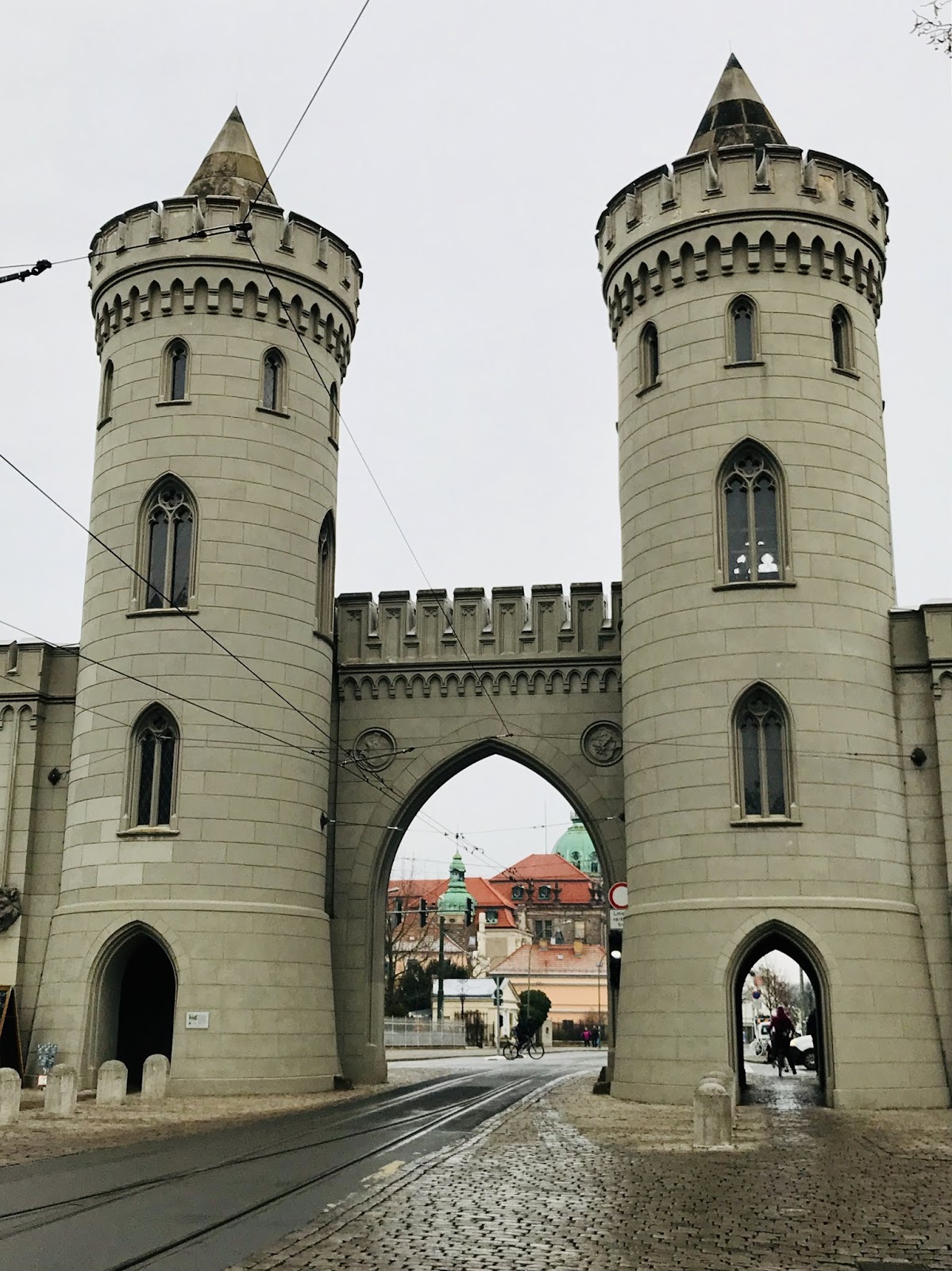
| Nauener Tor, an 18th-century city gate, and a very modern tram. |
- From the Dutch Quarter, I rode the tram (614, 650, 692, 695, 697) to make a quick stop at the Brandenburg Gate. From my understanding, this two-faced gate that used to be part of Potsdam's city wall was built a few years earlier than its more well-known cousin in Berlin, also named the Brandenburg Gate (see
here).
 |
| Potsdam's Brandenburg Gate. |
- After a brief photo stop, I rode on tram 695 to my first main stop for the morning - the Sanssouci Palace (Schloss Sanssouci). It was the summer palace of King Frederick II of Prussia, and is recognizable for its grand flights of stairs outside the palace to the gardens below. The stairs were good enough for a royal fashion show!!
 |
| I was already halfway up!! |
 |
| This palace was often compared to Paris' Palace of Versailles, although I personally think that the Charlottenburg Palace in Berlin is closer to the feel and ambiance of the Palace of Versailles. |
 |
| At the backside of the palace. The are ruins at the far back. |
- One important piece of advice is to book tickets to the palace beforehand, especially since the palace limits it tourist visits per day. The tickets to go inside the palace have a specific time on them, and you should be at the entrance of the palace at the designated time for the audio-guided tour. Each of the Sanssouci's rooms are colored in a bright color - red, yellow, green, depending on the theme. The motifs of the rooms are usually based on nature as well, such as fruits, gardens, forests, animals, or stones, as a way to bring the "outside in." A lot of natural light can also illuminate the room if the curtains are open, and those inside the rooms can have a fantastic view of the gardens outside as well.
 |
| A lot of palaces were under renovation when I went. |
 |
| The very ornate music room. |
 |
| The thing at the center is not a crack, but a spiderweb. |
 |
| The marble room. |
 |
| Ceiling of the marble room. |
- The massive garden also has other buildings such as the Orangery and the New Palace, but I did not have enough time to go to them since I underestimated the size of the garden. Instead of going around the gardens, I took tram 695 back to Platz der Einheit and had lunch. Platz der Einheit is a centrally-located square that also acts as an intersecting point of many trams. Right after lunch, I rode tram 603 to the Schloss Cecilienhof tram stop. I was quite scared when I got off because it was an eerily quiet residential area on one side of the small street, and a park (called "Neuer Garten" or "New Garden") with a million trees on the other; the worst part was I was alone for as far as my eyes could see. (I honestly thought I was in an episode of Riverdale.) I went inside the park and found the traditional German-looking Cecilienhof Palace. This palace looks a lot different from the earlier majestic and ornate palaces, because this was built in the early 1900s and was built by the last monarchs of Germany.
 |
| Traditional German architecture. |
 |
| This room was made to look like the interior of a ship, just because Duchess Cecilie was fascinated with ships. |
 |
| Writing room. |
- While it does not look much compared to the bigger palaces of Germany, this small palace is historically significant. After World War 2, the Potsdam Conference was held in this palace to decide how to restore order to the world after the unconditional surrender of Germany in Europe and Japan in Asia. The main leaders who attended this conference were Joseph Stalin (USSR), Winston Churchill and Clement Atlee (UK), and Harry Truman (USA). I was very glad that the palace's conference room was included in the audio-guided tour. Needless to say, I stood in the middle of this room - the largest room in the palace perhaps - for a longer time, looking at that round table where some of the world's most powerful leaders of the 21st century made history. It was interesting to know that during the Potsdam Conference, the palace was separated into three main areas for the three countries that participated. It was only in the conference hall where all three countries met and talked.
 |
| Where history was made - the conference room. |
 |
| USSR, UK, and USA. |
 |
| The actual Potsdam Conference. |
 |
| Not allowed to go upstairs. |
 |
| I stayed too long in this room. |
 |
| With the Cecilienhof Palace inner courtyard. |
- After leaving the palace, I rode the tram back to Potsdam Hauptbahnhof and rode an S-Bahn going back to Berlin. At the hostel, I had a bit more time to fix my things before having dinner with famed German Chef Steffen Burkhardt whom I had the opportunity to work with and tour around Manila while working on a project with Goethe-Institut Philippines late last year. He was kind enough to treat me to a restaurant that does a rather different and modern take on German cuisine.
 |
| Thank you Chef Steffen!! It was nice to see you again!! |
- That night, I had a deep sleep after a whole day out and a sumptuous dinner. Although it was my last day in Berlin, I was just starting to grow fonder of Germany; I wasn't leaving the country yet at least, and was excited to explore more of Germany. Plenty of people had told me that while Berlin was probably more modern, more hipster, and more historical, I'd surely love the southern part of the country more since it was more traditional and fairy-tale-like. As I was headed there the next day, I could not wait to visit and experience the "fairy-tale wonder" of the southern part of German called "Bavaria" or "Bayern," starting with its capital - Munich!!
- Please don't forget to read about my other adventures in Germany, Austria, and Slovakia here:
GERMANY:
Berlin and Potsdam: Part 1
here, Part 2
here, Part 3
here
Munich and Schwangau: Part 1
here, Part 2
here, Part 3
here, Part 4
here
AUSTRIA:
Salzburg: Part 1
here, Part 2
here, Part 3
here
Vienna: Part 1
here, Part 2
here, Part 3
here
SLOVAKIA:
Bratislava: Click
here