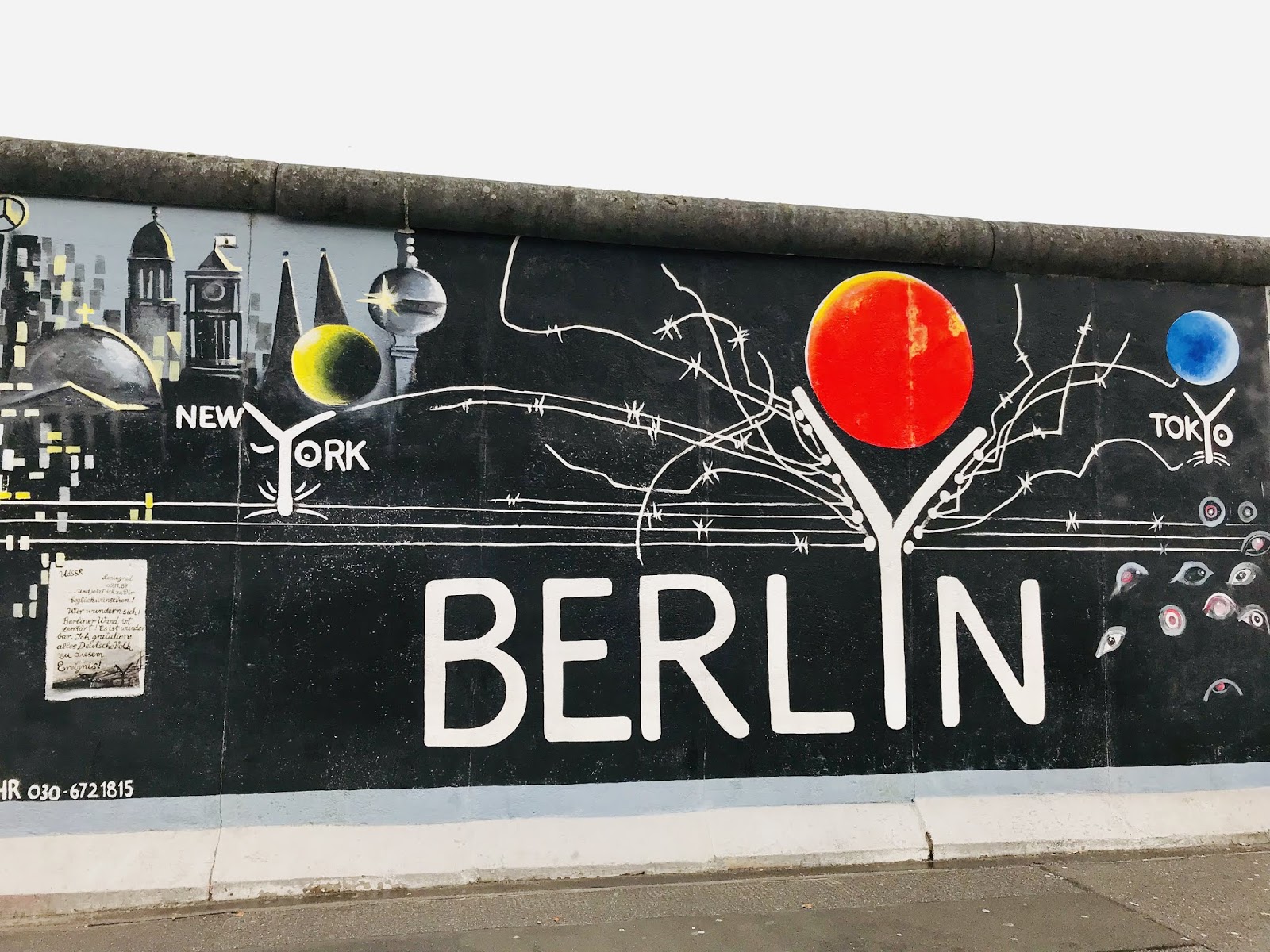
- December 17, 2018, Monday.
- Germany is rich in history and Berlin has a lot to show when it comes to German history. Apart from museums, Berlin has also preserved and restored a lot of its important buildings and landmarks, and are marked with informative plaques or visitor guides. In short, Berlin has turned itself into one giant museum!
- After an early breakfast I headed to Berlin's main landmark, the Brandenburg Gate. It is most accessible via the Brandenburger Tor S-Bahn/U-Bahn Station, although I decided to take a cab there because I'd be going on a big u-turn if I took the train from where I was. The Brandenburg Gate was built by the Prussian King Frederick William II in the late 1700s; Prussia was a German state that now has parts in Germany and other surrounding countries, with Berlin as its capital in later Prussian history. Although it initially served as a symbol for Prussian honor, it also eventually symbolized the unity of Berlin after the Berlin Wall was demolished in 1989. This gate was also heavily damaged during World War 2 as can be seen in plenty of photos in museums and textbooks, and was restored right after the war. The road in front of the gate called Unter den Linden is currently a known historical road for shopping and sightseeing. One can also reach the Museum Island from the west by walking or driving through Unter den Linden.
 |
| Inspired by the Prussian uniforms. Also, the Prussians are known for their distinct shade of dark blue called "Prussian blue." |
 |
| Trapped in a golden Christmas ball. |
 |
| A closer view of the Brandenburg Gate. |
- Aside from going along Unter den Linden, other areas around the Brandenburg Gate are also historically significant, which is why I decided to spend a whole day in this central part of Berlin, which is called "Mitte." Behind the Brandenburg Gate, to the north, is the Reichstag or the Parliament Building; it is known by tourists for its dome which can be accessed but prior reservations are necessary. To the south of the Brandenburg Gate is the Memorial to the Murdered Jews of Europe. This memorial is a public art installation opened in 2005, and is recognizable for its endless gray concrete blocks that are not of the same height. Many tourists, me included, think that these blocks look like coffins of the murdered Jews; it is also said that the uneven height of the blocks, some of which like those at the center can be taller than a regular adult, is suppose to let visitors feel the confusion and the uncertainty experienced by the Jews during World War 2. If only I had more time, I would have strolled through the blocks to feel that sense of confusion and uncertainty. However, I had to get going if I wanted to finish everything I had in store for the day.
 |
| The Reichstag. |
 |
| Memorial to the Murdered Jews of Europe. |
 |
| These don't look much now, but wait 'til you reach the center. The blocks will become towers. |
- I eventually reached the Topography of Terror, a museum which used to be the site of one of the headquarters of the Nazi regime. Although the museum mostly shows photographs, I was more interested in the outside exhibition that shows what I'd say is a summary of Germany's history in the mid 20th century: the remains of some parts of the Berlin Wall, and underneath it are former prison cells of the Nazi headquarters.
 |
| One of the entrances to the Topography of Terror. |
 |
| Exhibition inside. |
 |
| Exhibition outside. The gray wall above is one of the remains of the Berlin Wall, and the bricked part below used to be the prison of the Nazi headquarters. |
- Later on I continued walking until I reached a rather livelier part of the southern part of the historic downtown. Here, one can find Checkpoint Charlie, or "Checkpoint C," which was one of the checkpoints between the eastern and western parts of Berlin during the Cold War. Today, is a happy tourist site with a fake guard in full costume. Visitors may take photos with the guard, or even dress up like the guards too! Checkpoint Charlie's area is also full of museums related to the Cold War, and if I had a day or two more in Berlin, I would have gone to each one of them. Checkpoint Charlie has its own U-Bahn station, Kochstrasse/Checkpoint Charlie Station.
 |
| A sidewalk stall selling communist-era souvenirs. |
 |
| Metal tiles are placed all over Berlin, and these tiles show where the Berlin Wall once stood. "Berliner Mauer" means "Berlin Wall" in English. |
 |
| Checkpoint Charlie. |
 |
| A replica of the original checkpoint. |
- Going northward towards the main center, I passed by Gendermenmarkt, which is a square surrounded by the Konzerthaus (Concert Hall), the German Church, and the French Church. As expected, it turned itself into a giant Christmas market for the holidays.
 |
| The German Church. |
 |
| The German Church, the Konzerthaus, and the Christmas market that has occupied Gendarmenmarkt. |
 |
| Merry Christmas!! |
- I walked further north until I reached Unter den Linden after passing by Bebelplatz. It is another public square that is surrounded by St. Hedwig's Cathedral and some buildings of Humboldt University. This area is near the German Historical Museum (Deutsche Historisches Museum), which is located by the banks of the Spree, right before Museum Island (see some of the museums of Museum Island in Part 1
here). The museum was founded in 1987 and currently has a very organized exhibition of German history from prehistory, to antiquity, and finally, to modernity.
 |
| German shields. |
 |
| An Ottoman Turkish tent. |
 |
| Prussian blue everywhere. |
 |
| An old piano. |
 |
| Propaganda art!! |
 |
| German Empire flag. |
 |
| Some parts of the Berlin wall. |
- The closest metro station is the Friedrichstrasse S+U Bahn metro station, although the nearest entrance is roughly a 10-minute walk from the German Historical Museum. From there I took the train north to the Berlin Nordbahnhof metro station. In this quiet neighborhood, and right outside the metro station, is the Berlin Wall Memorial (Gedenskätte Berliner Mauer). It is an open park, free of charge, which shows a part of the Berlin Wall in its original location, as well as photos and information on the hardships of Cold-War Berlin, and the people who died trying to cross over the wall or were victims of the border police. The Berlin Wall, which existed from 1961-1989, divided Berlin into two parts - the democratic west and the socialist east. People who tried to cross over the wall were mostly those living in the east who wanted to go to West Berlin, and ultimately have a chance to go to other parts of western Europe. After a wave of events, migrations, and revolutions, Germany finally reunited in 1989.
 |
| This wall packs so much history. |
 |
| YES. I AGREE. |
 |
| Yes!! |
 |
| More walls. |
- Finally, I headed further north Berlin-Gesundbrunnen S+U metro station to join a tour by the "Berlin Underground" (Berlin Unterwelten E.V.) This is a special agency that provides several tours concerning, well, anything related to subterranean Berlin (click
here for their website.) Tickets can be bought at their ticketing office and bookstore right beside the station's U-Bahn exit, and depending on the tour, the guided tour can last an hour or two. All tours are guided since the places to be visited are normally off limits and involve tunnels. I took the tour called "Dark Worlds," which talks about the underground air raid shelters from World War 2 that still exist today. To my surprise, the air raid shelter that we visited was right inside the U-Bahn station!! A special door inside the station led people to the underground maze. There are two special things about this tour. First, the paint and most things inside the air-raid shelter are original, and second, whenever the subway train would whiz by, the sound and the vibration caused by the train would perfectly simulate an air raid. It sent chills down my spine because the experience was just too real and immersive (and I like that.) Unfortunately though, photography is not allowed inside.
 |
| This is the only thing I can take a photo of - the ticketing office and bookstore. |
 |
| Celebrated my day by eating a giant (edible) bowl of currywurst, the most popular German street food. Currywurst is just sausage with curry-spiced ketchup. |
- After a successful day of learning about Berlin's history, I spent the rest of the late afternoon thrift-shopping in Berlin. Apparently, thrift- and second-hand shopping (we call this "ukay-ukay" in the Philippines) is a thing in some parts of Europe including Germany, and there are a few of these stores around. Some stores I can recommend are Pick n' Weight, and Humana. Pick n' Weight has more "hipster" type clothing, while Humana has more regular clothing and more options for traditional clothes. I also love how these stores are very clean and mostly organized, without much of that old musky thrift-store smell. My main reason for going to these thrift stores is because I wanted to buy traditional German/Alpine clothes that can burn a hole in the wallet when bought from regular retail stores. Imagine this - a regular traditional trachten coat can normally cost around 160-200 euros in regular stores, but I got mine in Humana for just 6 euros (and the one I got looked brand new too!!) I was also ecstatic to know that there were two Pick n' Weight branches and two Humana branches near my hostel. Needless to say, I went crazy that late afternoon.
- With my thrift-shopping hauls, I happily fixed my things in my dorm room that night, and was prepared to immerse myself even more in Germany's hipster and royal cultures the following day. Berlin was a lot more interesting than I initially thought!
- Please don't forget to read about my other adventures in Germany, Austria, and Slovakia here:
GERMANY:
Berlin and Potsdam: Part 1
here, Part 3
here, Part 4
here
Munich and Schwangau: Part 1
here, Part 2
here, Part 3
here, Part 4
here
AUSTRIA:
Salzburg: Part 1
here, Part 2
here, Part 3
here
Vienna: Part 1
here, Part 2
here, Part 3
here
SLOVAKIA:
Bratislava: Click
here